

A GTIN number (Global Trade Item Number) is the global ID of a product in the GS1 system: 8, 12, 13 or 14 digits, printed as an EAN-8, UPC-A (GTIN-12), EAN-13 or GTIN-14 barcode. Numbers come from GS1: GS1 US in the US, your country's GS1 in the EU and UK. If you resell someone else's product, you don't buy a code: you use the manufacturer's.
Sellers get this wrong in two ways. They type any number to get past a required field, and the listing is rejected or shown less. Or they buy a cheap code from a reseller and end up with another company's prefix. Below: GTIN types and the check digit formula, a table of whose code to use, GS1 US prices with the cost for 30 and 120 items, and the errors that get a GTIN rejected.
When people ask what a GTIN is
It usually happens at listing time: a marketplace form or a feed spec has a GTIN, UPC or EAN field, and something has to go in it. The first searches are "what is a gtin" and "gtin number". Next come "how to get a upc code", "how much does a gtin cost", "is a gtin the same as a upc" and "can I sell without a barcode".
The most common question is "how do I create a GTIN", and it's the wrong one. You can create the barcode image. The number itself either already exists at the manufacturer, or GS1 issues it to the brand owner.
GTIN types
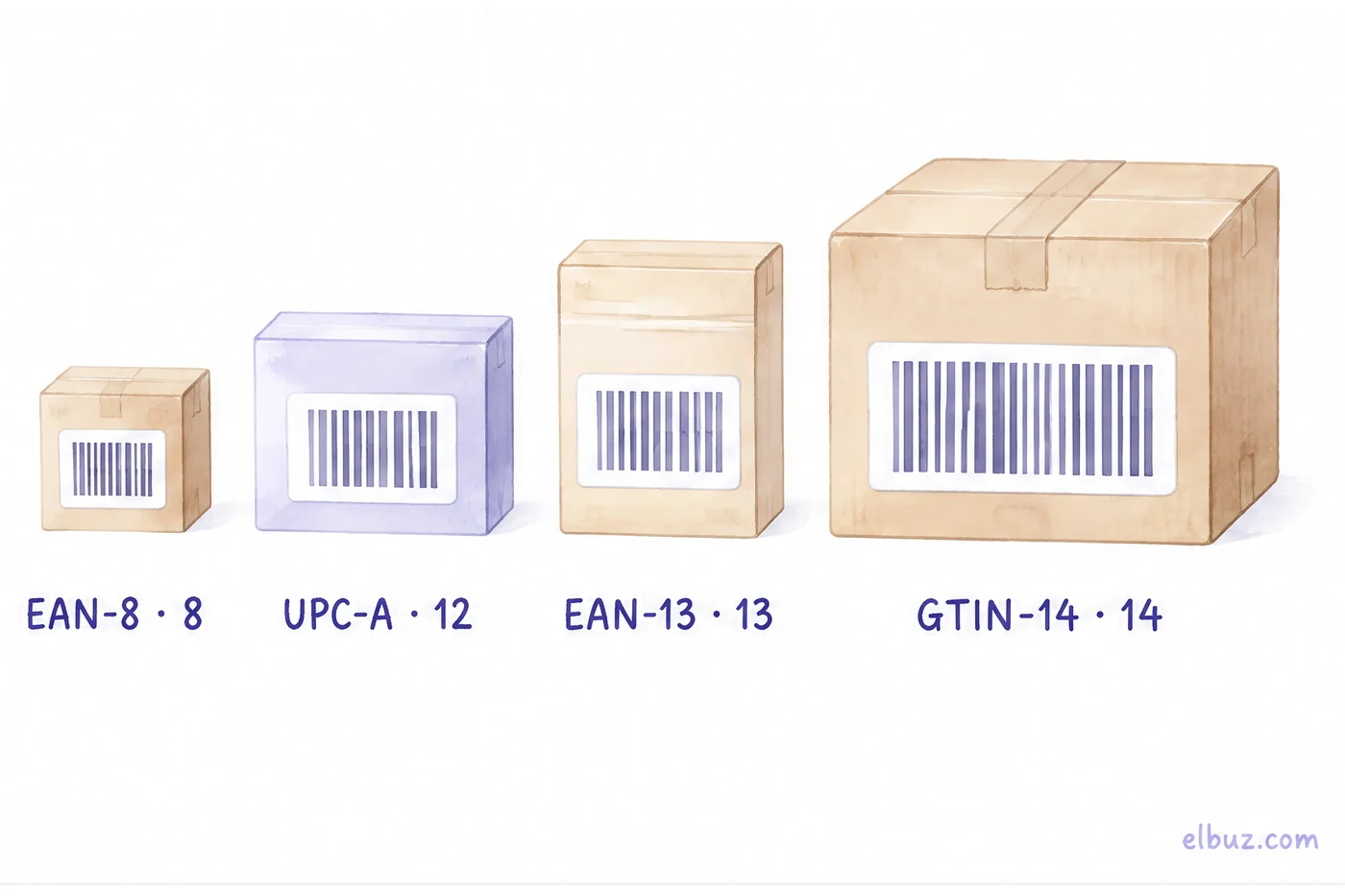
There are four formats, and they are all one number of different length: a shorter GTIN is padded with leading zeros to 14 digits and stays the same GTIN.
| Format | Digits | Where it's used |
|---|---|---|
| EAN-8 (GTIN-8) | 8 | Very small packs that can't fit an EAN-13 |
| UPC-A (GTIN-12) | 12 | Standard retail barcode in the US and Canada |
| EAN-13 (GTIN-13) | 13 | Standard in Europe and most other countries; books (ISBN 978, 979) use it too |
| GTIN-14 | 14 | Shipping cases holding several units, ITF-14 barcode |
"Is a GTIN the same as a UPC?" Almost: the GTIN is the number, and UPC-A is the barcode that carries a 12-digit GTIN. That's why marketplaces and feeds ask for the digits, and you draw the label image from them, for example with an EAN-13 barcode generator, then print labels with barcodes.
How the number is built and how to check the check digit
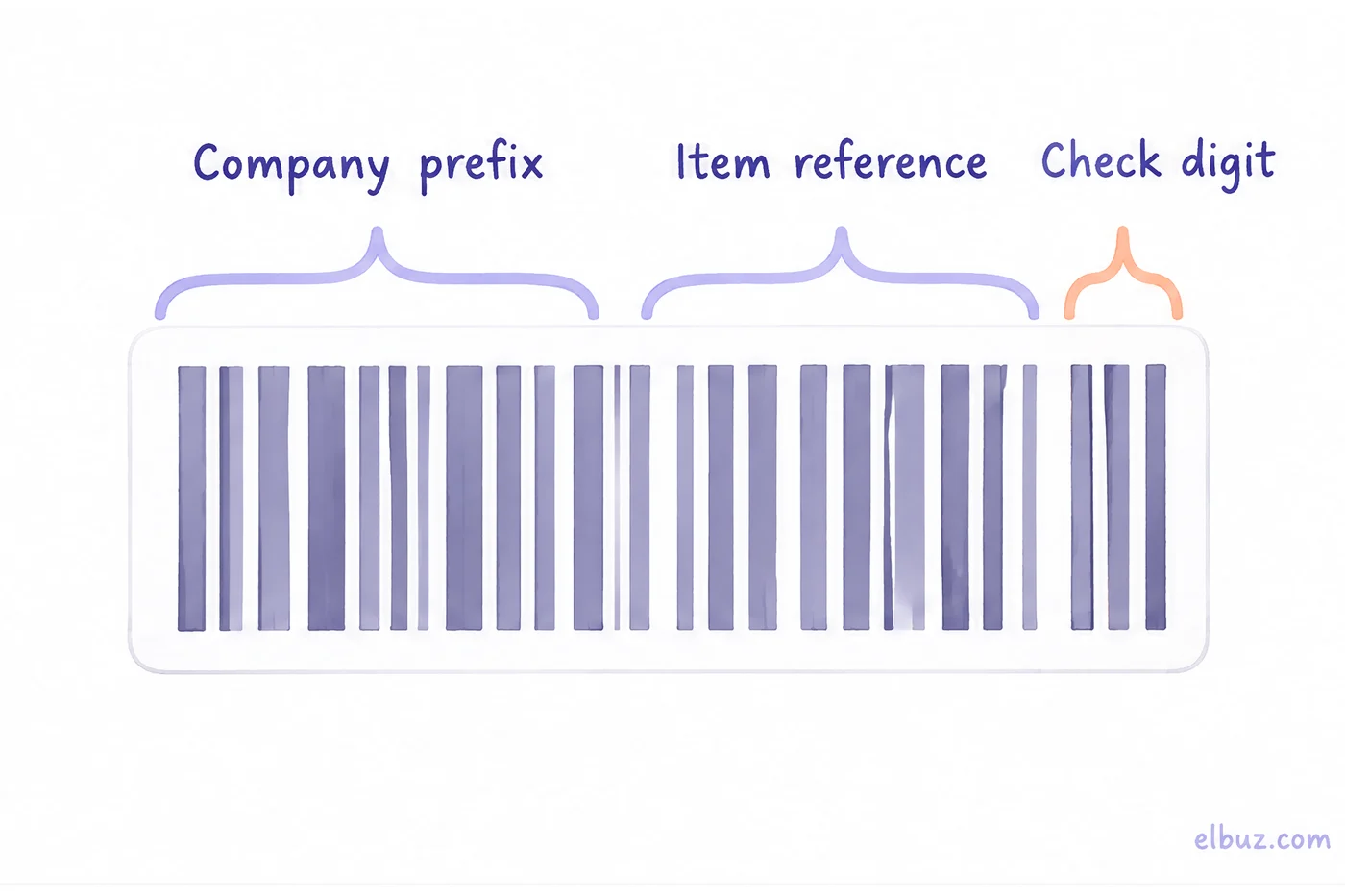
A GTIN is a company prefix, an item reference and a check digit. GS1 licenses the company prefix to your business, you assign item references to your products, and the last digit is calculated from the others.
Check digit formula. Take every digit except the last. Going from right to left, multiply them alternately by 3 and by 1, then add them up. Check digit = (10 − sum mod 10) mod 10, i.e. how much is missing to the next multiple of 10.
Example with the illustrative UPC-A number 0 12345 67890 5:
- First 11 digits: 0 1 2 3 4 5 6 7 8 9 0.
- Digits in odd positions from the left get × 3: 0 + 2 + 4 + 6 + 8 + 0 = 20, × 3 = 60.
- Digits in even positions get × 1: 1 + 3 + 5 + 7 + 9 = 25.
- Sum: 60 + 25 = 85. 90 is 5 away, so the check digit is 5, as in the number.
The same formula works for 8, 13 and 14 digits because the weights start from the right. Checking a hundred codes this way takes a while: paste them into the GTIN and UPC checker, which verifies the length and check digit and flags in-store and coupon numbers.
Whose GTIN goes on the product
The brand owner assigns the GTIN: the company whose brand the product is sold under, wherever it was made. That decides where your code comes from.
| Situation | What to use | Why |
|---|---|---|
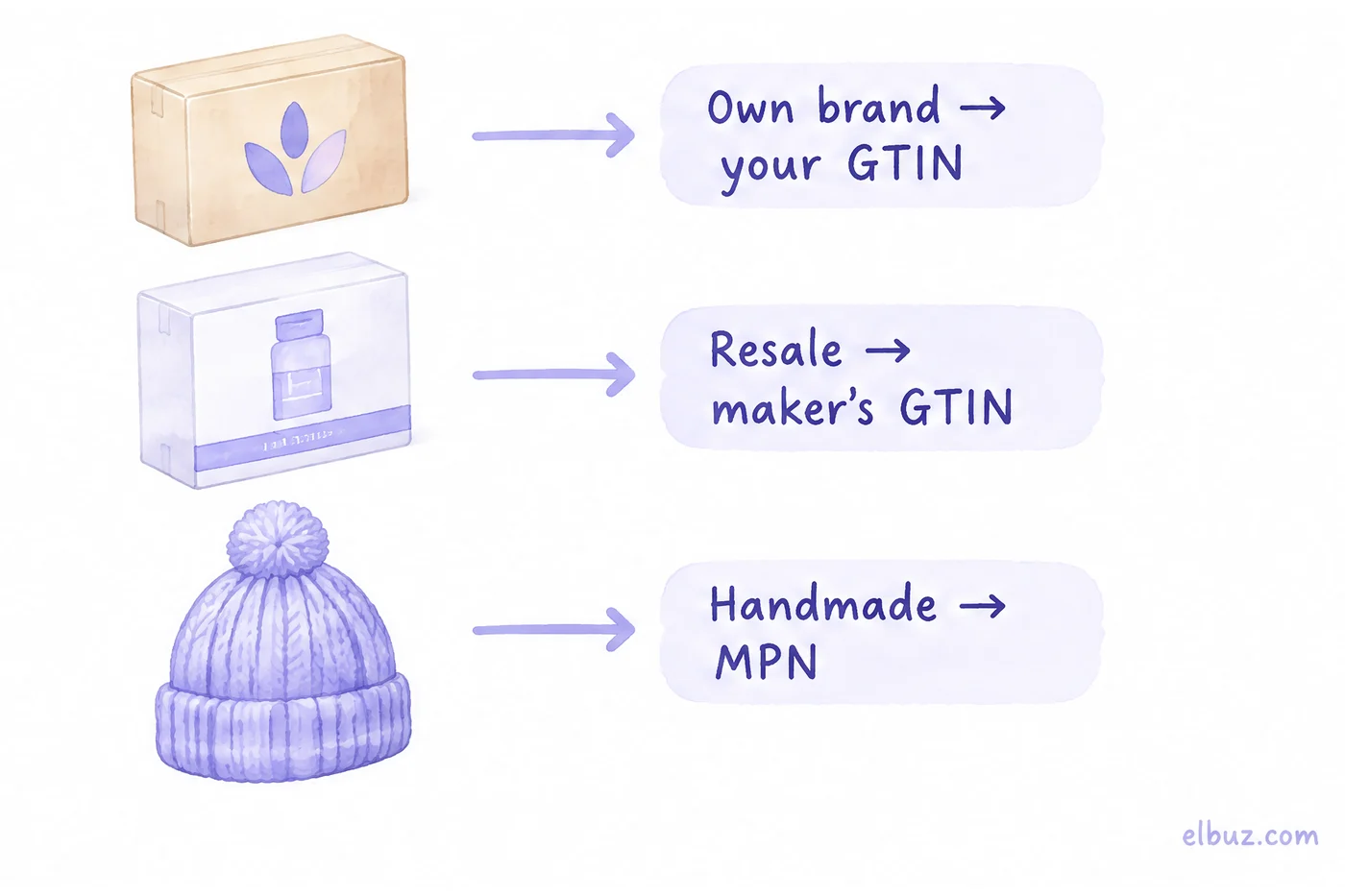
| Your own brand (you make it or have it made for you) | Your GTIN from GS1 | You are the brand owner |
| Reselling another brand | The manufacturer's GTIN from the pack or the supplier | The same product has one number at every seller |
| Variants: colour, size, volume, pack count | A separate GTIN for each variant | Google: each product and each variant has its own GTIN |
| Handmade or one-of-a-kind items | No GTIN: brand and MPN, or identifier_exists = no when there are none | Google's guidance for products without identifiers |
What not to do: make up a number, copy the code of a similar product, or put a supplier's code on your private-label item. Google says not to guess or use values from similar products, and a product that has a GTIN but is submitted without one may get limited visibility (Google's help page on unique product identifiers). Amazon's seller FAQ asks for a GS1 barcode (GTIN, UPC, EAN, JAN or ISBN) for listed products and offers a GTIN exemption for products that have none.
Where to get a GTIN: GS1 US, or your national GS1 in Europe
In the US, GS1 US sells two options. A single GS1 US GTIN costs $30 once, with no annual fee; it isn't available for pharmaceuticals, variable-measure products, mixed cases or coupons. A GS1 Company Prefix gives you a block of numbers under your own prefix, with an initial fee and an annual renewal:
| Product | Initial fee | Annual renewal |
|---|---|---|
| 1 GS1 US GTIN | 30 | 0 |
| Prefix for 10 items | 250 | 50 |
| Prefix for 100 items | 750 | 150 |
| Prefix for 1,000 items | 2,500 | 500 |
| Prefix for 10,000 items | 6,500 | 1,300 |
| Prefix for 100,000 items | 10,500 | 2,100 |
In the EU and UK there is no single store: each country's GS1 member organisation sets its own membership rules and fees, often by company revenue. GS1 Poland, for example, charged 136 zł a year (gross) for companies under 2 million zł revenue with no registration fee for a 10-number pool (gs1pl.org, checked 18.11.2026). Check the price page of your own country's GS1 before you plan a budget.
Two things to know before you buy:
- Prefix numbers are licensed, not owned outright. A company prefix comes with an annual renewal; plan it into your yearly costs.
- Codes can't be resold. GS1 states that a GS1 Company Prefix "may not be sold, leased, or given, in whole or in part, for use by any other company". A cheap code from a reseller therefore carries another company's prefix, and the GS1 record won't show your brand.
Numbers starting with 2 (and 02, 04) are restricted circulation numbers for in-store use, such as weighed goods priced at the scale. They only work inside the store's own system and don't belong in a marketplace listing or feed.
Why a GTIN gets rejected
Most rejections come down to five mistakes, and each one is visible before you upload anything.
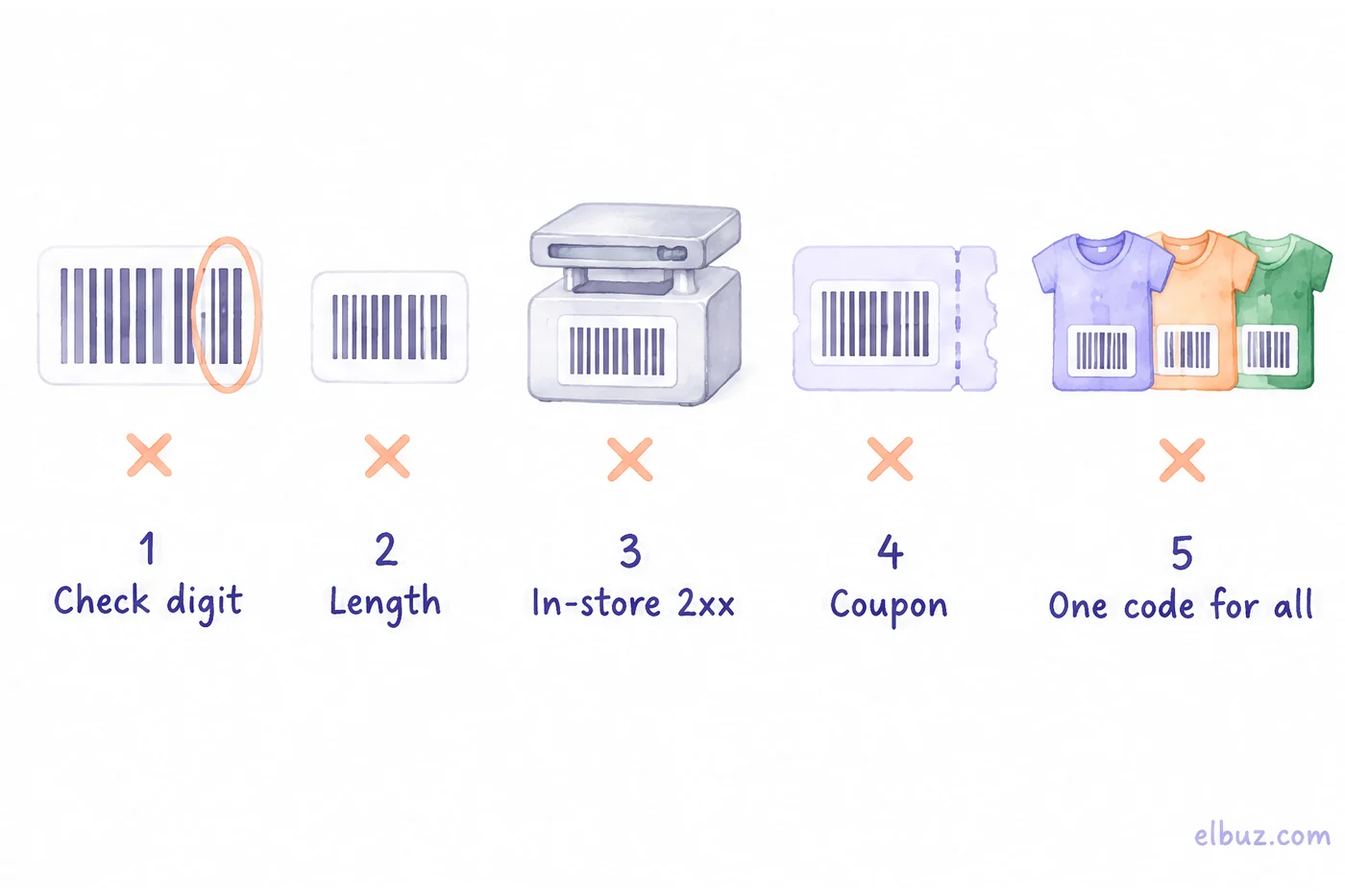
- Wrong check digit. One mistyped digit, or a leading zero dropped by Excel, and the number no longer adds up.
- Wrong length. A GTIN has 8, 12, 13 or 14 digits. A 6- or 10-digit SKU in the UPC field isn't a barcode.
- In-store number. Prefixes 02, 04 and 20–29 are reserved for internal and scale labels. Google doesn't accept these ranges.
- Coupon or refund receipt. Prefixes 05, 980–984 and 99 are reserved for coupons and never identify a product.
- Someone else's code, or one code for every variant. A number can be arithmetically valid and still belong to another product or brand. One GTIN for three T-shirt colours merges them into one item.
Book prefixes 977, 978 and 979 (ISSN, ISBN) are not an error: they are proper GTINs for books and periodicals. The free GTIN and feed checker catches the first four: paste a list of codes or a feed file (Google XML, CSV, YML) and you get errors per product plus a feed readiness score from 0 to 100. The fifth needs the manufacturer's product data, no formula can see it.
How much GTINs cost for 30 and 120 products
You need one number per variant, not per model. Illustrative example: a shop sells its own T-shirt brand with 10 designs, 3 colours and 4 sizes, which is 10 × 3 × 4 = 120 GTINs. For comparison, take 30 products without variants.
| Products | Option | Year 1 | Total after 3 years |
|---|---|---|---|
| 30 | 30 single GTINs | 900 | 900 |
| 30 | Prefix for 100 | 750 | 1,050 |
| 120 | 120 single GTINs | 3,600 | 3,600 |
| 120 | Prefix for 1,000 | 2,500 | 3,500 |
The 3-year totals assume no new products: 750 + 150 + 150 and 2,500 + 500 + 500. At 30 products, single GTINs come out cheaper from the third year on; at 120, the prefix is cheaper for the first three years and single GTINs win from year four. If you plan to add products every season, the prefix leaves room to grow without buying codes one by one.
How to check barcodes across the whole catalog before export
When you have thousands of products and the codes arrive in supplier price lists, nobody can review them by hand, and a bad code only shows up after the marketplace rejects it.
Elbuz has a feed quality report for this: for every export template it lists products with errors before the file goes out, including an invalid GTIN, using the same checks as above (length, check digit, in-store and coupon prefixes). A feed rule "GTIN invalid → exclude" keeps such products out of the file until the product cards are fixed.
Elbuz doesn't issue GTINs; only GS1 does. Feed rules work in XML and Google exports. And if you only need to check a list of codes once, you don't need software at all: the free checker on our site is enough.
Product feeds from your catalogBarcode checks and feed rules in Elbuz, 14 days free
FAQ
Who owns a GTIN?
The brand owner that licensed the GS1 Company Prefix, or bought the single GTIN, and assigned the number to the product. When you resell that product, you use their GTIN but don't own it.
How much does a GTIN cost?
In the US, $30 for a single GTIN with no annual fee, or from $250 plus $50 a year for a prefix covering 10 items. In Europe, it depends on your country's GS1; see the cost comparison.
What is a GTIN vs a SKU?
A GTIN is global: the same product has the same GTIN at every store. A SKU is your internal stock code and means nothing outside your business.
Is a GTIN the same as a UPC?
A UPC-A barcode carries a 12-digit GTIN, so in the US the terms are used interchangeably. GTIN is the wider term that also covers EAN-8, EAN-13 and GTIN-14.
Can I get a UPC for free?
Not a legitimate one for your own brand: GS1 is the only issuer, and a single GS1 US GTIN costs $30. A free barcode generator only draws the image of a number you already have.
Can I sell my products without a barcode?
Yes, if the product genuinely has no GTIN, such as handmade or custom items: you list brand and MPN instead, and marketplaces like Amazon have a GTIN exemption process. If the product does have a GTIN, Google warns that leaving it out can limit its visibility or get it disapproved.
How do I find the GTIN for a product I resell?
Look at the barcode on the package or ask the manufacturer or distributor. Then run the code through the GTIN checker to rule out typos before you list it.
Sources
- GS1 US, How to get a UPC barcode: Single GTIN and GS1 Company Prefix prices — gs1us.org.
- GS1, "GS1 identification keys allocation by third parties", 2018, section 2.2 — gs1.org.
- GS1 Poland, price list (cennik) — gs1pl.org.
- Google, gtin attribute (allowed lengths, restricted ranges 02, 04, 2, coupon ranges 05, 98, 99) — support.google.com; unique product identifiers — support.google.com; identifier_exists — support.google.com.
- Amazon Seller Central, seller forum FAQ "How to list a product if I do not have a product ID (GTIN)?" — sellercentral.amazon.com.
Checked 18.11.2026.


