
Names and part numbers
The scraper takes the name, SKUs and product link from every product page — no copying by hand.
Purchasing and products department one of the departments in your AI company
An ecommerce scraper is a program that collects product names, prices, photos, descriptions and specs from websites by itself and moves them into your catalog.

Everything on a product page: from name and price to photos, description and specs.
The scraper takes the name, SKUs and product link from every product page — no copying by hand.
Prices and availability go into the source price list, and then your markup rules and statuses apply, just as with a regular supplier price list.
Product image scraping: photos move into product records at catalog update, and images that are already there are recognized — a daily run creates no duplicates.
Product data extraction straight into your catalog attributes, and files from the product page come along with the product.
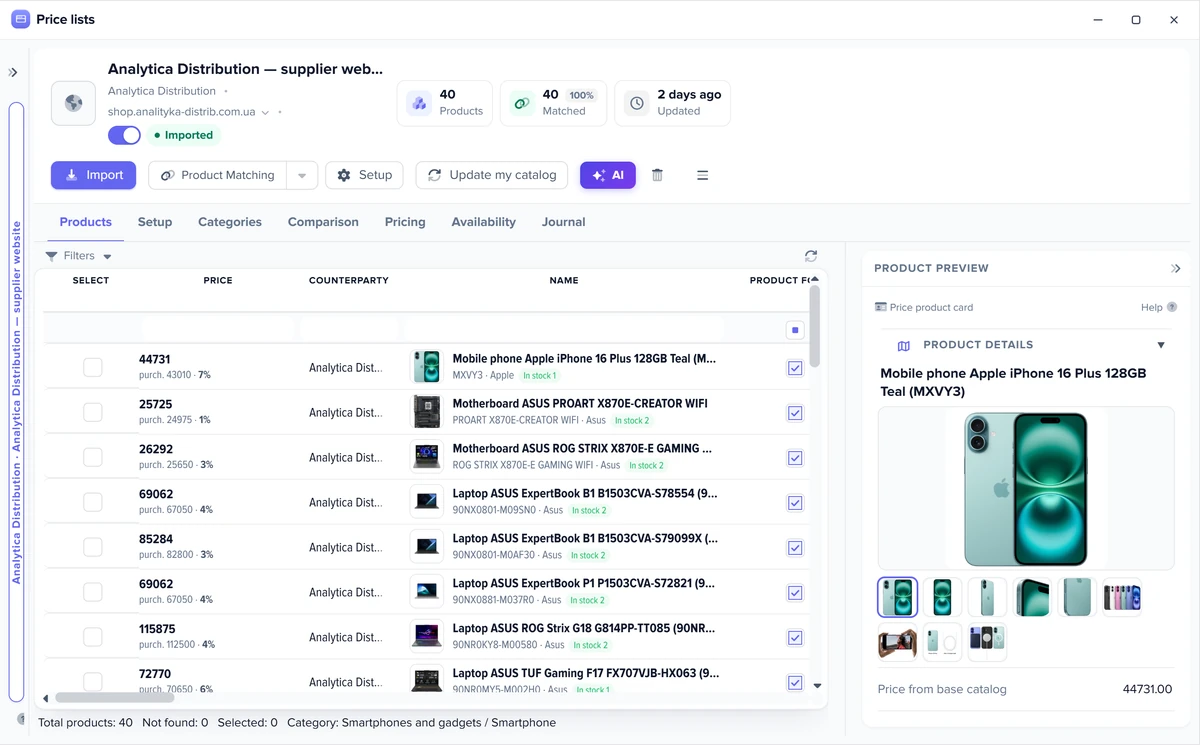
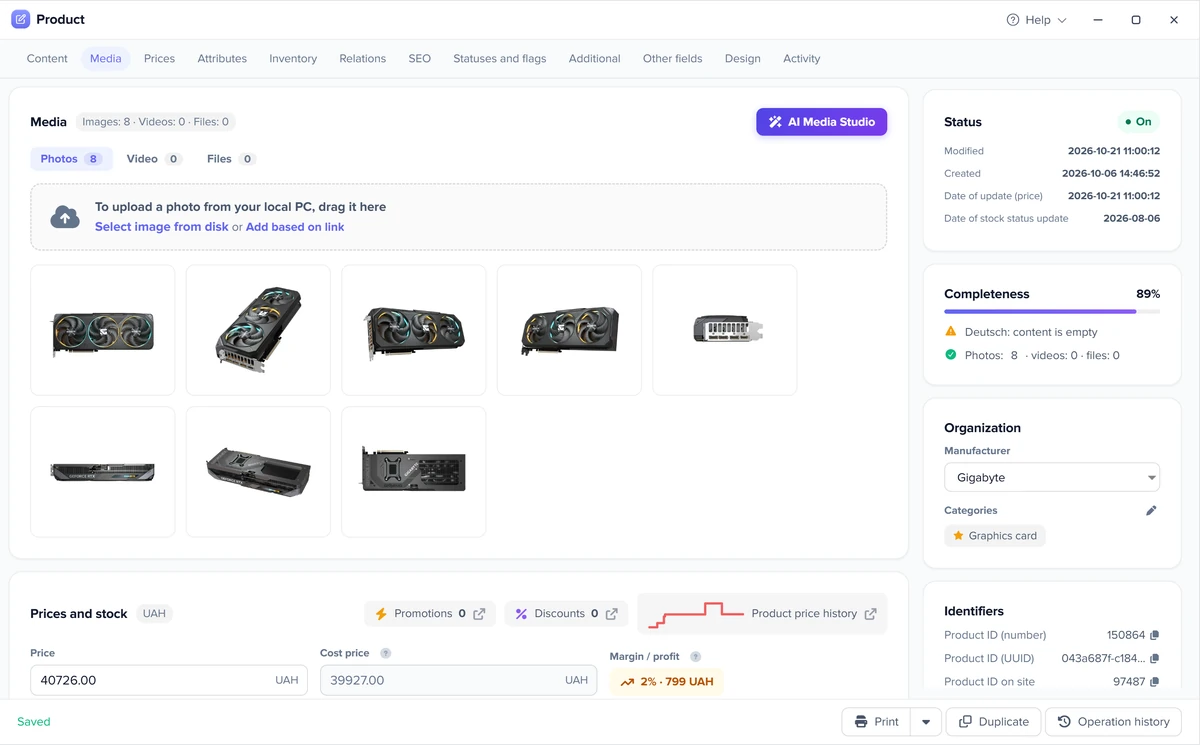
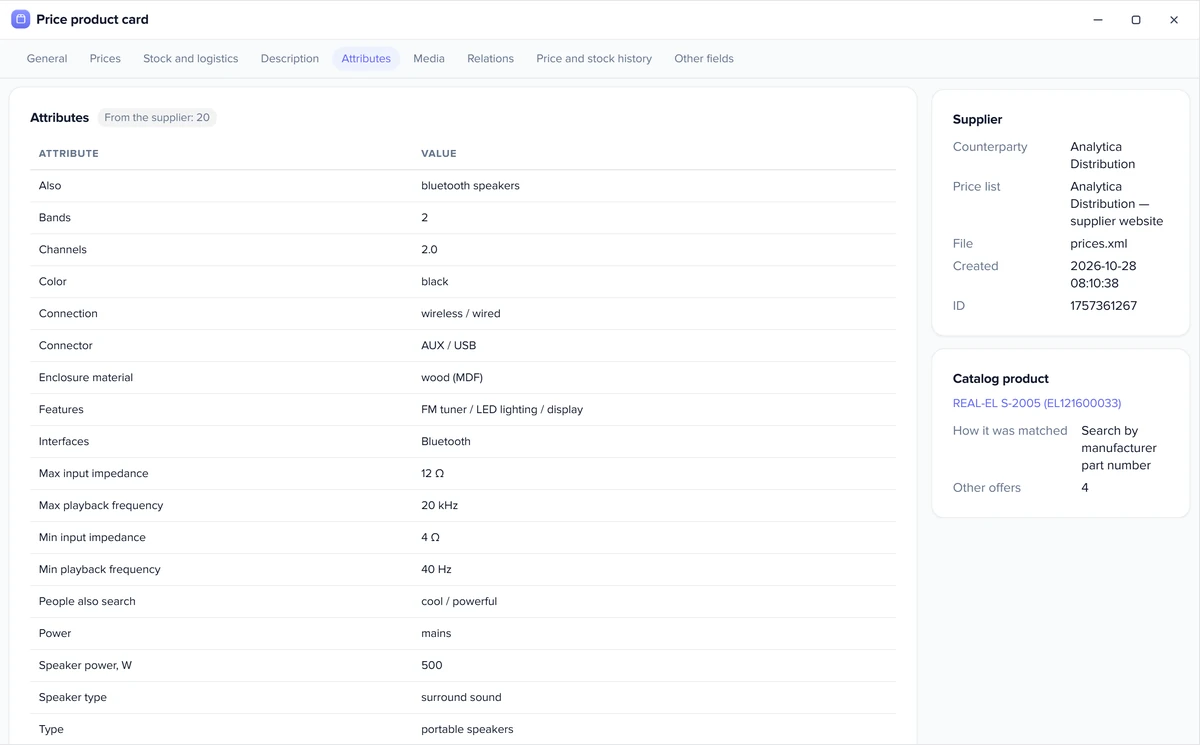
Two typical jobs: tracking prices and stock in a competitor store, and collecting full content for product pages.
The scraper updates prices and stock on a schedule, for example daily, and a price formula recalculates your price by your rules — say, 1% below the lowest competitor price. More — competitor price monitoring.
https://shop.example/catalog/headphones
| Name | SKU | Price | Old price, discount | Stock | Link |
|---|---|---|---|---|---|
| Wireless headphones, model X1 | X1-BLK | €59.99 | In stock | shop.example/p/x1-blk | |
| Noise-cancelling headphones, model X3 | X3-WHT | €129.00 | none | In stock | shop.example/p/x3-wht |
| Kids’ on-ear headphones, model K2 | K2-BLU | €29.90 | Low stock | shop.example/p/k2-blu | |
| Gaming headset, model G5 | G5-RGB | €84.90 | none | Out of stock | shop.example/p/g5-rgb |
| Sport earbuds, model S1 | S1-GRN | €39.99 | In stock | shop.example/p/s1-grn |
| Product | Competitor price | Your price | Difference | Flag |
|---|---|---|---|---|
| Wireless headphones, model X1 | €59.99 | €62.49 | +€2.50 | You are higher |
| Noise-cancelling headphones, model X3 | €129.00 | €124.90 | −€4.10 | You are lower |
| Kids’ on-ear headphones, model K2 | €29.90 | €28.90 | −€1.00 | You are lower |
| Sport earbuds, model S1 | €39.99 | €41.99 | +€2.00 | You are higher |
Competitor prices on a schedule, your price by formula.
The manufacturer site gives full specs and official photos that the store does not have. AI can rewrite the description, and Elbuz maps the specs to the attributes of your categories — see PIM software.
Storehttps://shop.example/p/x3-wht
Manufacturerhttps://brand.example/products/x3
| Field | Store, shop.example | Manufacturer, brand.example |
|---|---|---|
| Photos | ||
| Name | Noise-cancelling headphones, model X3 | X3 wireless over-ear headphones with active noise cancelling |
| Brand | none | Example Audio |
| Model | X3 | X3 |
| Barcode (EAN) | none | 2000000000015 |
| Description | Wireless noise-cancelling headphones. Up to 30 hours of playback. | Over-ear headphones with active noise cancelling and transparency mode. Bluetooth 5.3, connects to two devices at once, up to 30 hours on a single charge, USB-C charging. |
| Sound | ||
| Type | Over-ear | Over-ear |
| Noise cancelling | Active | Active, transparency mode |
| Frequency range | none | 20–20,000 Hz |
| Driver size | none | 40 mm |
| Connectivity | ||
| Bluetooth | 5.3 | 5.3 |
| Codecs | none | SBC, AAC |
| Multipoint | none | 2 devices at once |
| Power | ||
| Battery life | Up to 30 h | Up to 30 h |
| Charging port | none | USB-C |
| General | ||
| Color | White | White |
| Weight | none | 250 g |
A complete product record from two sources in one pass.
Scrape products from a supplier site, a marketplace or a manufacturer catalog — all in the same window.
Any other site is collected by the universal scraper: enter the address, and the system looks for the sitemap and tries to work out the parsing rules itself.
Ready-made scrapers for Amazon and eBay: just pick them in the wizard, no selectors to write.
Products from AliExpress and other sites are collected by the universal scraper from the page address.
The universal scraper reads pages of any website, whatever platform it runs on — WooCommerce, Shopify, OpenCart, PrestaShop or a custom build. Collected products then go to your own store on any platform, through the Elbuz Tunnel module or as a feed. You do not have to move to Elbuz CMS.
A no-code web scraper for ecommerce: nothing to install, and collection is set up without a single line of code.
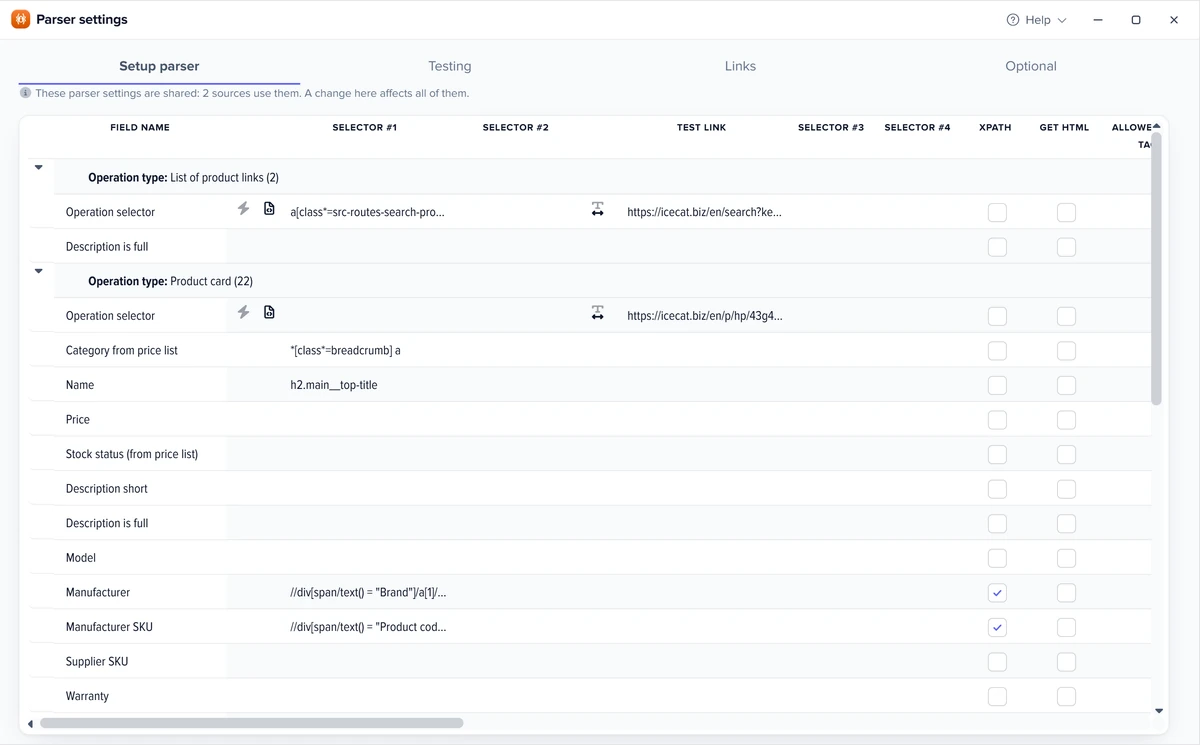
Supplier and market prices for your catalog, with the same collection engine.
The price scraper takes prices and stock from supplier and market websites into the source price list, and then your markup rules and statuses do the rest — prices on your website update themselves.
Other stores’ prices next to yours — that is competitor price monitoring.
The best ecommerce scrapers differ not only in crawl speed, but in what happens to the data next.
| What we compare | Elbuz scraper | Standalone scraping app | Custom scraping service |
|---|---|---|---|
| Where the data goes | Into the source price list and on to your catalog | Into a file you have to upload somewhere | Into a file from the contractor |
| Updates | On a schedule, on the server | You run it yourself | Depends on the agreement |
| The site changed | Scraping log and a selector wizard with AI | You fix the settings yourself | You contact the contractor |
| Prices and stock next | Markup, statuses and feeds in the same system | In another app | In another app |
Compared by way of working, without naming services: what happens to the data after collection.
Four typical cases: from a store working with suppliers to a content manager.
From a site address to products in your catalog — four steps.
Collection starts on a schedule, for example every night, and runs on the server without anyone. Products already collected are not downloaded again, and an interrupted run continues from where it stopped. After the crawl the system applies markup, stock and the other price list rules to the products.
Real Elbuz windows on demo data.
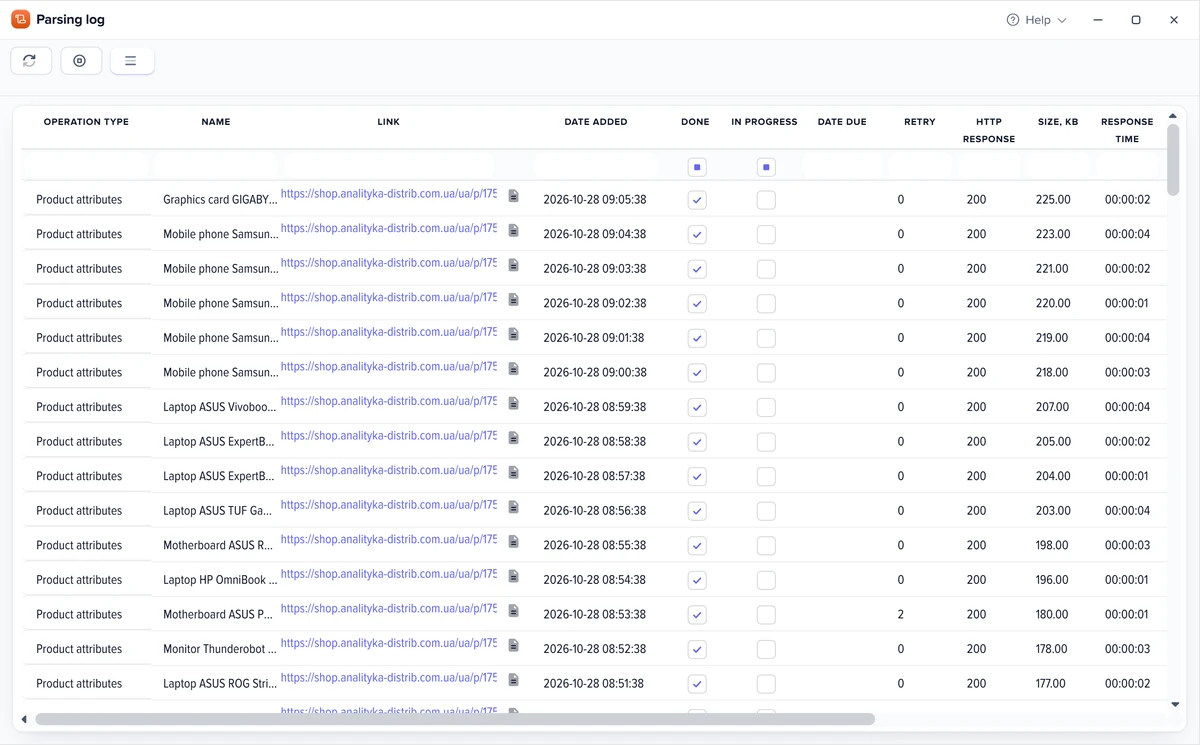
Scraping is when a program opens the pages of a website by itself and copies what you need from them: names, prices, stock, photos, specs. Instead of copying product pages by hand, you get a ready product list. In Elbuz the result goes into a source price list and is processed like a regular supplier price list.
Price scraping is collecting prices and availability from other websites on a schedule — from suppliers for your catalog, or from competitors to compare with your own prices. In Elbuz competitor prices sit next to yours in the product record. More — competitor price monitoring.
Everything on the product page: name, prices, part numbers, stock, photos, files, description and specs. Specs are mapped to the attributes of your categories.
There is no free-forever plan, but the scraper is not sold separately: collecting products and prices from websites is part of the Elbuz plan. The first 14 days after sign-up are free with a positive balance, and €50 is added to your balance when you register.
Collecting products and prices is part of the Elbuz plan, which starts at €87 a month and depends on the number of products and users. The scraper works three ways: through the extension in your browser — free; through the Elbuz server; and through third-party proxies that get past site protection — then each request is billed. See pricing.
No coding needed. For Amazon and eBay the scrapers are ready — you just pick them in the wizard. For any other site, enter the address: the system looks for the sitemap, collects the first products and tries to work out the parsing rules, and the selector wizard and AI help fine-tune them. A turnkey scraper setup is available as a separate service: €20 to €75 per website, depending on its complexity.
€20 to €75 per website, depending on how complex the site is. We give the exact price once we have looked at the site. The Elbuz subscription is billed separately — pricing.
The scraper collects only public data — the same that any visitor sees — and breaks nothing. How you use what was collected is up to the store owner, and so is the responsibility: texts and photos from someone else’s site may be protected by copyright, so for your catalog it is better to use them with the site owner’s permission.
Yes: Elbuz runs in the browser, scheduled collection runs on the server, and for difficult sites there is a Chrome extension.
Enter the site address in the wizard. The first automatic run collects 300 products to check the rules; after that you collect the whole site or selected sections. There is no limit on the number of products per run.
As often as you set in the schedule, for example every night. Products already collected are not downloaded again, and an interrupted run continues from where it stopped.
Yes: the scraper reads a site on any platform, and the collected products go to your own store through the Elbuz Tunnel module or as a feed. You do not have to move to Elbuz CMS.
Open the scraping log: every page of the run is recorded with its response code and size, so you see whether the site did not serve the page or the parsing rules no longer read it. The rules are fixed in the selector wizard, and AI helps pick new ones.
A scraper fills your catalog, while monitoring shows other stores’ prices next to yours; both run on the same collection engine. More — competitor price monitoring.
The result goes into the source price list, and the catalog update moves prices and stock into your products and adds new ones if that is turned on. From the catalog, products go out to your website and marketplaces on a schedule — after collection this happens by itself.

14 days free
The purchasing and products department joins your AI company along with every other department. €50 on your balance after sign-up and 14 days to test the scraper on your own suppliers.
Updated