

A marketplace manager runs a brand's or store's sales on marketplaces such as Amazon, eBay, Walmart, Etsy, Allegro, Kaufland, Zalando and TikTok Shop. The job covers listings, prices, stock, orders, ads and promotions, plus a weekly check of how much each channel earns after fees. The U.S. Bureau of Labor Statistics has no separate category for it. The closest ones pay a median of $78,760 for marketing specialists and $166,790 for marketing managers (May 2025).
The role is often confused with a listing or content specialist. The difference is money: a content specialist is responsible for the product pages, a marketplace manager for making sure every order still earns something after referral fees, shipping and returns. Below: duties by day and week, how to read the pay data, four metrics with formulas, a 4-week plan for a beginner, and how an employer can tell whether the business needs this hire yet.
Who searches for "marketplace manager"
Two different people search for it. One wants to change careers, from retail, sales or admin work, and asks "what does a marketplace manager do", "marketplace manager salary", "can I do it remotely" and "do I need a course". The other runs a store that has grown onto two or three marketplaces, can no longer keep up and wonders whom to hire and what to ask from them. A third group types "Amazon account manager" and gets a mix: agency jobs that manage sellers' Amazon accounts, and jobs at Amazon and AWS themselves, which are a different career.
Both main readers need the same thing: a list of daily tasks and the numbers that show results. A certificate or a résumé line does not replace either.
What a marketplace manager does
Six areas of work: listings, prices, inventory, orders, ads and promotions, reports. Some tasks are daily, some weekly.
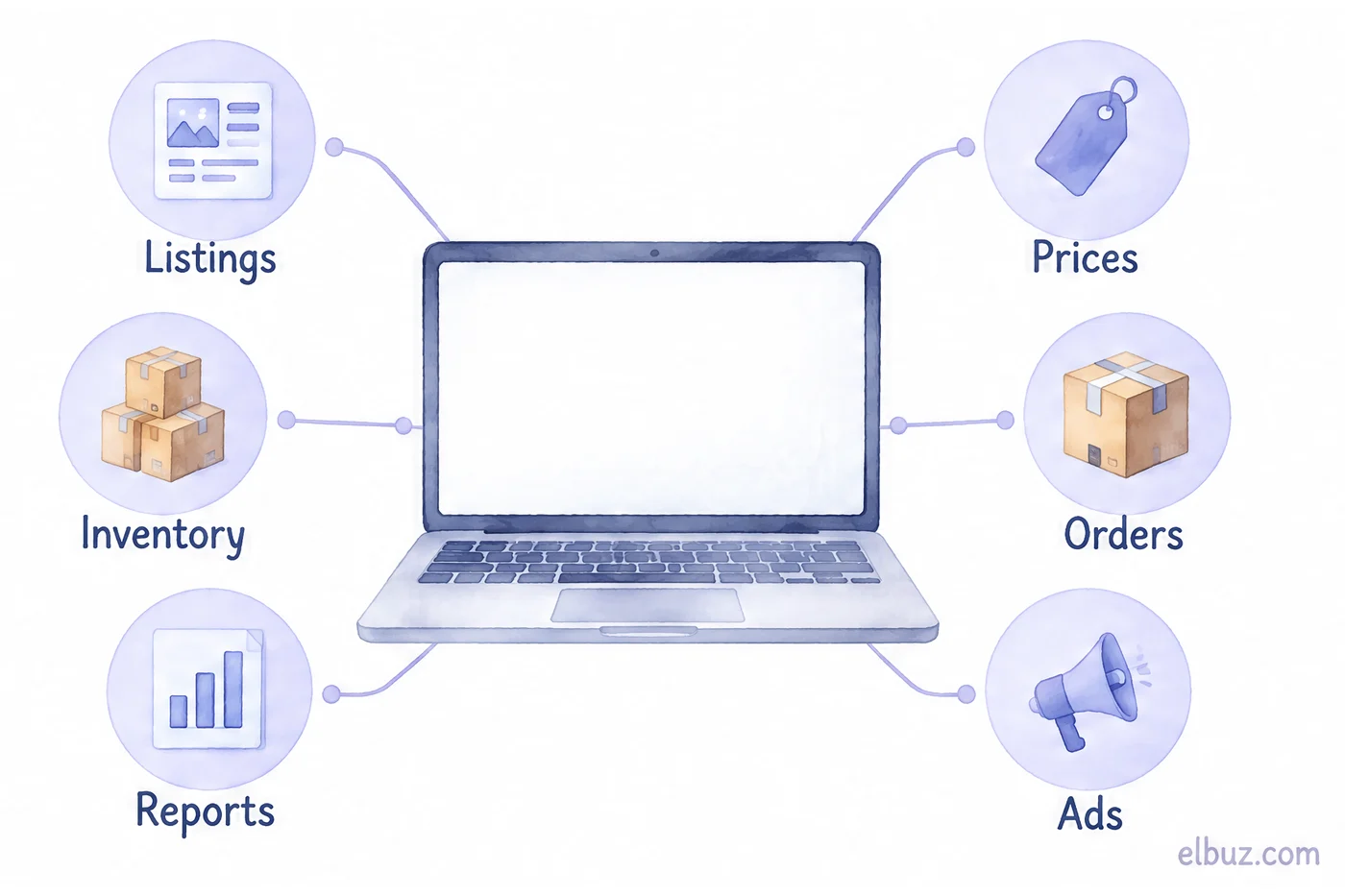
| Area | Daily | Weekly |
|---|---|---|
| Listings | Fix listings that were suppressed or rejected | Fill in missing attributes, replace weak photos on items that do not sell |
| Prices | Check that no price is below the minimum that covers fees | Compare prices with competing offers on the same product |
| Inventory | Make sure the feed updated and nothing sold out still shows as available | Build the reorder list |
| Orders | Confirm and ship on time, answer buyers, add tracking | Review cancellations and returns: why they happened |
| Ads and promotions | Watch the ad budget and cost per sale | Decide which products go into marketplace deals |
| Reports | — | Margin after fees by channel, cancellations, best and worst sellers |
What takes the most effort depends on the marketplace. On Amazon several sellers often share one product page, so price and delivery decide who gets the featured offer, and the seller's account health is watched closely. Walmart Marketplace accepts sellers by application. Etsy limits what can be sold to handmade, vintage and craft supplies. On Allegro and Kaufland listings must be in the local language and category attributes are strict; on Zalando sizes and returns take most of the time; on TikTok Shop sales come through videos and creators. A manager who knows the rules of their two or three channels is worth more than one who knows a little about all of them.
How much a marketplace manager makes
There is no official U.S. wage figure for "marketplace manager": the Bureau of Labor Statistics does not track it as a separate occupation. The two closest BLS occupations give a realistic range: $78,760 median for market research analysts and marketing specialists, and $166,790 for marketing managers (May 2025 data).
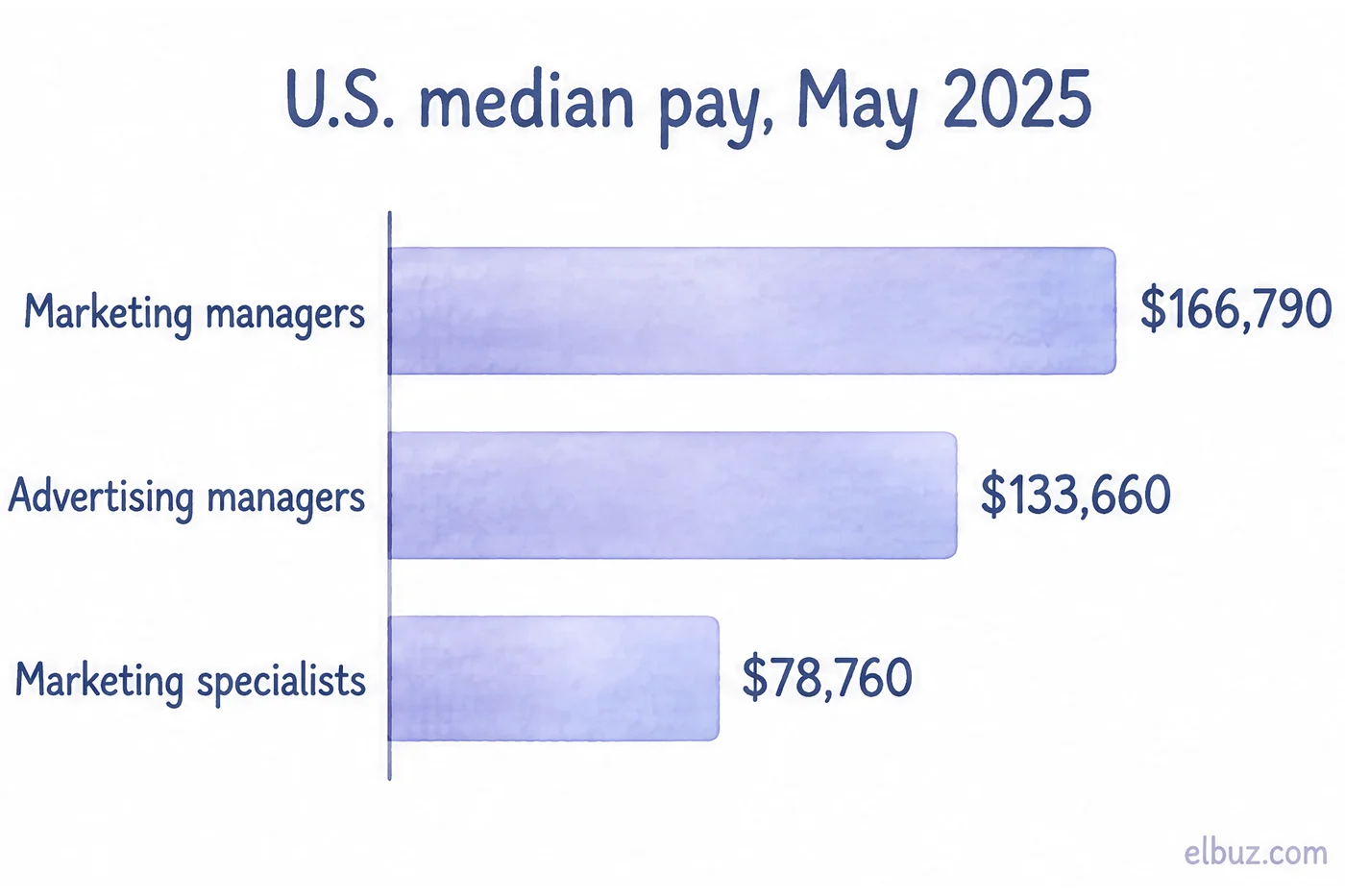
| Occupation (BLS) | Median pay | Projected jobs, 2025–35 |
|---|---|---|
| Marketing managers | $166,790 | +7% |
| Advertising and promotions managers | $133,660 | −4% |
| Market research analysts and marketing specialists | $78,760 | +7% |
How to read this: a marketplace manager who handles listings and day-to-day operations on their own is closer to the specialist line. One who owns the channel's budget, profit and a small team is closer to the manager lines. These are medians for whole occupations, not offers for this exact title. The salary figures on job sites are calculated from job ads with methods they do not publish, so we do not quote them. In the EU, official statistics do not break pay down to this role either. In interviews, ask what any bonus is based on: revenue or margin after fees. A bonus on revenue rewards selling at a loss.
The metrics a marketplace manager is judged by
Four numbers show whether the work pays off: margin after fees, cancellation rate, listing conversion rate and days of stock. All of them come from the seller account reports plus your own cost prices.
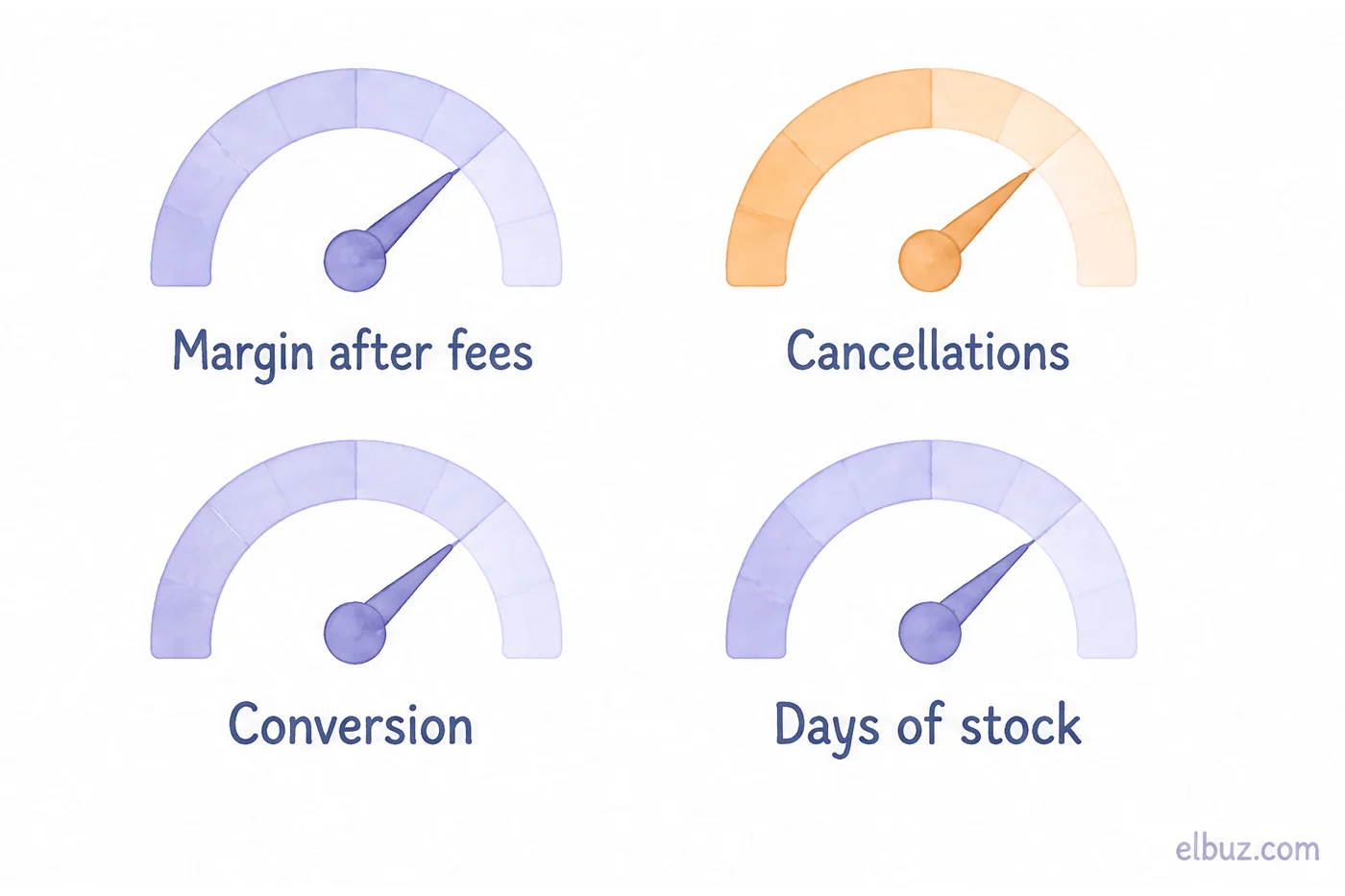
- Margin after fees = (revenue − cost of goods − marketplace fees − packing and shipping you pay) ÷ revenue × 100%. Revenue alone says little: the channel with more sales can bring in less money.
- Cancellation rate = orders you cancelled ÷ all orders × 100%. The usual cause is selling an item that is not actually in stock. Marketplaces track this, and on Amazon it is part of account health, which decides whether you can keep selling.
- Listing conversion rate = orders ÷ listing views × 100%. Use it where the marketplace shows views or sessions. Low conversion at a fair price is a reason to rework photos, title and attributes.
- Days of stock = units on hand ÷ average units sold per day. It tells you when to reorder so the item does not drop off the shelf.
Illustrative example for the arithmetic, not market prices: in one week a marketplace brings 40 orders worth $4,000. Cost of goods is $2,600, marketplace fees $600, packing and shipping $200. Margin after fees: (4,000 − 2,600 − 600 − 200) ÷ 4,000 = 15%. You cancelled 2 of 42 orders placed: 4.8%. The listing had 2,000 views for 40 orders: 2% conversion. A fast seller has 30 units left and sells 3 a day: 10 days of stock. To set a price that cannot fall below cost after fees, see the profit margin formula with fees and a worked example.
How to become a marketplace manager with no experience
The shortest way in is to run the whole cycle by hand on one marketplace: listings, prices with fees, the feed, a report. A course helps, but employers check what you have already done, not the certificate. Here is a 4-week plan you can follow on a friend's store or on 10–20 products of your own.
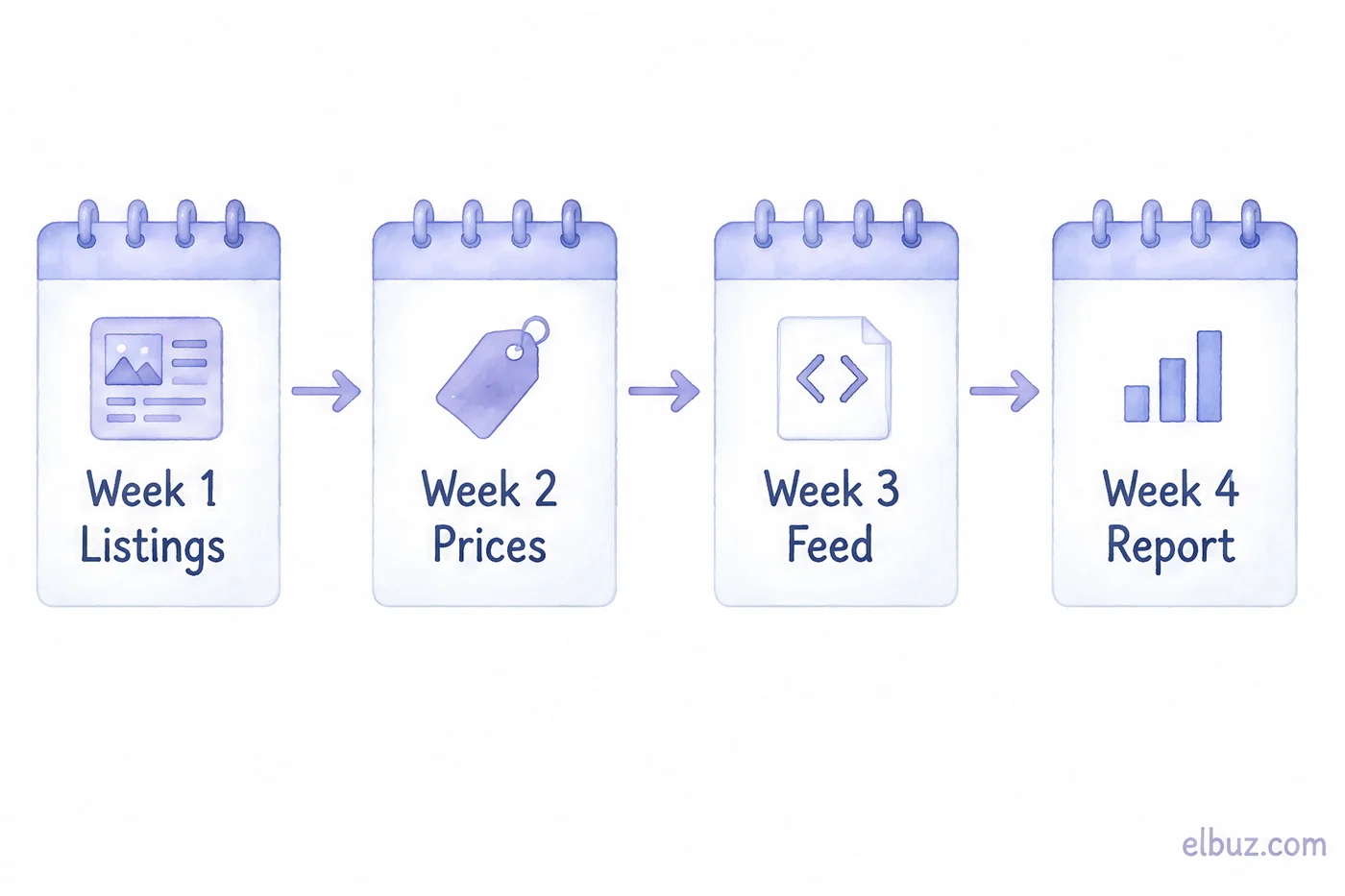
- Week 1: listings. Read one marketplace's listing requirements (title, attributes, images) and create 10 listings that pass review. No studio needed for photos: how to take product photos with a phone.
- Week 2: prices. For each product, calculate the minimum price that covers fees, packing and returns, and compare it with competing offers.
- Week 3: feed and stock. Learn how the marketplace takes products in bulk (a file template, a feed or an API connection), how often it updates and what happens to an item that disappears from the file.
- Week 4: report. Put together a weekly report on the four metrics above. This is your portfolio: in an interview it carries more weight than a certificate.
Skills employers ask for come down to the same cycle: knowing the listing and pricing rules of the channels, understanding how fees are charged, working with bulk upload files, and spreadsheets at the level of formulas and pivot tables. The easiest first job is a listing or content specialist role: you learn listings and review rules there and move on to pricing and reports later. Search job boards for "marketplace specialist", "ecommerce marketplace manager" and "Amazon account manager" (agency side).
How an employer can tell it is time to hire one
Hire a marketplace manager when the marketplaces run on the owner's evenings and mistakes start costing money. Signs that point to it:
- You sell on two or more marketplaces, and prices or stock are updated in each seller account by hand.
- Cancellations because an item was already sold elsewhere keep coming back.
- Nobody can say which marketplace earns the most after fees, only which one sells the most.
- Listings wait weeks to go live because nobody has time to fill attributes.
Give candidates a test task that is the plan above in miniature: create 3–5 listings to a marketplace's requirements, calculate the minimum price after fees for a given cost, and explain why a product with views does not sell. In an hour you see whether the person counts money or only fills in fields. If you are looking for a job, try the same task yourself before the interview.
Which routine to hand over to software
Once there are two or three marketplaces and hundreds or thousands of products, most of a manager's daily work is retyping prices and stock in several seller accounts. That mechanical work is where mistakes happen: a sold item still shows as available, or a new supplier price never reaches one of the channels.
In Elbuz products, prices and stock live in one catalog. Supplier price lists update it on schedule, and listings, prices and stock go to Amazon, eBay, Walmart, Etsy, Allegro, Kaufland, Zalando and TikTok Shop from that same catalog, with orders coming back into one list. The markup that covers each marketplace's fees is set as a formula per channel. The manager then works on what they are paid for: listings, promotions and the margin report. An honest caveat: with one marketplace and a few dozen products, the seller account itself is enough. Details are on the marketplace integration page and on the pages for Amazon, eBay and Walmart.
Every marketplace from one catalogPrices and stock update on schedule, 14 days free
Frequently asked questions
What does a marketplace manager do?
Runs a store's sales on marketplaces: listings, prices, stock, orders, buyer messages, ads and promotions, and a weekly check of margin after fees. The schedule of tasks is in the duties section.
How much does a marketplace manager make?
BLS does not track the title separately. The closest U.S. occupations had a median of $78,760 for marketing specialists and $166,790 for marketing managers in May 2025.
What does an Amazon account manager do?
On the seller side, the same work focused on one channel: Amazon listings, pricing, stock, ads and account health, often at an agency serving several brands. Jobs titled "account manager" at Amazon or AWS are a different role.
Can I become a marketplace manager with no experience?
Yes. The easiest entry is a listing or content specialist job, or your own small project with 10–20 products: listings, prices with fees, a feed and a weekly report.
Can a marketplace manager work remotely?
Yes. Seller accounts on every marketplace work online, so the job does not depend on being in the warehouse, as long as someone there ships the orders.
What skills does a marketplace manager need?
The listing and pricing rules of your marketplaces, how fees are charged, bulk upload files or feeds, and spreadsheets at the level of formulas and pivot tables.
Sources
- U.S. Bureau of Labor Statistics, Occupational Outlook Handbook: Advertising, Promotions, and Marketing Managers — median pay May 2025 ($166,790 marketing managers, $133,660 advertising and promotions managers), employment projections 2025–35 — bls.gov/ooh/management/advertising-promotions-and-marketing-managers.htm.
- U.S. Bureau of Labor Statistics, Occupational Outlook Handbook: Market Research Analysts (SOC 13-1161, includes marketing specialists) — median pay May 2025 ($78,760), employment projections 2025–35 — bls.gov/ooh/business-and-financial/market-research-analysts.htm.
Checked on November 1, 2026. BLS updates the Occupational Outlook Handbook once a year.


