

A product description answers three questions: what it is and who it is for, how it helps, and whether it fits — size, compatibility, what is in the box. The structure that works has five blocks: one sentence about the product and the buyer, 3–5 benefits, specs as a list, what is in the box, care and warranty. The formulas AIDA, FAB, PAS and 4P are just different ways to order the benefits.
Descriptions are rarely ruined by style — they are ruined by empty words: "high-quality", "innovative", "best". Shoppers skip them and go ask in chat or buy elsewhere. Below: the structure, which formula to pick when, four sample descriptions, a template, the limits on Amazon, Google Merchant Center, Etsy and eBay, and how to handle a thousand products.
When people search for how to write product descriptions
Usually when a store has loaded hundreds of products from a supplier feed and the product pages carry only a name and a spec table. Or when a marketplace sends a listing back for rework. People search for "product description examples", "product description template" and "how to write a product description that sells".
The second question is about length: "how long should a product description be". There is no single number; a description is done when it answers the questions shoppers ask in chat. More on that in the section on description length.
What a product description should include: five blocks
A description has five blocks in this order: from the essentials everyone reads to the details sought by people who have almost decided to buy.
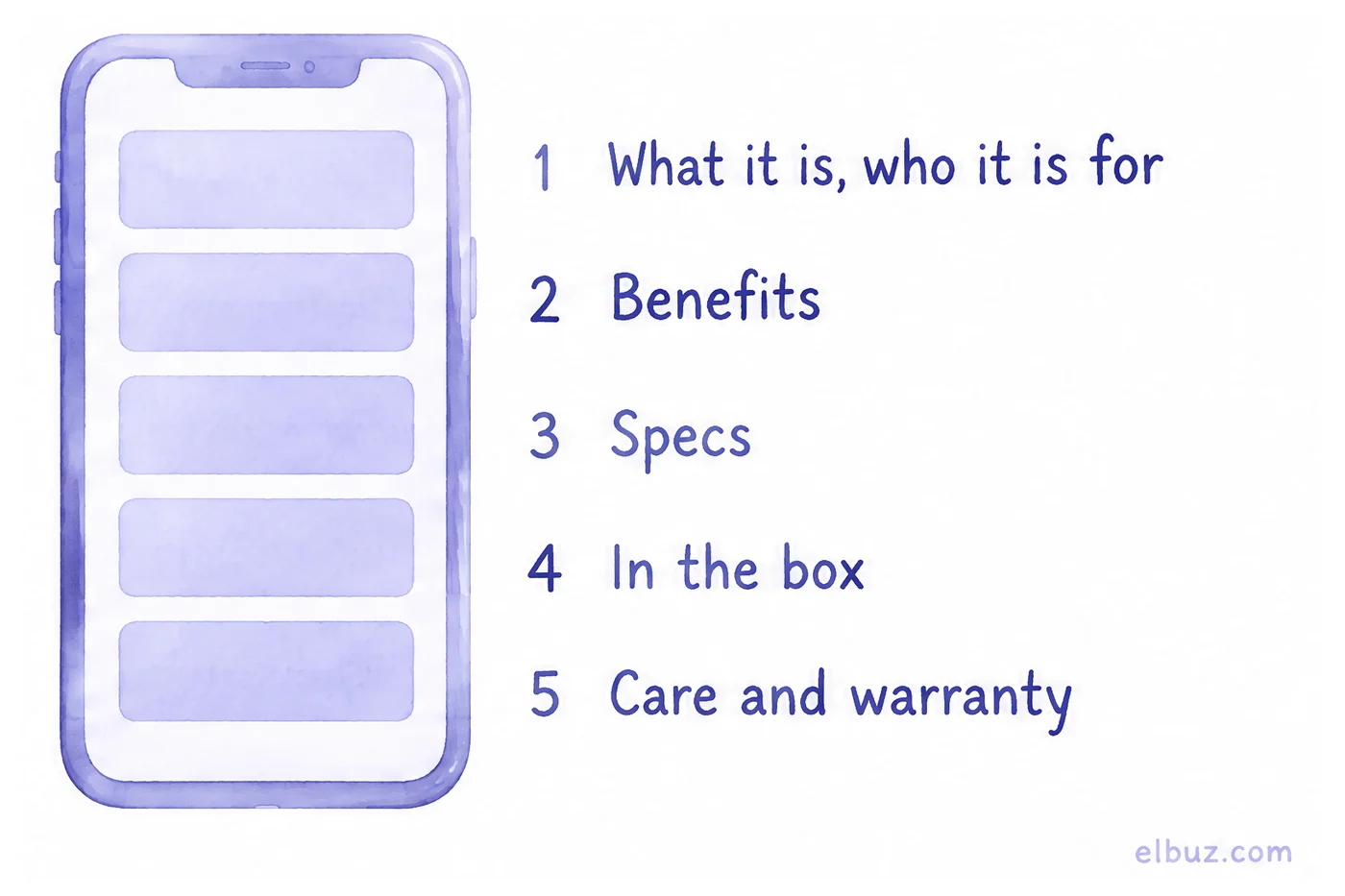
- What it is and who it is for. One or two sentences: product type, main property and the buyer. "A 500 ml (17 oz) travel mug for people who take their coffee on the road."
- Benefits. 3–5 bullet points, each a feature plus what it gives the buyer. Not "double walls" but "double walls — coffee stays hot on the way".
- Specs. A list or a table: dimensions, weight, material, capacity, compatibility. Numbers here, no adjectives.
- What's in the box. What the package contains. Leaving this out is a frequent cause of returns like "I thought the charger was included".
- Care and warranty. How to wash, clean and store it; the warranty period and return terms if they differ from your usual ones.
Blocks 1 and 2 are the part that sells. Blocks 3–5 remove doubts and objections before the shopper writes them. How to answer the ones that still come is in the article on handling customer objections.
Product description formulas: AIDA, FAB, PAS, 4P — which one when
The formula sets the order of the benefits block. Choose by how the shopper picks this product: by specs, by problem or by emotion.
| Formula | Order | For which products |
|---|---|---|
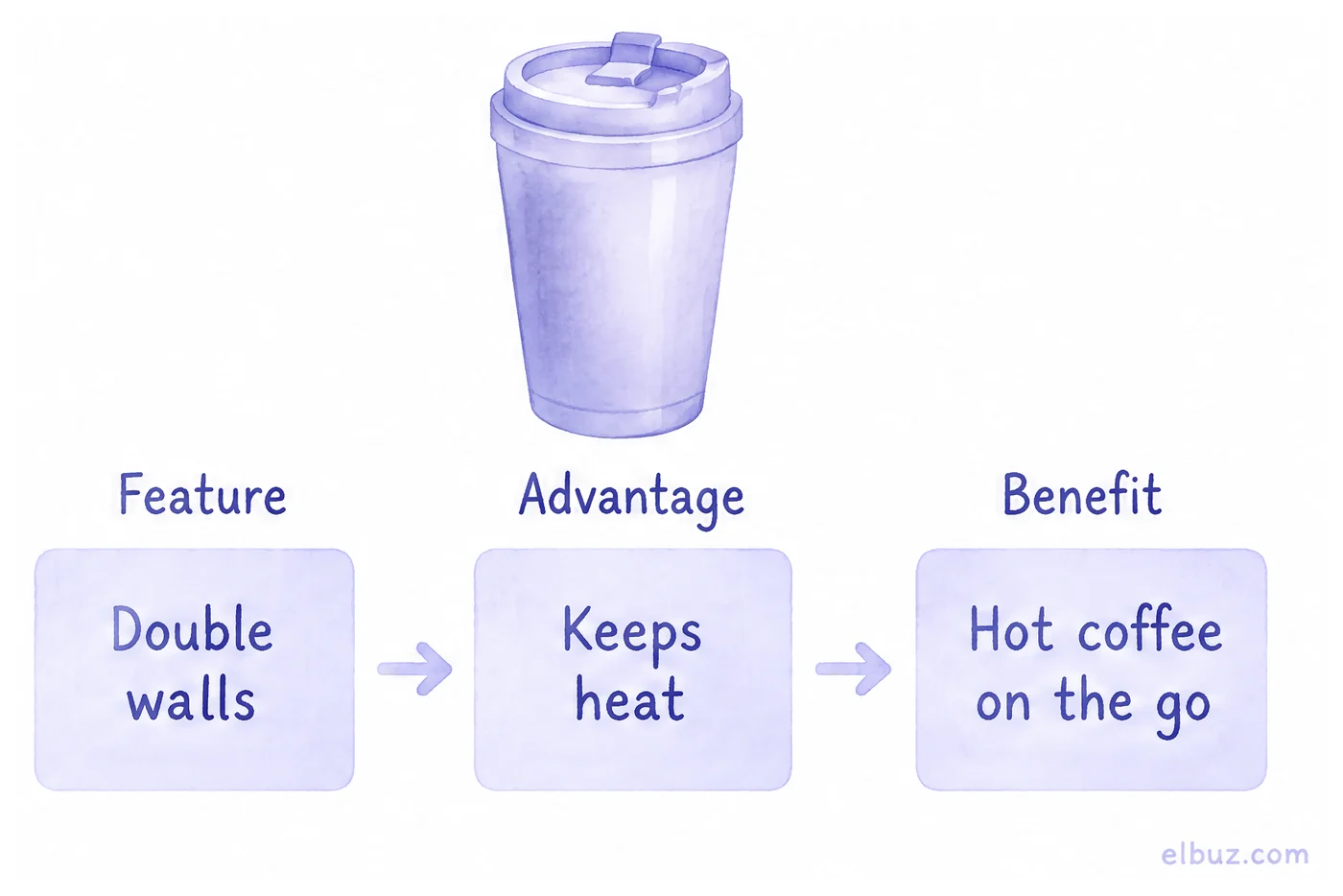
| FAB | Feature → advantage → benefit | Electronics, tools, anything compared by specs |
| PAS | Problem → agitation (why it bothers) → solution | Products that fix a specific inconvenience: organizers, care products, orthopedic goods |
| AIDA | Attention → interest → desire → action | Gifts, hobby products, new items nobody searches for by specs yet |
| 4P | Picture → promise → proof → push | More expensive goods where the promise needs backing: a certificate, a warranty, a test |
The most universal is FAB: it turns a spec table into benefits and fits most products in an online store. It is easy to test: if you cannot add "— which means you…" after a feature, the bullet is not needed.
Product description examples
The products in the examples are illustrative, and their specs are made up to show the structure. Square brackets in the template below mark the places for your own data.
Travel mug (FAB)
A 500 ml (17 oz) travel mug for people who take coffee on the road or to the office.
- Double stainless steel walls with a vacuum — the drink stays hot for a long time, and the outside never burns your hands.
- A locking lid — you can drop it into a bag on its side and nothing spills.
- 20 cm tall — fits a car cup holder.
Specs: capacity 500 ml, weight 320 g, stainless steel, height 20 cm. In the box: mug, lid. Care: hand wash only, not microwave safe.
Cable organizer (PAS)
Chargers, earbuds and cables in your backpack tangle into a knot every time, and you spend five minutes looking for the right one. The organizer gives each its own pocket, so you see every cable at a glance.
- Six elastic loops and two zip pockets — for cables, a charger and a power bank.
- Water-repellent fabric — getting caught in the rain is not a problem.
Specs: 24 × 16 × 5 cm, weight 150 g. In the box: organizer.
Microgreens growing kit (AIDA)
Fresh greens on your windowsill in a week — no soil and no gardening skills.
The kit has everything you need: a tray, mats instead of soil and seeds of three crops. Spread the seeds on a damp mat and water once a day.
A good gift for people who cook at home and a first project to do with kids.
In the box: tray, 3 mats, 3 seed packets, instructions. Add to cart — we ship [shipping day].
Orthopedic pillow (4P)
Picture a morning without a stiff neck. The memory foam pillow keeps your head at the same height whether you sleep on your back or your side.
Proof is facts, not words: [material certificate], [warranty period], the option to return it if it does not suit you, [return terms].
Specs: 60 × 40 × 12 cm, removable cover, machine wash at 30 °C.
In 4P, back health promises only with documents you actually hold. In the US the FTC expects advertisers to have evidence for their claims before the ad runs; "cures" and "doctor recommended" without proof invite complaints rather than sales.
Product description template
[Product type] [main property] for [who buys it / what for].
- [Feature 1] — [what it gives the buyer].
- [Feature 2] — [what it gives the buyer].
- [Feature 3] — [what it gives the buyer].
Specs: [dimensions], [weight], [material], [compatibility].
In the box: [list].
Care and warranty: [how to care for it], [warranty period].
How long should a product description be
There is no single norm: a description should be long enough that the shopper does not need to ask in chat. For a simple product that is a few sentences and a spec list; for electronics, several screens.
To set the length for your category, list the questions shoppers ask in chat and on calls about this type of product and check that the description answers each one. The first phone screen should hold blocks 1 and 2 — after that, only people who need details keep reading.
Marketplaces and shopping channels set limits too, but mostly on the title and as upper bounds for the description:
| Platform and field | Limit | What else to know |
|---|---|---|
| Amazon, product title | 200 characters | Including spaces, for most categories, since January 21, 2025; some characters such as ! $ ? are not allowed. Amazon Ads recommends titles of about 60 characters |
| Amazon, bullet points | up to 5 | Amazon Ads advises at least three, covering contents, uses and dimensions |
| Google Merchant Center, description | 5,000 characters | Put the most important details in the first 160–500 characters |
| Google Merchant Center, title | 150 characters | Users usually notice only the first 70 or fewer |
| Etsy, listing title | 140 characters | Etsy suggests fewer than 15 words |
| eBay, item description | 500,000 characters | On mobile devices, an 800-character summary |
The practical takeaway: the first 160 characters of the description and the first 60–70 of the title do the work everywhere, so put the product type and the main benefit there. If your catalog feeds Google Shopping, the description in the feed comes from the same product card — see product feeds for Google Shopping, Meta and TikTok.
What not to write in a product description
| Bad | Why | Better |
|---|---|---|
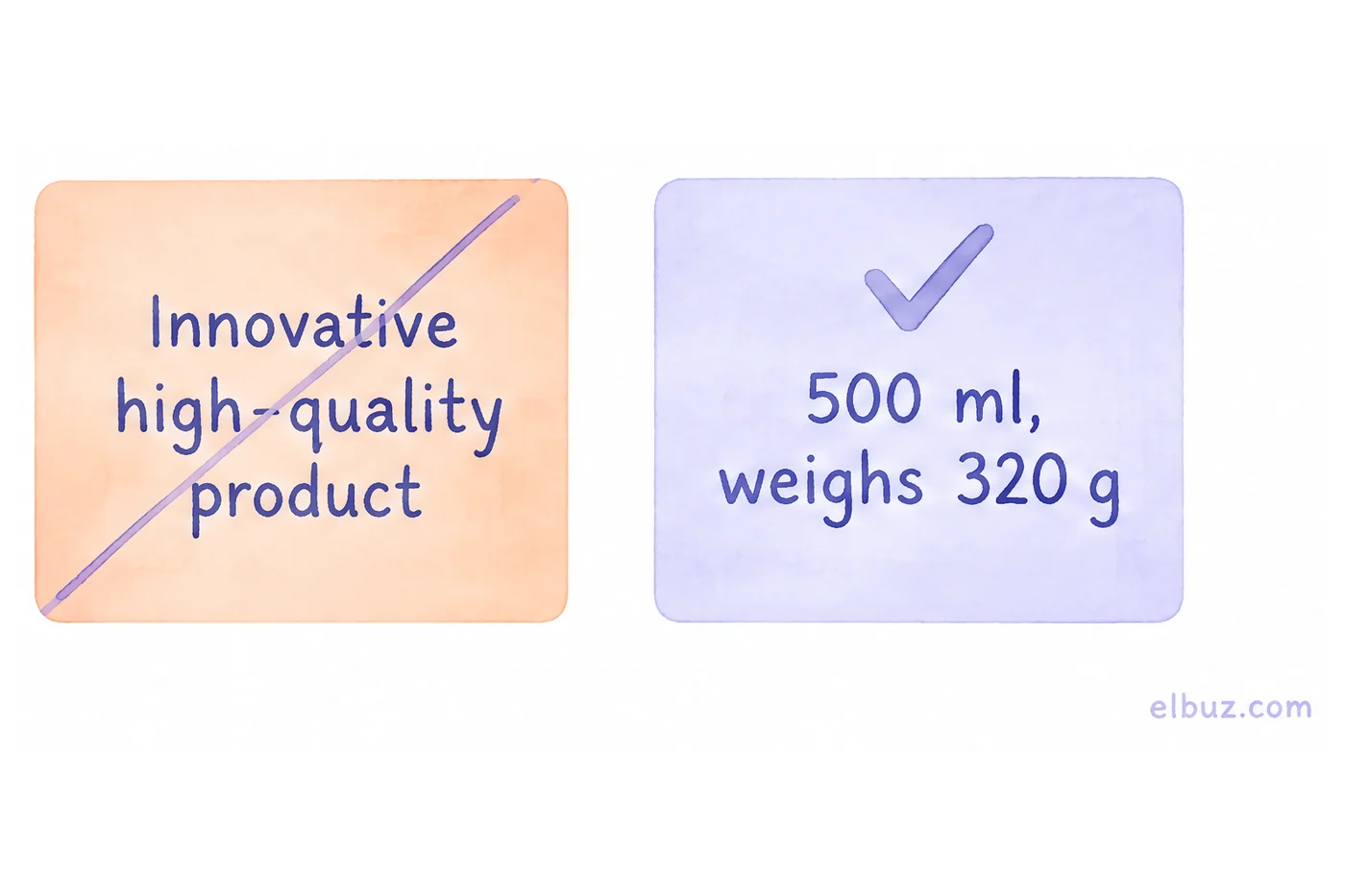
| "Innovative high-quality product" | A judgment without a fact; shoppers skip it | "0.8 mm steel, 24-month warranty" |
| The manufacturer's description word for word | The same text on hundreds of sites; nothing sets your page apart | Your own first paragraph and benefits; specs can stay |
| Only a spec table | The shopper does not see what the numbers give them | Add 3–5 benefits using FAB |
| "Improves sleep by 67%" | A number without a source that nobody believes, and a health claim you must be able to prove | Only what a document confirms |
| Nothing about what's in the box | Expectations do not match — returns | A separate "In the box" line |
The same goes for images with text: repeat the important parts (dimensions, compatibility) as text in the description, or search engines and marketplaces will not read them. How to lay out an extended description with image blocks for marketplaces is in the article on rich content.
How to write descriptions for a thousand products
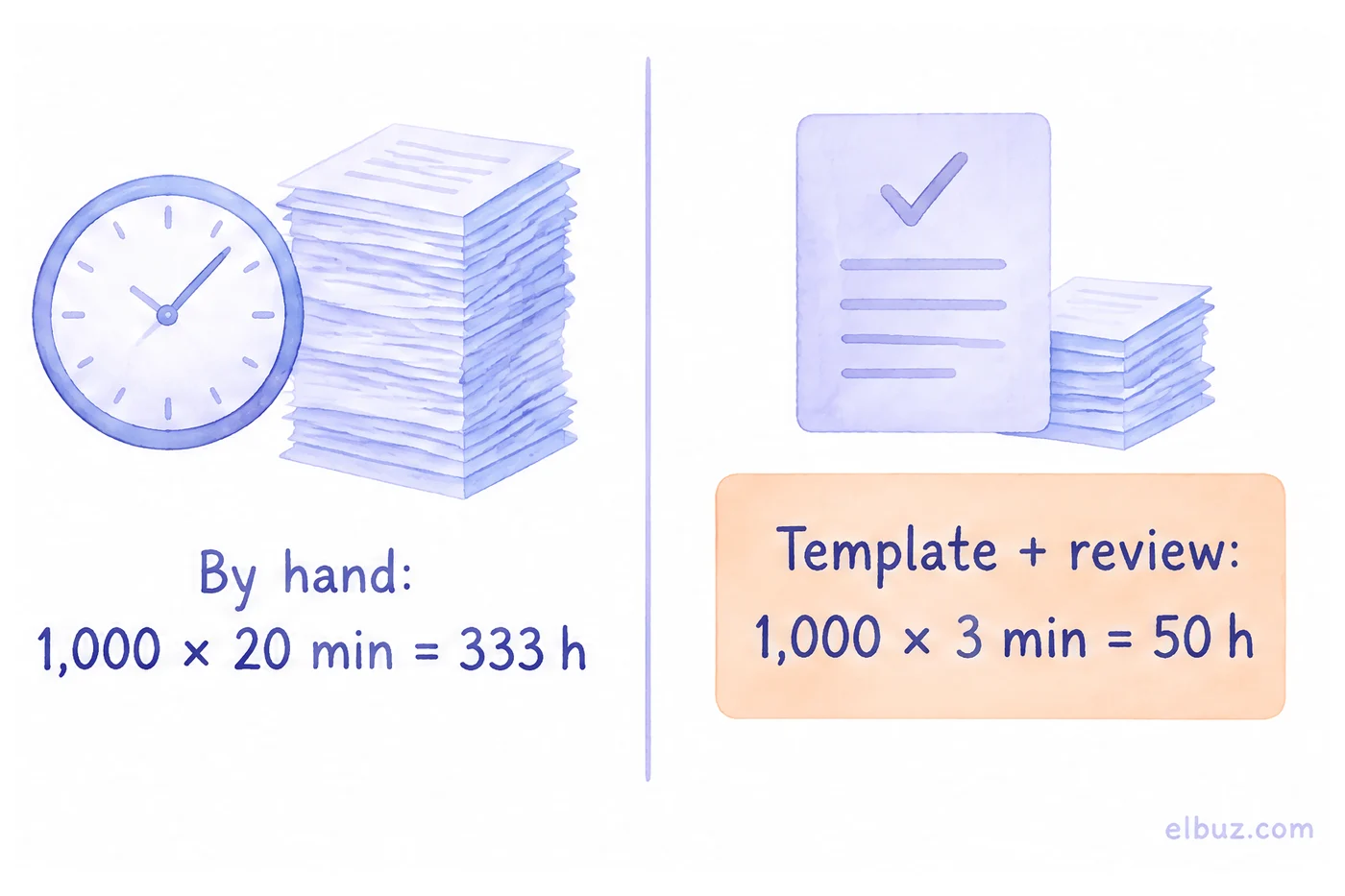
Descriptions for hundreds or thousands of products are written from a template filled with product data, and a person reviews them instead of writing from scratch. The time difference is several-fold.
Illustrative example for the arithmetic. One description by hand takes 20 minutes. For 1,000 products that is 20,000 minutes, over 333 hours — two months of one person's work. If a template gives the draft and a person spends 3 minutes reviewing it, that is 3,000 minutes, or 50 hours.
- Start with the products that sell. Write descriptions for your top 50 by hand, using the structure above.
- For the rest, build a template per category from fields the product card already has: type, material, dimensions, compatibility.
- Generate drafts with the template or with AI from the product specs — but only from data in the card, so the model does not add what is not there.
- Review a sample: check a few descriptions in each category and fix the template, not each text separately.
When descriptions are written in bulk in the catalog
When products arrive from supplier feeds by the hundred and new ones appear every week, writing descriptions one by one in your store admin no longer keeps up.
In Elbuz the SEO text generator writes product descriptions, meta tags and H1s for a category or the whole catalog in the background, from the name, specs and card fields, with a preset or your own instructions. Before the run you can preview the result on one product, and by default it fills only empty fields, so text written by hand is not overwritten. How it works is on the AI product description generator page.
Who does not need it: if you have a few dozen products and the range rarely changes, write the descriptions by hand using the structure in this article.
Frequently asked questions
How do you write a great product description?
Start with one sentence on what it is and who it is for, then 3–5 benefits built on features, then specs as a list, what is in the box, care and warranty. Details are in the section on the five blocks.
How do you write an Amazon product description?
The same way, within Amazon's fields: the title (up to 200 characters for most categories) states the product type and key attribute, up to five bullet points carry the benefits, and the description adds what is in the box, care and use.
How long should a product description be?
There is no single norm. A description should answer the questions shoppers ask in chat; platforms set only upper limits — for example, 5,000 characters in Google Merchant Center, where the first 160–500 matter most.
Can I copy the manufacturer's description?
The specs, yes — they are the same everywhere. Write the first paragraph and the benefits yourself: the manufacturer's text sits on hundreds of sites and does nothing to set your page apart.
Can I write product descriptions with AI?
Yes, if the model gets the real specs from the product card and a person reviews a sample of the results. Without data, AI writes generic phrases and may add properties the product does not have.
What is the difference between a product description and specifications?
Specifications are dry parameters: dimensions, weight, material. A description explains what those parameters give the buyer and answers their questions.
Sources
- Amazon Seller Central, "New product title requirements effective January 21, 2025" (200 characters, special characters, word repetition) — sellercentral.amazon.com.
- Sell on Amazon, "How to create Amazon product listings" (up to five bullet points) — sell.amazon.com.
- Amazon Ads, "How to improve your product detail page for advertising" (title of about 60 characters, at least three bullet points) — advertising.amazon.com.
- Google Merchant Center Help, Description [description] (1–5,000 characters, first 160–500) — support.google.com/merchants/answer/6324468.
- Google Merchant Center Help, Title [title] (1–150 characters, first 70 or fewer noticed) — support.google.com/merchants/answer/6324415.
- Etsy Help Center, "How to Create a Listing" (title up to 140 characters, fewer than 15 words) — help.etsy.com.
- eBay Developers, Trading API user guide, Item description (500,000 characters, 800 on mobile) — developer.ebay.com.
- FTC, "Advertising FAQ's: A Guide for Small Business" (claims must be truthful and substantiated) — ftc.gov.
Checked on October 31, 2026.


