

There are three ways to find suppliers in China: Alibaba.com, the international B2B marketplace built for foreign buyers; 1688.com, China's domestic wholesale market with prices in yuan; or a sourcing agent who buys and ships for you. Choose a supplier by landed cost, not by the yuan price: price × exchange rate + freight to the border + duty + import VAT + broker.
The gap between those two numbers is wide: in the illustrative example below, a product that costs €5 at the factory costs €9 in an EU warehouse. If you set your markup on the factory price, you sell at a loss and find out after the first shipment. Below: where to search, how to cost a shipment for the EU and the US, what to check before you pay, and how to turn a yuan price list into prices on your website.
When stores start looking for suppliers in China
Usually the store already sells a product bought from a local wholesaler and then sees the same item on a Chinese marketplace for a fraction of the price. The first searches are "china suppliers", "how to find suppliers in china" and "alibaba vs 1688". Right after them come "how much does it cost to import from china" and "do I have to pay tariffs if I order from china".
The riskiest question here is "where is it cheapest". The marketplace price leaves out freight, duty and VAT, and together they can add more than half of the product price. Cost one shipment first, then choose the marketplace.
Where to find suppliers in China
For a first order, Alibaba.com is the simplest place to start: the interface is in English, sellers work with foreign buyers, and orders can be protected. Prices on 1688.com are lower, but the site is built for buyers inside China, so ordering without an agent is hard.
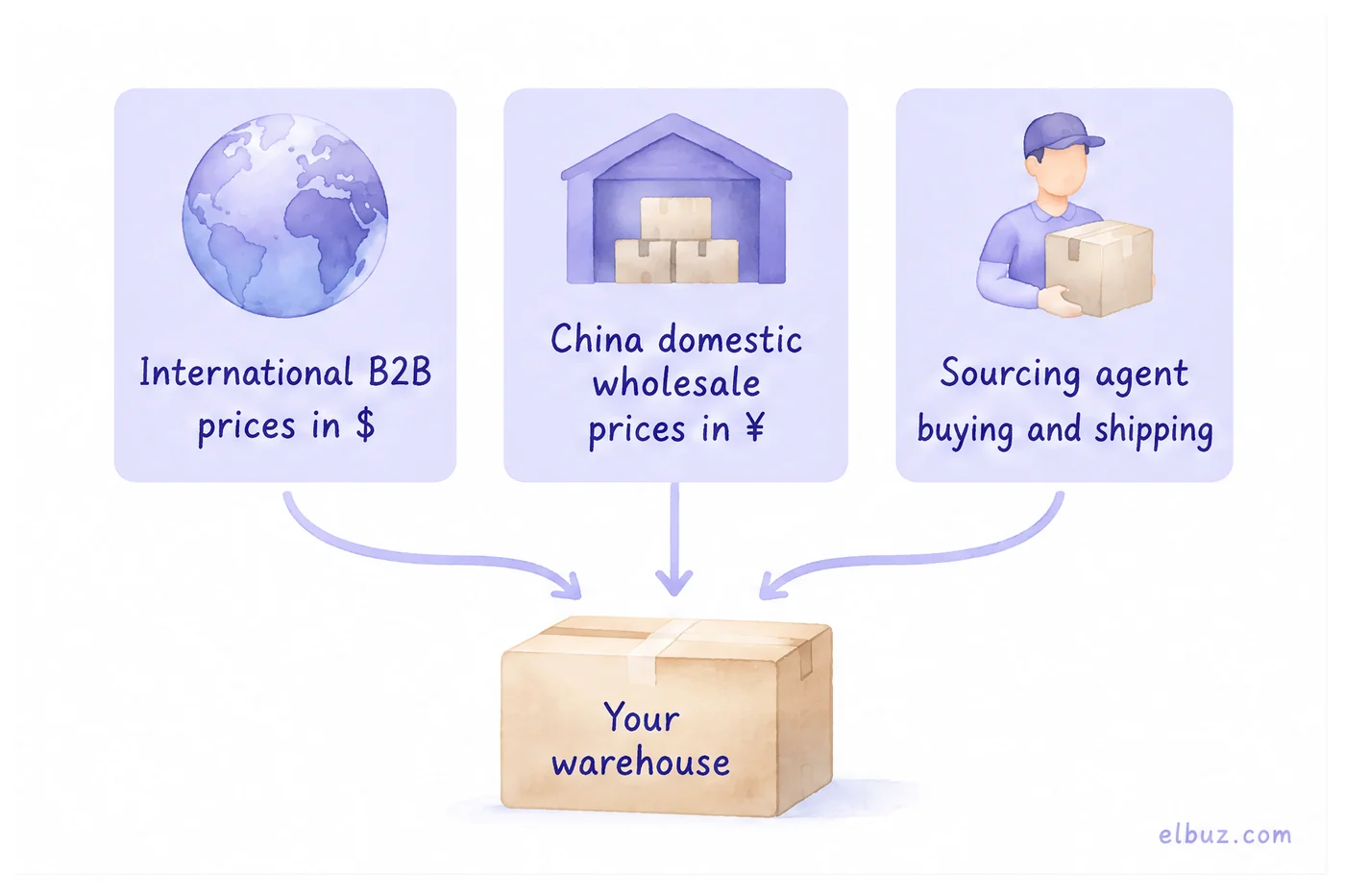
| Route | Alibaba.com | 1688.com | Sourcing agent |
|---|---|---|---|
| Built for | Foreign buyers, international wholesale | China's domestic wholesale market | You, without direct contact with the factory |
| Language and currency | English, prices usually in dollars | Chinese, prices in yuan | Your language, invoice from the agent |
| Payment protection | Trade Assurance for orders placed through it | Designed for Chinese buyers | Depends on your contract with the agent |
| Shipping to you | Agree with the seller or use your own forwarder | Within China only, then the agent | Part of the service |
| Best for | First order, batches from a few hundred units | When you have an agent and a proven product | Small batches, different products from different sellers |
Each seller sets its own minimum order quantity (MOQ), and it is often negotiable: for a first order, ask for less than the listing says, even at a slightly higher unit price. Prices are usually tiered — the bigger the batch, the lower the price — so cost the quantity you will actually buy.
How to calculate landed cost from China
For the EU: landed cost per unit = (price × exchange rate + freight and insurance to the EU border) × (1 + duty rate) × (1 + import VAT rate) + broker and delivery to your warehouse.
Why the formula looks like this. The customs value is the price of the goods plus transport and insurance up to the place where the goods enter the EU (Union Customs Code, Art. 70–71). Duty is charged on the customs value at the rate for the product's code in TARIC. Import VAT is charged on the customs value plus duty, at the rate of the EU country where the goods are released (VAT Directive, Art. 85–86).
Illustrative example for the arithmetic, not market prices: 1 ¥ = €0.125, duty 10%, import VAT 20%, freight and broker fees are made up. The shipment is 500 units at 40 ¥.
| Item | Calculation | Shipment, € | Per unit, € |
|---|---|---|---|
| Goods | 500 × 40 ¥ × 0.125 | 2,500 | 5.00 |
| Freight and insurance to the EU border | forwarder's invoice | 750 | 1.50 |
| Customs value | 2,500 + 750 | 3,250 | 6.50 |
| Duty | 3,250 × 10% | 325 | 0.65 |
| Import VAT | (3,250 + 325) × 20% | 715 | 1.43 |
| Broker, clearance, delivery to warehouse | invoices | 210 | 0.42 |
| Landed cost | 4,500 | 9.00 |
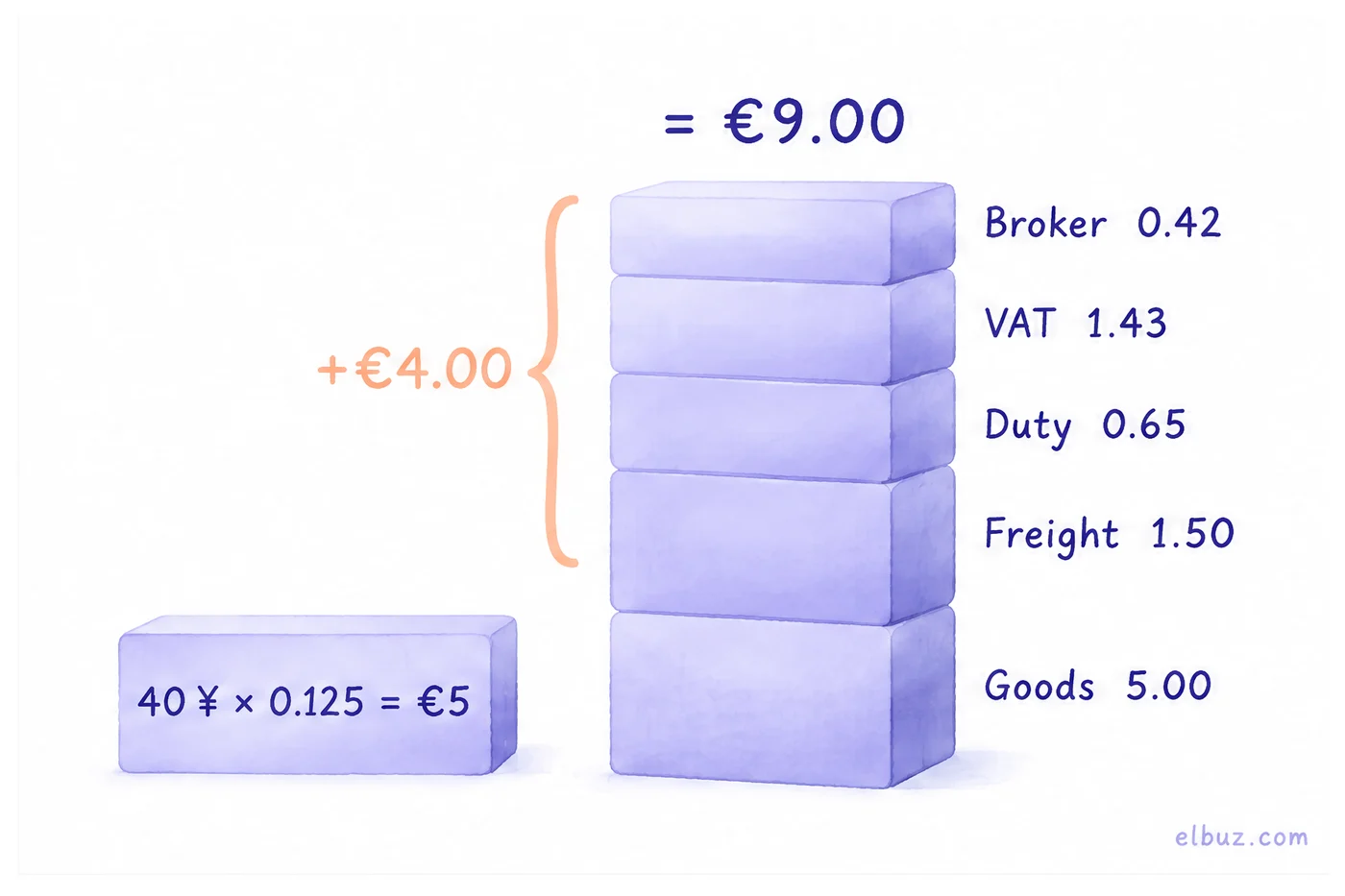
A product priced at 40 ¥ costs €9.00 in the warehouse — €4.00 more than "price × exchange rate". Put your usual 30% markup on €5 and you get €6.50, which is below cost. Strictly, transport from the border to the first destination in the EU also belongs in the VAT base; in the example it is a few cents per unit, so we keep it in the last line.
A VAT-registered business can usually reclaim import VAT as input tax, and then its landed cost in the example is €7.57. For a business that is not registered for VAT, those €1.43 are a straight cost. Look up the duty rate for your product's code in TARIC before you order, and agree the code with your customs broker: it decides both the rate and the documents you need. To import into the EU you also need an EORI number.
For the US the base is different. The dutiable value is the transaction value, which does not include international freight and insurance (19 CFR 152.103), and there is no import VAT. On top of the general rate in the Harmonized Tariff Schedule, goods from China can carry additional tariffs, and these have changed several times since 2025 — check the HTS and CBP notices before each order. A merchandise processing fee is added to formal entries, and a harbor maintenance fee to ocean shipments.
What to do with the landed cost next — how to add ads, fees and rounding to the price — is covered in how to calculate markup and price.
Small parcels or a commercial shipment
For a store, a declared commercial shipment. Low-value parcel rules were built for online purchases sent to consumers, and both the EU and the US have closed most of the duty-free route in 2025–2026.
- EU. The customs duty exemption for consignments up to €150 ended after 30 June 2026. From 1 July 2026 until 1 July 2028 such distance sales pay a temporary duty of €3 per item, where an item means a tariff classification, not a piece: five T-shirts are one item, a T-shirt and a watch are two (Council Regulation (EU) 2026/382). After that, normal duty rates apply. Import VAT on these parcels was already due before.
- US. The $800 de minimis exemption is suspended for goods from all countries and all modes of transport, including mail; CBP codified the indefinite suspension in interim final rules on June 24, 2026. Every low-value shipment now goes through a formal or informal entry with duty.
Building a store's supply on parcel rules is risky either way: they keep changing, and a commercial batch with a declaration is what your costing above is based on. Check the current rules on the EU customs and CBP websites before each shipment.
What to check before the first payment
Check five things: a sample, a written specification, the payment method, an inspection before shipping and a trial order. General checks of any wholesale supplier — company details, reviews, the supply contract — are covered in wholesale suppliers for online stores. Here is what is specific to China.
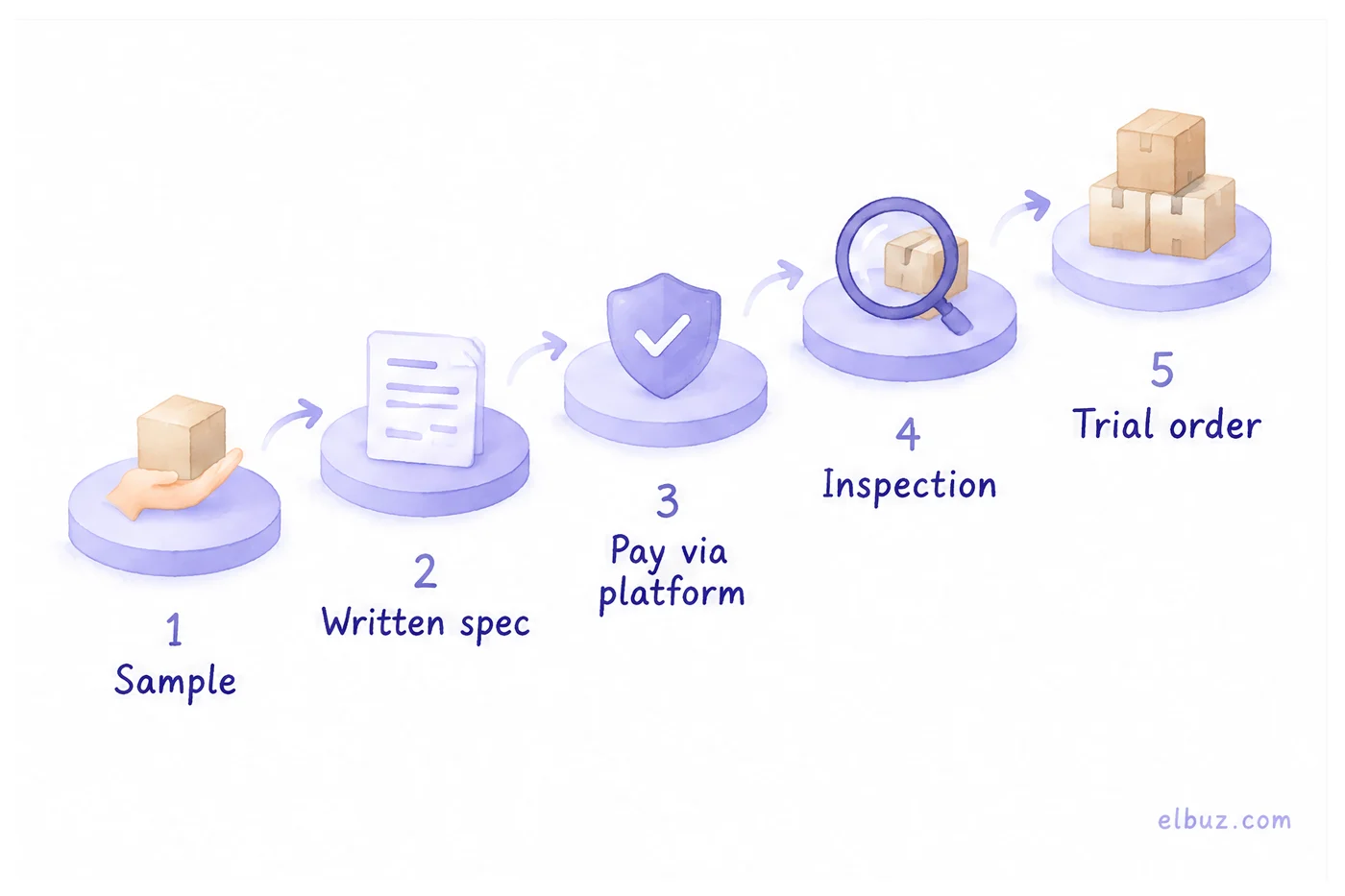
- Sample. Order a sample before the batch and compare it with the listing: material, weight, packaging, labels. Red flag: the seller refuses a sample or asks you to pay for it outside the platform.
- Written specification. Dimensions, material, colour, contents, packaging, shipping date — in the order or in messages on the platform. Without it you have nothing to win a quality dispute with.
- Payment through the platform. On Alibaba.com, Trade Assurance gives you a refund or a dispute if the seller does not ship on time or the quality does not match what was agreed. It covers orders placed through Trade Assurance; paying straight to the seller's bank account gives no such protection.
- Inspection before shipping. For a large batch, order an inspection at the seller's warehouse: photos, count, a check of a random sample. A defect found in Europe or the US is far more expensive to send back than one found before departure.
- Trial order. Keep the first batch small and recalculate the real landed cost from it: actual invoices for freight, duty and the broker often differ from your estimate.
How to turn a yuan price list into website prices
Website price = price-list price × exchange rate × cost factor + markup, then rounded. The cost factor is landed cost divided by "price × exchange rate": in the example, 9.00 ÷ 5.00 = 1.8.
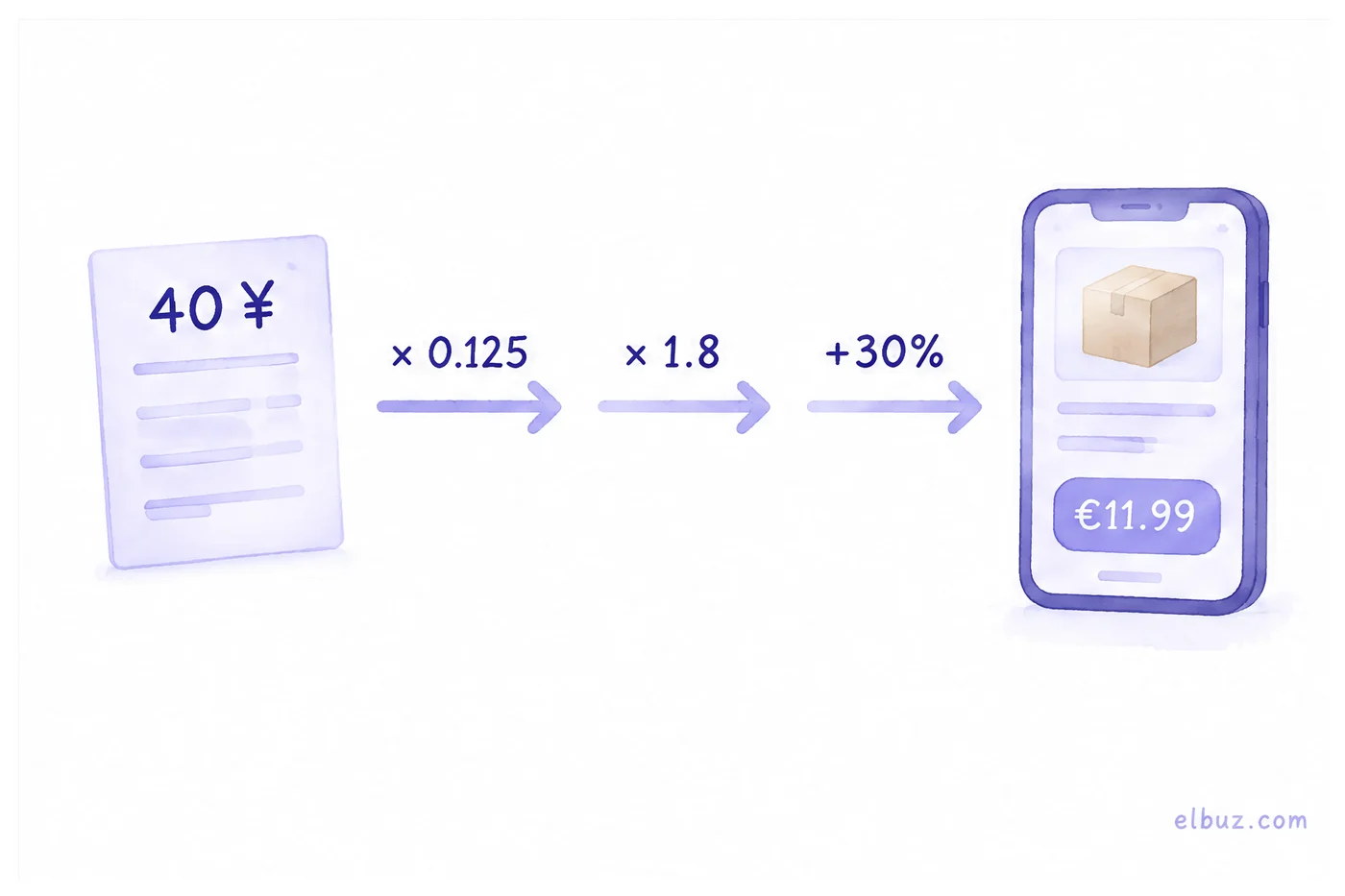
Continuing the illustrative example: 40 ¥ × 0.125 = €5.00, × 1.8 = €9.00 landed cost, + 30% markup = €11.70, rounded up to €11.99. If you are VAT-registered, start from the cost without import VAT and add sales VAT on top in the EU (in the US, sales tax is added at checkout). Recalculate the factor after each shipment from actual invoices, and the exchange rate on the day you update the price list.
While you have a few dozen products, a spreadsheet does the job. When the supplier sends a file with hundreds of rows, Chinese column names and several prices for different quantities, retyping it every time becomes the main source of pricing errors.
When to hand a Chinese supplier's price list to software
When the supplier sends price lists regularly and they have hundreds of rows. In Elbuz, a price list loads from a file, an email or a link; the program recognises the columns itself (AI handles unfamiliar ones), and you choose which of the prices to take. For a yuan price list you can set its own exchange rate, separate from the rate in your currency list, and put freight and duty into a markup rule — sale prices are then recalculated with every new file. How it works: supplier price list automation.
Who it does not fit: Elbuz does not calculate duty and VAT for you — you set the cost factor yourself from the invoices of the first shipment. And if you buy a few products in China once a season, the spreadsheet formula from this article is enough.
Supplier price lists in ElbuzAny currency, its own exchange rate, prices by rules, 14 days free
Frequently asked questions
How do I find a reliable supplier in China?
Start on Alibaba.com: shortlist a few sellers for your product, order samples and compare them, and pay for the first batch through Trade Assurance. 1688.com is cheaper, but ordering there is hard without an agent.
Alibaba or 1688: which is better?
It depends on your experience and volume. Alibaba.com is built for foreign buyers and has order protection; 1688.com is China's domestic wholesale market with prices in yuan, where you need an agent.
How much does it cost to import from China?
It depends on the product code, the route and the destination. Add freight, duty, import VAT (in the EU) and broker fees to the price; in the illustrative example a €5 product costs €9 landed — see the calculation.
Do I have to pay tariffs if I order something from China?
Yes, in most cases. In the EU, parcels up to €150 pay a temporary €3 duty per item from 1 July 2026, and commercial shipments pay the TARIC rate plus import VAT. In the US, the $800 de minimis exemption is suspended, so duty applies to low-value shipments too.
Do I need a license to import from China?
For most goods, no. In the EU you need an EORI number; in the US, commercial shipments above $2,500 need a formal entry, usually filed by a licensed customs broker. Some products, such as electronics, cosmetics or toys, must also meet safety and labelling rules.
How much does shipping from China cost?
There is no single price: sea freight is the slowest and cheapest, air is faster and more expensive. Get a quote from a forwarder for your weight and volume, and put it into landed cost together with duty and VAT, as in the calculation.
Sources
- Union Customs Code, Regulation (EU) No 952/2013, Art. 70–71 (customs value, transport and insurance to the place of entry) — eur-lex.europa.eu.
- VAT Directive 2006/112/EC, Art. 85–86 (taxable amount on importation) — eur-lex.europa.eu.
- European Commission, temporary €3 customs duty per item on low-value imports from 1 July 2026 until 1 July 2028, Council Regulation (EU) 2026/382 (published 8 June 2026, updated 20 July 2026) — taxation-customs.ec.europa.eu.
- TARIC, EU duty rates by product code — ec.europa.eu.
- CBP, E-Commerce FAQ: suspension of the de minimis exemption for all countries and modes — cbp.gov; interim final rule of June 24, 2026 — federalregister.gov.
- 19 CFR 152.103, transaction value — ecfr.gov.
- Harmonized Tariff Schedule of the United States — hts.usitc.gov.
- Alibaba.com, Trade Assurance: refund or dispute if the seller does not ship on time or quality does not match — alibaba.com.
- Alibaba Group on 1688.com, China's domestic wholesale marketplace — alibabagroup.com.
Checked on October 31, 2026.


