

There are three ways to get products into WooCommerce: the built-in CSV import, an import plugin that runs on a schedule, or external software with a product scraper that collects products from supplier price lists and websites. The choice depends on what your supplier gives you: a ready CSV — the built-in import is enough; their own file that changes daily — a plugin or software; only a website with no file — a scraper.
The usual mistake is choosing a tool before looking at the sources: a plugin gets installed, and then half of the suppliers turn out to have no files at all. Below: a "what you have → how to import it" table, how the standard CSV import works with a sample file for a variable product, where it stops coping, and what a scraper does.
When store owners look for a WooCommerce product scraper
Usually a WooCommerce store is already running, and products are added by hand or with a one-off import. Then a new supplier with thousands of items comes along, and the searches begin: "WooCommerce CSV import", "WooCommerce product import CSV template", "how to import variable products", "WooCommerce product scraper".
"Which scraper is best" is premature here. First look at what each supplier actually gives you — that decides whether you need a scraper at all.
Three ways to import products into WooCommerce
Pick the method by the data source and how often it changes:
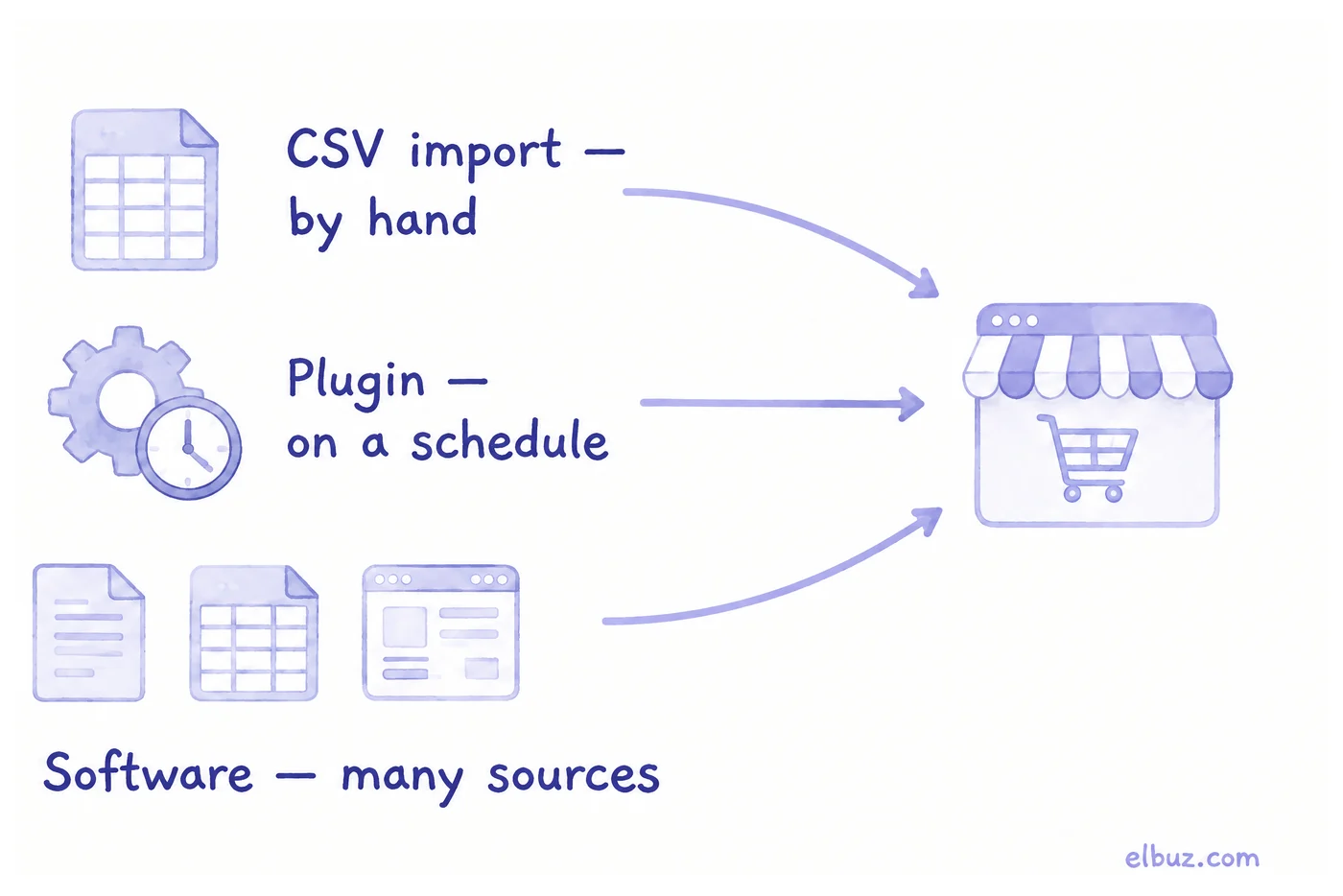
| What the supplier gives you | How often it changes | Method |
|---|---|---|
| A CSV in WooCommerce format, or a file you prepare yourself | Rarely | Built-in CSV import |
| Their own XML, CSV or Excel file with their own columns | Daily | Scheduled import plugin or external software |
| Several suppliers, the same product in different price lists, a price with your markup | Daily | External software that merges price lists and calculates the price |
| No file, products only on the website | Any | Product scraper |
Illustrative example: a store has three suppliers. The first sends a CSV of 300 products once a month — the built-in import handles it. The second provides an XML feed of 2,000 products with prices and stock that change daily — this needs a schedule. The third has 800 products only on its website — without a scraper they would have to be copied by hand. One tool for all three makes sense when the second and third have to go into one catalog with the same pricing rules.
The built-in WooCommerce CSV import
WooCommerce has its own product CSV importer and exporter (WooCommerce documentation). The Import and Export buttons are at the top of Products → All Products, next to Add new product.
- Prepare the file in UTF-8, with a header row and a comma as the separator. The easiest way to get the right template is to export a few existing products and fill in your file with the same columns.
- Back up the store before the first large import; WooCommerce recommends testing a small import on a staging site.
- Products → All Products → Import, choose the file. To update existing products instead of creating duplicates, tick the option to update existing products: WooCommerce matches rows by ID or SKU.
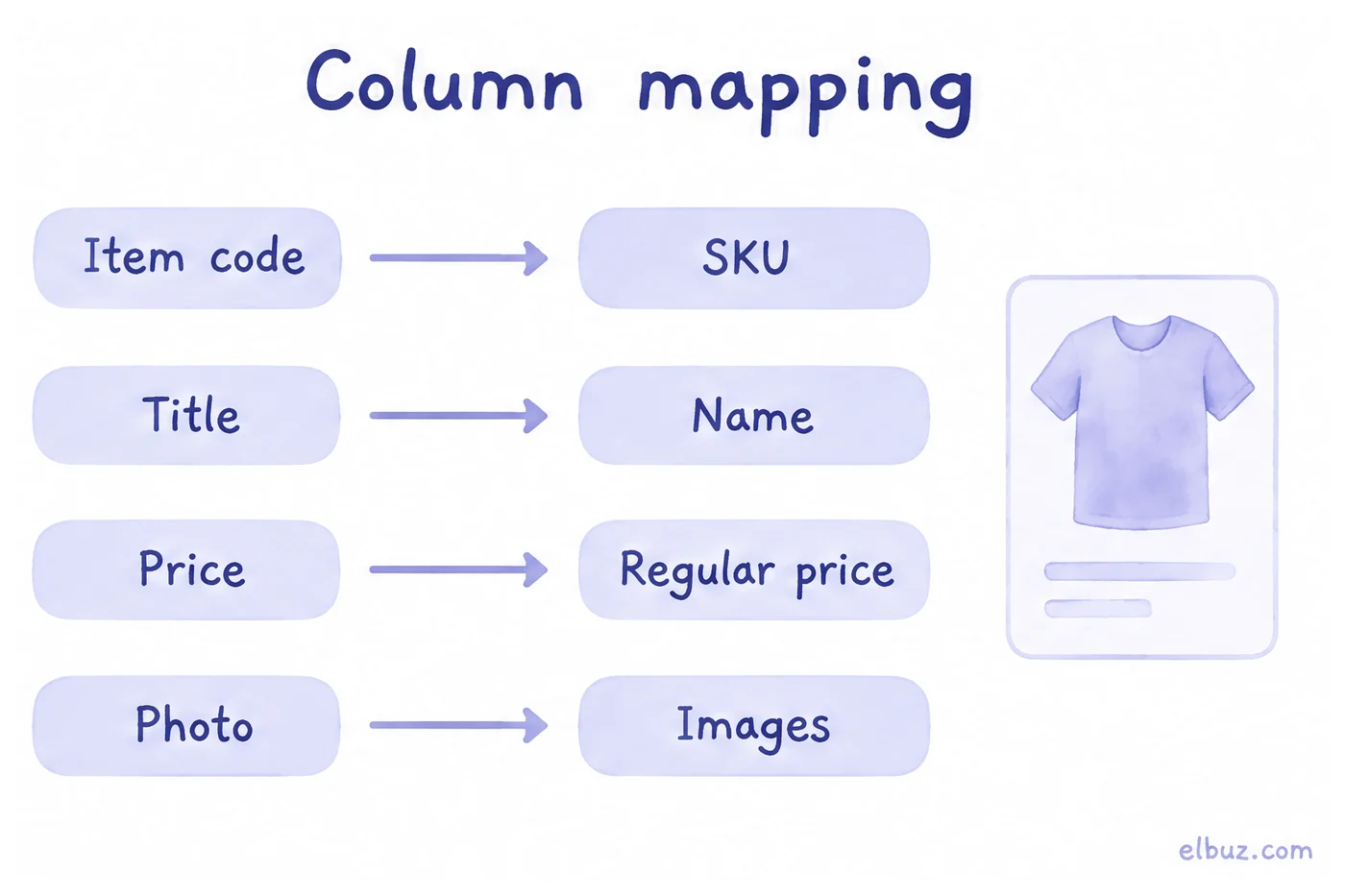
- Map the columns of the file to product fields. Columns named as in the WooCommerce export are mapped automatically.
- Check the result on 5–10 products: how many were created, updated and skipped, and whether images, categories and variations are in place. Only then import the whole file; WooCommerce advises splitting a large catalog into smaller batches.
Main CSV columns
| Column | What to enter |
|---|---|
| Type | simple — a simple product, variable — a product with variations, variation — the variation itself |
| SKU | Your item code; a repeat import updates the product by it |
| Name, Description, Short description | Name, full and short description |
| Regular price, Sale price | Regular and sale price, with a dot as the decimal separator |
| Stock, In stock? | Quantity and stock status |
| Categories | Levels separated with >: Clothing > T-shirts; several categories separated with commas |
| Images | Image URLs separated with commas; the first one becomes the featured image. Images must already be uploaded or available online |
| Parent | For a variation, the SKU or ID of the parent product (an ID with the id: prefix) |
| Attribute 1 name, Attribute 1 value(s) | Attribute name and values: on the parent product all of them, comma-separated; on a variation one |
How to import variable products with a CSV
The parent product is a row with type variable and all attribute values; each variation is a separate row with type variation, the parent's SKU in the Parent column and one value.
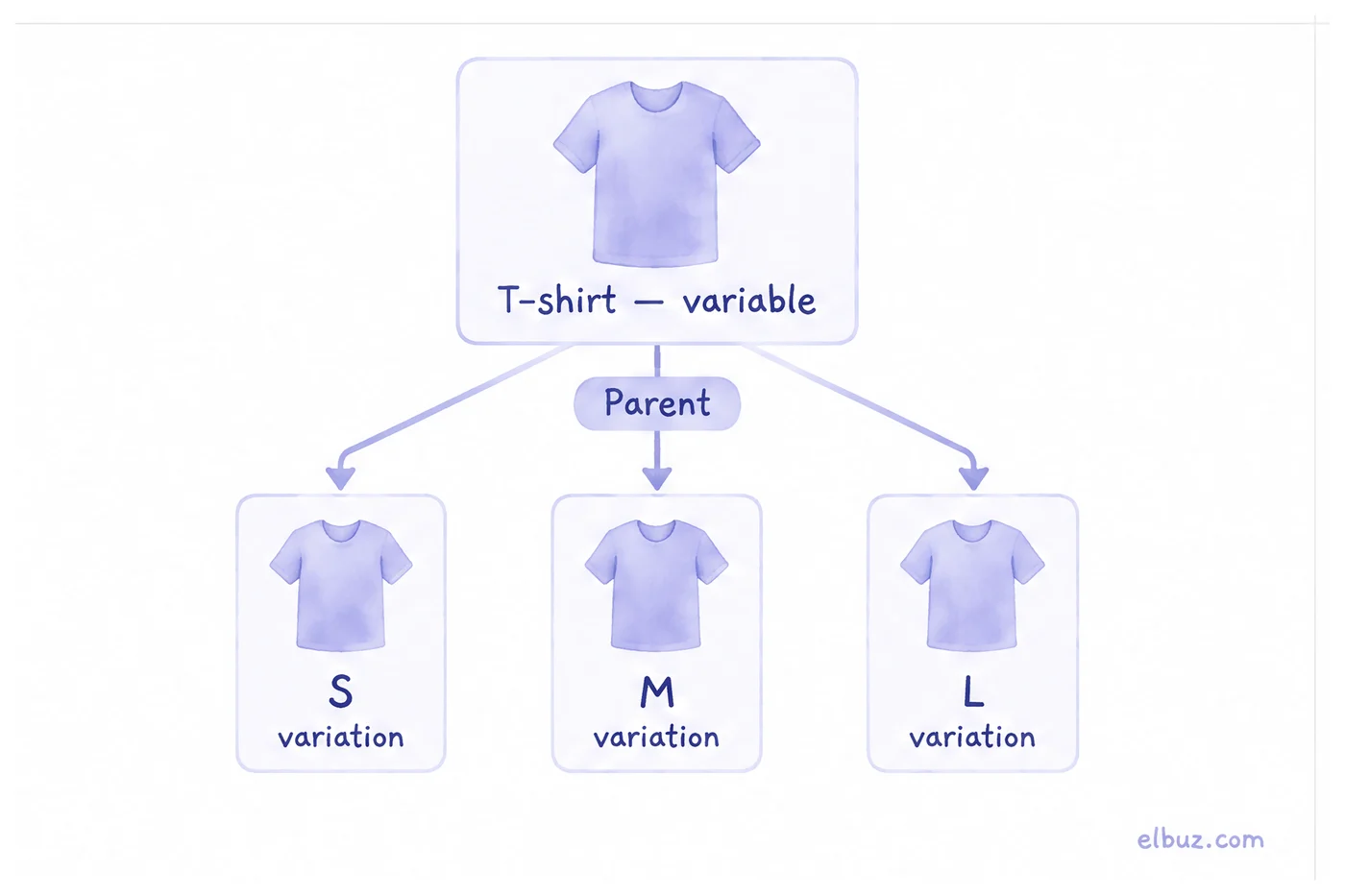
| Type | SKU | Name | Parent | Regular price | Attribute 1 name | Attribute 1 value(s) |
|---|---|---|---|---|---|---|
| variable | TS-01 | Basic T-shirt | Size | S, M, L | ||
| variation | TS-01-S | TS-01 | 19.00 | Size | S | |
| variation | TS-01-M | TS-01 | 19.00 | Size | M | |
| variation | TS-01-L | TS-01 | 21.00 | Size | L |
Two rules that break variation imports: the parent row has to be in the file or already in the store, and a variation's attribute value has to be among the parent's values. Otherwise the variation is skipped.
Common CSV import mistakes
- Encoding. A file saved from Excel in a non-UTF-8 encoding turns accented letters into garbage. Save it as "CSV UTF-8".
- Separator. Excel with regional settings that use a comma for decimals saves CSV with semicolons. Open the file in a text editor before importing.
- Duplicates. Without SKUs and without the update option, a repeat import creates the products a second time.
- Images. Image URLs have to open from the internet; a site that blocks downloads from other servers gives you products without images.
- Large files. The import breaks off on hosting limits — split the file into batches.
When the CSV import is not enough
The built-in import works well when you prepare the file yourself, and rarely. It does not cope when someone else prepares the file, every day:
- the supplier sends XML or Excel with their own columns, and it has to be reworked into WooCommerce format every time;
- the same product is in two price lists at different prices, and you have to choose whom to buy from;
- the purchase price comes in another currency, and the selling price has to be calculated with your markup;
- a product that disappeared from the price list has to go out of stock on the site, not keep selling;
- the supplier has no file at all — products, images and specs exist only on their website.
The first four cases are a job for a scheduled plugin or external software. A plugin runs on your hosting and loads it, and each supplier in it is a separate setup. The last case is a job for a scraper.
What a product scraper is and what it collects
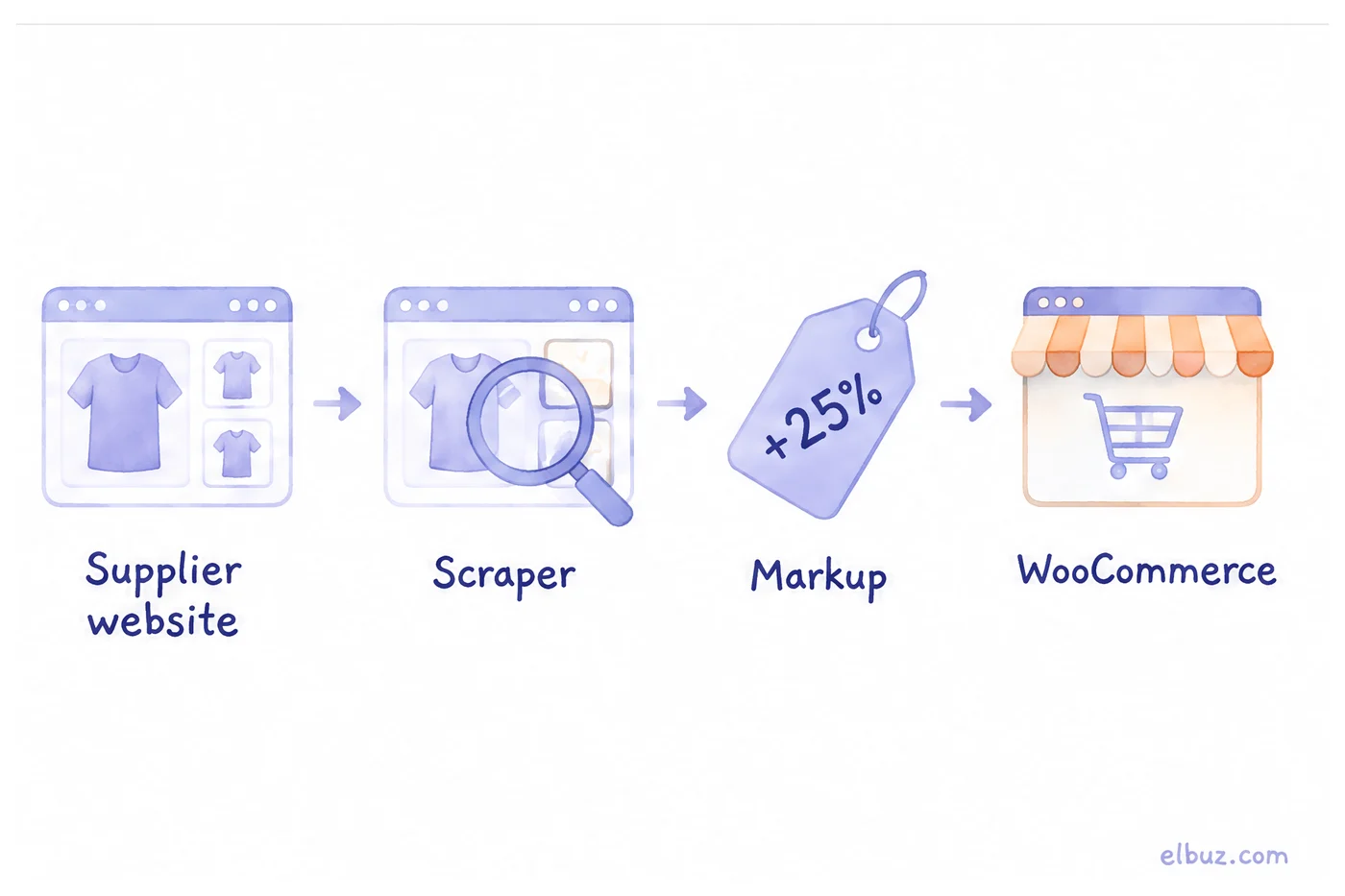
A product scraper is a program that opens the pages of a supplier's, marketplace's or manufacturer's website and takes data from them: name, SKU, price, availability, images, description and specs. For WooCommerce it covers the "products only on the website" case: what it collects becomes a price list, from which the price is calculated and the store is filled.
Before choosing a scraper, check three things:
- Where the data goes. A file you still have to import, or straight into a price list with your pricing rules.
- Whether it runs on a schedule without you. Prices and stock on a supplier's site change daily; a one-off scrape is out of date within a week.
- What happens when the site changes. Site layouts change, and the scraping rules will need fixing — by you or by a contractor.
Descriptions and images from someone else's site are someone else's content: agree with the supplier before you take them. Besides, the same description is already on dozens of sites, so for search it is better to write your own.
When there are several suppliers and some have no files
Then it is easier to collect everything in one place and send a ready catalog to WooCommerce. In Elbuz the universal scraper collects products from any website: enter the address, and the system looks for the sitemap and suggests parsing rules; the first run collects 300 products to check them, and after that collection runs on a schedule on the server. The result goes into the source price list next to other suppliers' files, your markup and stock rules apply to it, and products, prices and stock go to WooCommerce through the Elbuz Tunnel module on your hosting or as a feed. How it works — on the ecommerce scraper page; how the price is built from the purchase price — markup and pricing rules.
Who it is not for: if you have one supplier who sends a CSV in WooCommerce format, the built-in import is enough — separate software would be overkill.
Frequently asked questions
How do I import a CSV file into WooCommerce?
Go to Products → All Products → Import, choose a UTF-8 CSV, map the columns to product fields and run the import. Small batches first: check 5–10 products before the whole file.
Can you update existing products with an import in WooCommerce?
Yes. Tick the option to update existing products on the import screen: WooCommerce matches rows by ID or SKU and updates them instead of creating duplicates.
Where can I find a demo product CSV file for WooCommerce?
Export a few of your own products through Products → All Products → Export and fill in the file with the same columns. A sample file is in the sample-data folder of the WooCommerce repository on GitHub.
How do I import variable products with a CSV?
The parent product is a row with type variable and all attribute values separated by commas. Each variation is a separate row with type variation, the parent's SKU in the Parent column and one value; see the sample file above.
What is the difference between a scraper and a CSV import?
A CSV import loads a file that already exists. A scraper collects the data from website pages itself when there is no file, and can do it on a schedule.
How can I update prices and stock in WooCommerce automatically?
With a scheduled import plugin or external software that picks up supplier price lists, calculates the price by your rules and writes prices and stock to the store itself.
Sources
- WooCommerce, Product CSV Importer and Exporter — woocommerce.com.
- WooCommerce, Product CSV Import Schema — github.com/woocommerce.
Checked on October 31, 2026.


