

Wholesale suppliers for an online store are found through manufacturers, importers and distributors, wholesalers and B2B marketplaces, and trade shows. Choose them not by the price list but by two numbers: the landed cost of one unit in your warehouse, shipping included, and how much cash the minimum order ties up. Before the first large purchase, check the company in a business registry and place a trial order.
The usual mistake is taking the lowest unit price together with a large minimum order quantity (MOQ) and locking up for half a year the money that was meant for advertising. Below: where to look for wholesalers, a calculation of two offers on one product, checks before paying, and what to put in the supply contract.
When stores look for a wholesale supplier
Usually the store already sells: through dropshipping or made-to-order, and on best-sellers the dropship price eats the margin. Or someone is opening a store and wants to buy cheaper from day one. The first searches are "wholesale suppliers for online store", "how to find wholesale suppliers" and "wholesale suppliers for small business". Then come "how to vet a supplier", "distributor vs wholesaler" and "minimum order quantity".
"Who is cheapest" is the wrong question here. A better one: what will the product cost in your warehouse, and how many months will it take to sell the minimum order? That decides whether there is money left for everything else.
Where to find wholesale suppliers
In four places, and the closer the source is to the manufacturer, the lower the price and the larger the minimum order. A new store usually fits distributors and wholesalers; a manufacturer — once sales of the product are steady.
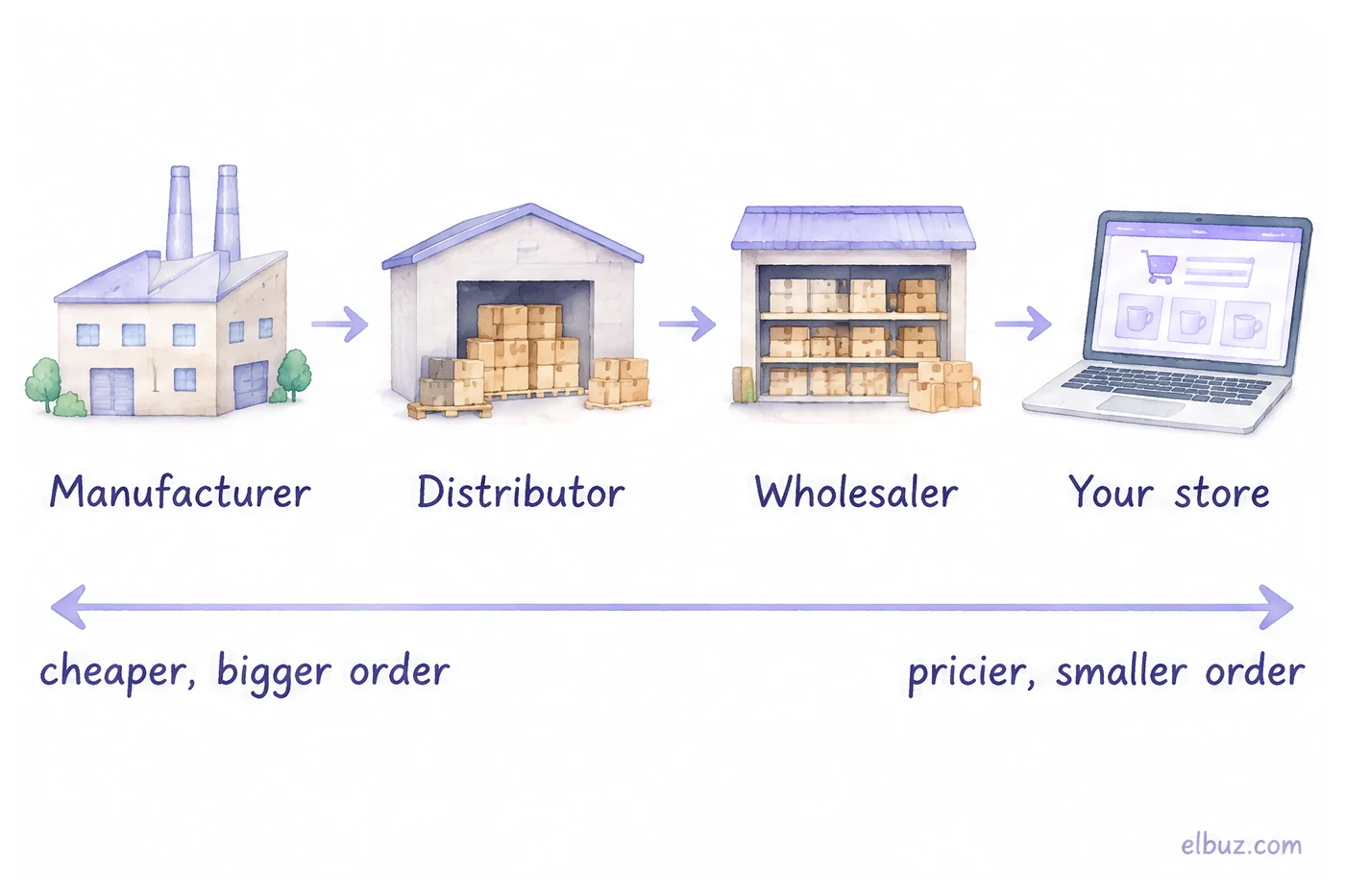
| Source | Price | Minimum order | Who it fits |
|---|---|---|---|
| Manufacturer | Lowest | Large, often paid upfront | A store with steady sales of the product, or a private label |
| Importer, distributor | Higher than the manufacturer | Medium, payment terms are possible | A store that sells brands and wants a wide range from one supplier |
| Wholesaler, B2B marketplace seller | Higher still | Small, sometimes a few units | Starting out and testing new products |
| Overseas supplier | Low at the factory, but freight, customs duty and import taxes come on top | Large | A store ready for long lead times and customs clearance |
Where to find contacts:
- Google. Search "[product] wholesale" or "[brand] authorized distributor". Manufacturer websites often have a "Wholesale", "Dealers" or "Become a retailer" page with terms.
- B2B marketplaces and directories. Alibaba and Global Sources for overseas manufacturers, Faire for independent brands with low minimums; the listing shows the minimum order.
- Trade shows. In one day you can talk to a dozen suppliers and see the product in person.
- Packaging and labels. A product that already sells well elsewhere names its manufacturer or importer — a starting point for the search.
A broader overview of supplier types, including dropshipping, is in how to find suppliers for an online store.
How to compare supplier prices
Compare the landed cost of one unit in your warehouse, not the price list. Shipping of the order from the supplier is added to the price, and for imports — customs duty and import taxes.
Landed cost per unit = (unit price × quantity + shipping of the order + other costs of the order) / quantity
Illustrative example for the arithmetic, not market prices. Two suppliers offer the same product. Supplier A: €40 per unit, minimum order 100 units, shipping at your expense €300, 100% prepayment. Supplier B: €45 per unit, minimum order 20 units, free shipping, payment 14 days after dispatch.
At A, the landed cost is (40 × 100 + 300) / 100 = €43; at B — €45. The price list difference is €5, in the warehouse only €2. A saves 2 × 100 = €200 on the order.
How much cash the first order ties up
As much as the minimum order costs, for as many months as it takes you to sell it. A lower price with a large order only pays off when you already know how the product sells.
Continuing the example: the store sells 20 units of this product a month.
| Supplier A | Supplier B | |
|---|---|---|
| Landed cost per unit | €43 | €45 |
| Minimum order | 100 units | 20 units |
| You pay | €4,300 upfront | €900 after 14 days |
| The order lasts at 20 units a month | 5 months | 1 month |
| Saving over 5 months | €200 | — |
| If it sells 5 units a month: tied up after month one | 95 × 43 = €4,085 | 15 × 45 = €675 |
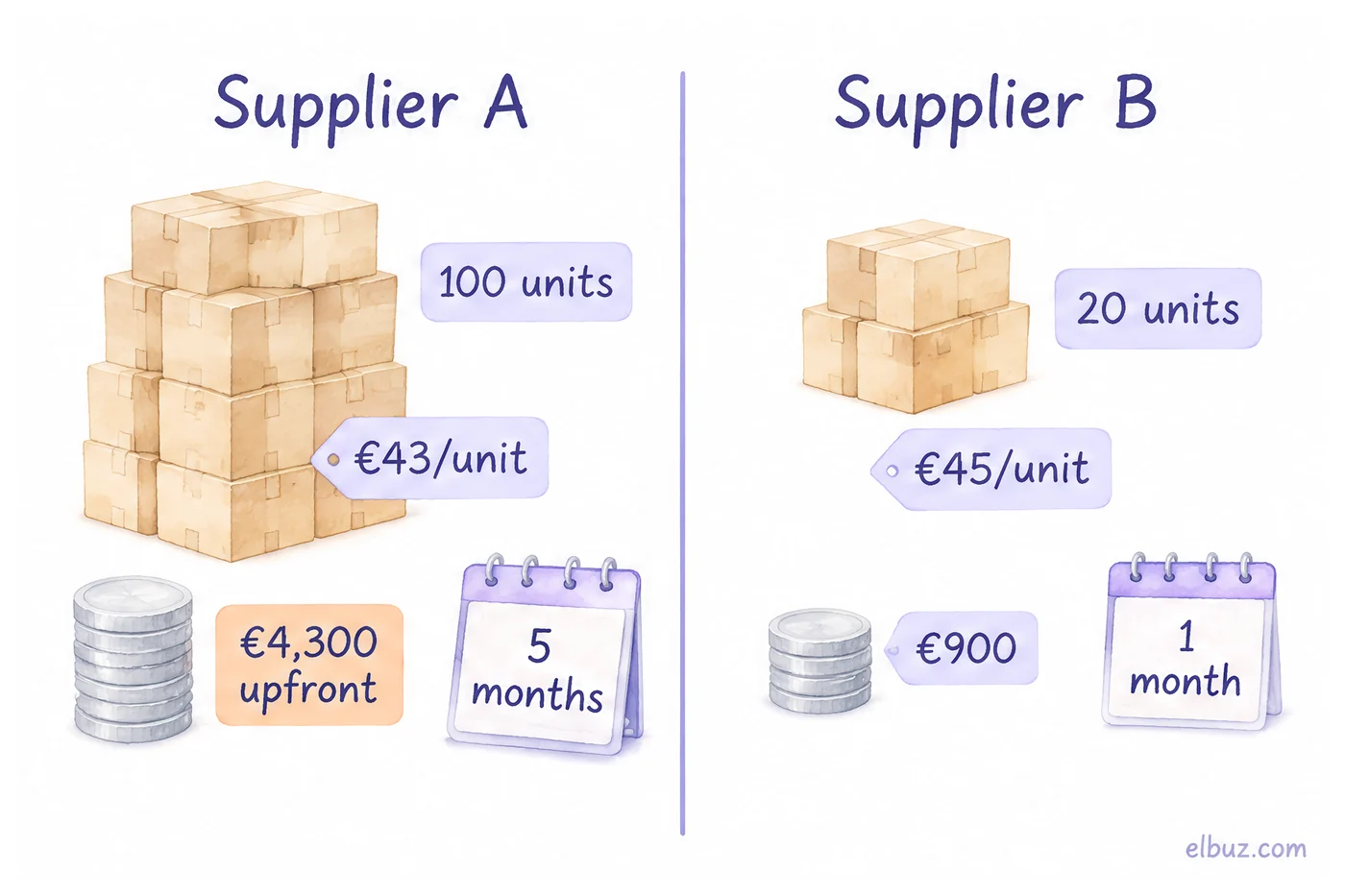
Over five months A saves €200, but all that time €4,300 sits in stock — money B lets you keep in advertising or other products. And if the product sells worse than expected, A ties up six times more cash.
A rule for starting out: buy a new product from a supplier with a small minimum order, even at a higher price. When sales have been steady for two or three months, move to the lower price with a larger order, and size the order by sales: no more than you sell in the time you are willing to tie the money up. How a difference in landed cost shows up in your margin — in gross margin vs markup.
How to vet a wholesale supplier before the first payment
Check five things: registration, documents, defect terms, the price list and a trial order. It takes a day or two; a mistake costs the whole prepayment.
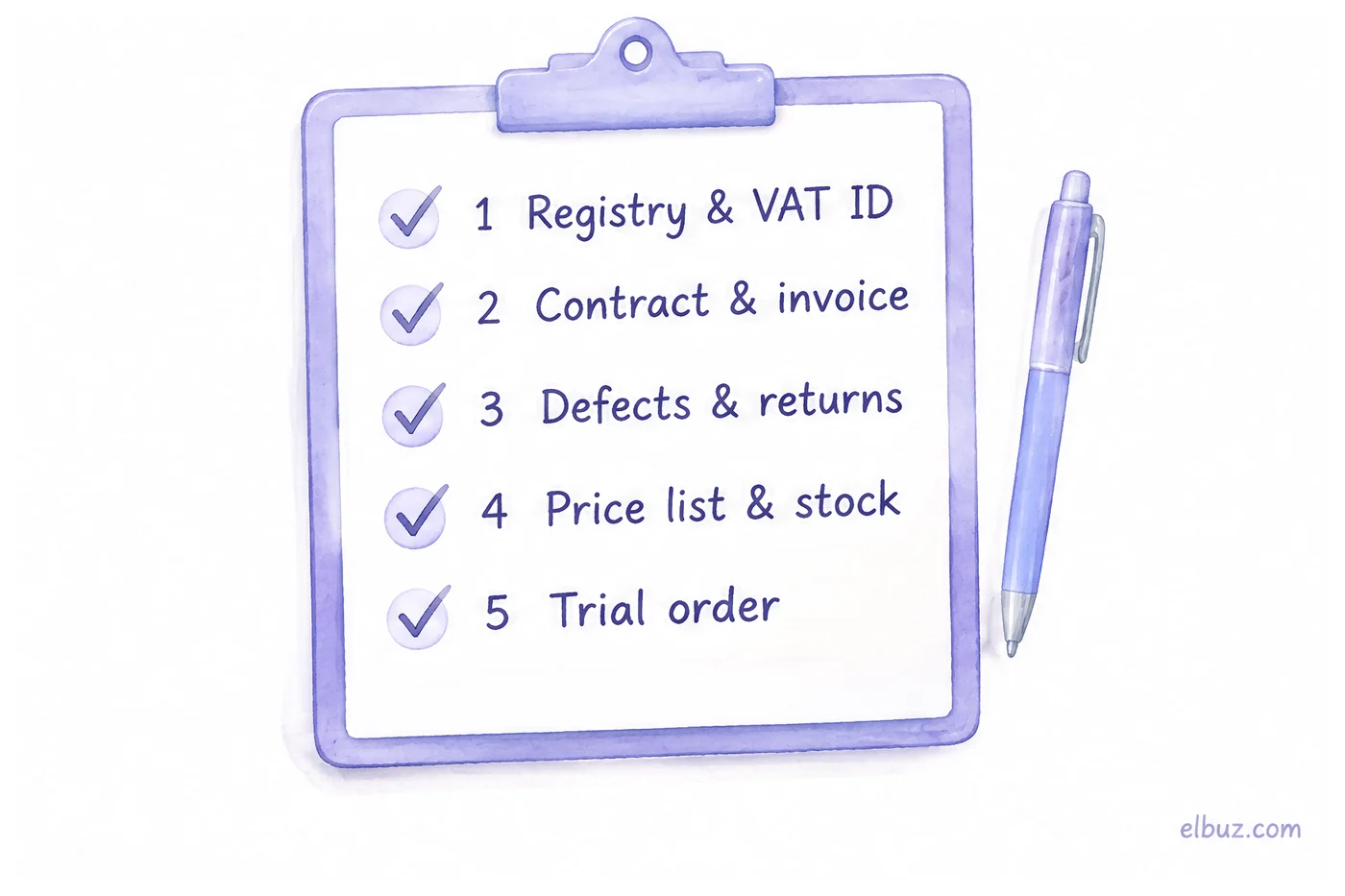
- Registry and VAT ID. For an EU supplier, check the VAT number in the European Commission's VIES service; for a US supplier, look the company up in the business entity search of its state. Check that the company is active, how long it has existed and that the name matches the invoice. A warning sign: the seller will not give a company number or the name differs from the one on the invoice.
- Contract and invoice. A wholesale purchase for resale needs a written supply agreement or at least a signed order confirmation, and the goods come with an invoice and a packing list. Without them you have no proof of cost and nothing to claim against for defects.
- Defects and returns. Ask who pays for returning defective goods, how many days after delivery you can report a defect, and whether they replace the item or refund. Some products need compliance documents, such as the CE marking in the EU — ask whether the supplier has them.
- Price list and stock. In what format the price list comes (Excel, CSV, XML, a link, an API), how often it updates and whether it includes stock. This decides whether your storefront shows current prices.
- Trial order. Make the first order the minimum, even if the unit price is higher.
Warning signs together: a price well below everyone else's; payment only as full prepayment to a personal account; no contract and no invoice; pressure to hurry ("the price is valid until tonight").
Trial order: what to measure
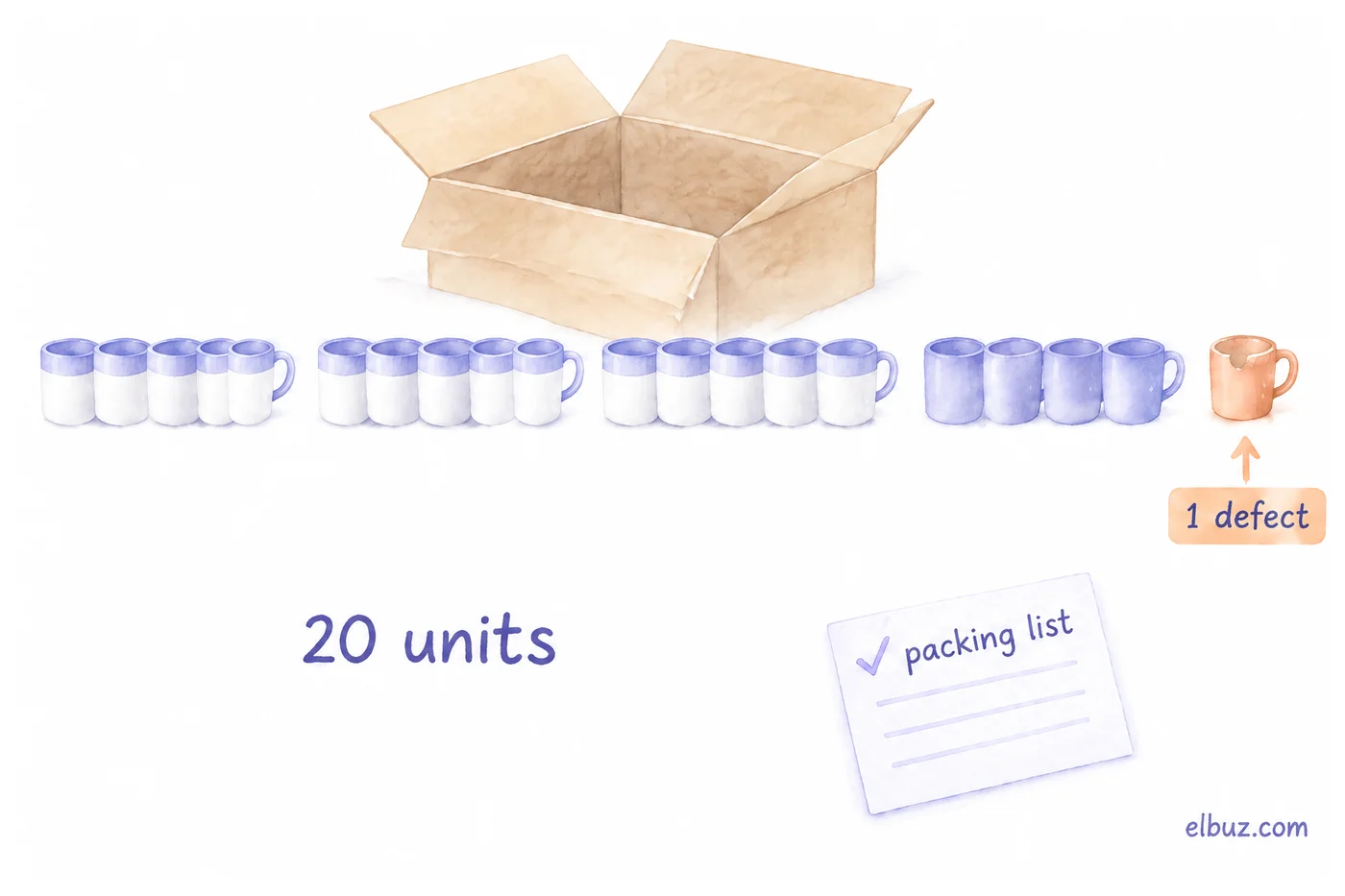
A trial order shows how the supplier actually works, not how they promise to. When it arrives, write down:
- Lead time. How many days passed from payment to dispatch and to delivery.
- Accuracy. Whether quantities, SKUs and contents match the packing list and the price list.
- Defects. How many units are defective and how the supplier responds to the claim: one defective item out of twenty is not a reason to walk away, a slow answer to the claim is.
- Packaging. Whether the product reaches the customer in your parcel without repacking.
- Documents. Whether the invoice and other promised documents arrived.
Compare these notes across several candidates: how to put prices, terms and reliability in one table — in comparing suppliers by price, terms and reliability.
What to agree on in the supply contract
In the US, a sale of goods between businesses falls under Article 2 of the Uniform Commercial Code as adopted by each state, and a contract for goods of $500 or more generally needs a signed writing to be enforceable. For cross-border purchases between businesses in countries that joined the UN Convention on Contracts for the International Sale of Goods (CISG), it applies unless the contract excludes it. Either way, write down everything that affects your cost and risk:
| Term | What to write |
|---|---|
| Price | Per the price list on the order date or fixed; how it changes with the exchange rate |
| Discounts | By order size or by monthly turnover |
| Minimum order | In units or by value |
| Payment | Prepayment, payment on dispatch or payment terms, in days |
| Lead time and shipping | How many days to dispatch, who pays for shipping and above what amount it is free; for imports — the Incoterms rule |
| Defects and returns | Claim period, who pays return shipping, replacement or refund |
| Documents | Invoice, packing list, compliance documents, warranty |
When you have several suppliers
When one product is in the price lists of two or three wholesalers and you have hundreds of products, comparing prices and stock in spreadsheets becomes daily work. That is exactly where money leaks: one supplier raised the price, another ran out, and the storefront still shows the old offer.
Elbuz loads all your suppliers' price lists on schedule and matches their products to your catalog. When a product is in several price lists, the app picks the price by your rule — minimum, average or maximum — and your main supplier or in-stock products can be preferred over a cheaper offer. How it works — on the supplier price list automation page.
Who it is not for: with one wholesaler and a few dozen products, the landed cost table from this article is enough.
Supplier price lists in ElbuzPrices and stock from all price lists in one catalog, 14 days free
Frequently asked questions
How do I find wholesale suppliers for an online store?
Look at manufacturers, distributors, wholesalers, B2B marketplaces and trade shows; in Google, search "[product] wholesale". Choose by landed cost per unit with shipping and by how much cash the minimum order ties up.
Distributor vs wholesaler: which is better?
It depends on your sales. A manufacturer or distributor gives a lower price but a larger order and more often asks for prepayment; a wholesaler costs more but ships smaller orders. Starting out, the smaller order usually wins.
How do I vet a wholesale supplier?
Check the company in VIES or the state business registry, ask for a contract and an invoice, agree on defects and returns, check the price list and place a trial order. The list is in the section on checks.
What is a minimum order quantity?
The smallest number of units or order value a supplier will accept. Start with the minimum, even at a higher unit price, and order more once sales are steady — no more than you sell in the time you are willing to tie the money up.
Do I need a contract with a wholesale supplier?
Yes. A written agreement fixes price, payment, lead times, defects and returns, and the invoice proves your cost. In the US, a sale of goods of $500 or more generally needs a signed writing to be enforceable.
Where can I get products for an online store without buying stock?
From dropshipping suppliers: they ship single items to your customers, and you pay after the sale at a higher dropship price.
Sources
- Uniform Commercial Code, Article 2 — § 2-102 Scope, § 2-201 Formal requirements; statute of frauds (Legal Information Institute, Cornell Law School).
- UN Convention on Contracts for the International Sale of Goods (CISG) — uncitral.un.org.
- European Commission, VAT number validation — VIES; duties and taxes on imports into the EU — Access2Markets.
- U.S. Customs and Border Protection — basic importing and exporting.
Checked on October 31, 2026.


