

STP marketing is a three-step model: Segmentation (split the market into groups with different needs), Targeting (choose the groups you serve) and Positioning (decide what your store should be for these people compared with the alternatives). The result of STP is one positioning statement, and your product range, prices, service and ad copy follow from it.
The usual mistake happens at the second step: the segment is chosen on gut feeling, or the store tries to serve everyone at once, and the positioning comes out generic, like "quality products at affordable prices". Below: how to compare segments with scores, how to write a positioning statement from a template, how to test it on a map of competitors, all on one illustrative coffee store.
When people look for STP marketing
A typical case: the store is growing, the range is getting wider, ads cost more, and the copy on the website reads like everyone else's. The owner or marketer searches for "stp marketing", "stp model" or "positioning strategy" and wants to know where to start. Students search for the same thing from the other side: how to lay out an STP analysis with an example.
The next questions are "what positioning strategies are there", "positioning statement vs value proposition" and "how to make a positioning map". The step people skip most often is choosing the segment, although without it the positioning has nobody to aim at.
The three steps of STP
Each step answers one question, and the order matters: positioning without a chosen segment speaks to everyone and promises nothing to anyone.
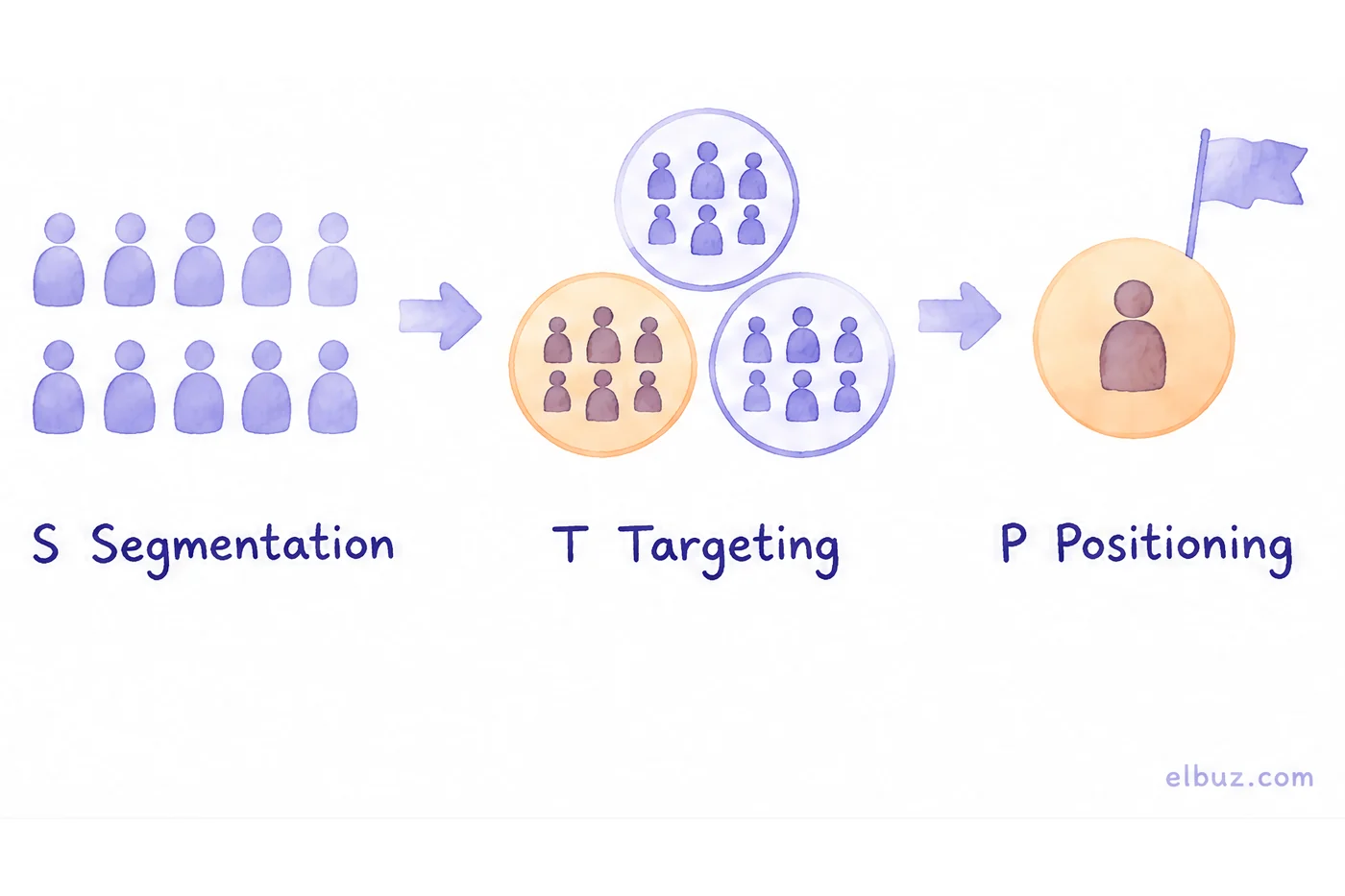
| Step | Question | Result |
|---|---|---|
| S — segmentation | Which groups of buyers are in the market, and how do their needs differ? | A list of segments with descriptions |
| T — targeting | Which segments do you serve, and which do you skip on purpose? | 1–2 chosen segments |
| P — positioning | Why should the chosen segment buy from you and not from an alternative? | A positioning statement and proof |
Segmentation: how to split the market
You split the market by traits that change how people buy. The classic groups are geographic, demographic, psychographic and behavioral. For an online store the most useful are behavioral: what people buy, how often, which channel they come from and what matters most to them.
| Type | Examples | Where you see it |
|---|---|---|
| Geographic | City, region, shipping country | Shipping address in the order |
| Demographic | Consumer or business, income level | Customer type, company details, average order value |
| Psychographic | Values, lifestyle, interests | Messages, reviews, topics of questions |
| Behavioral | Purchase frequency, occasion, channel, price sensitivity | Order history, order source, response to discounts |
How to find segments with five questions (what, who, why, when, where) and fill in the table is covered in the article on the 5W segmentation model. There, the illustrative coffee store ended up with three segments: "First espresso machine", "Beans every month" and "Gift". We continue with them.
Targeting: how to choose a segment with scores
Choose a segment by five criteria: size, margin, competition, access to a channel, and whether the store has the resources to serve it better than others. Score each criterion from 1 to 3 and add up the points: then the choice is visible on paper, not just in your head.
| Criterion | First espresso machine | Beans every month | Gift |
|---|---|---|---|
| Size | 3 | 2 | 2 |
| Margin | 1 | 3 | 2 |
| Competition (3 — weak) | 1 | 2 | 2 |
| Channel | 3 | 2 | 2 |
| Store resources | 2 | 3 | 1 |
| Total | 10 | 12 | 9 |
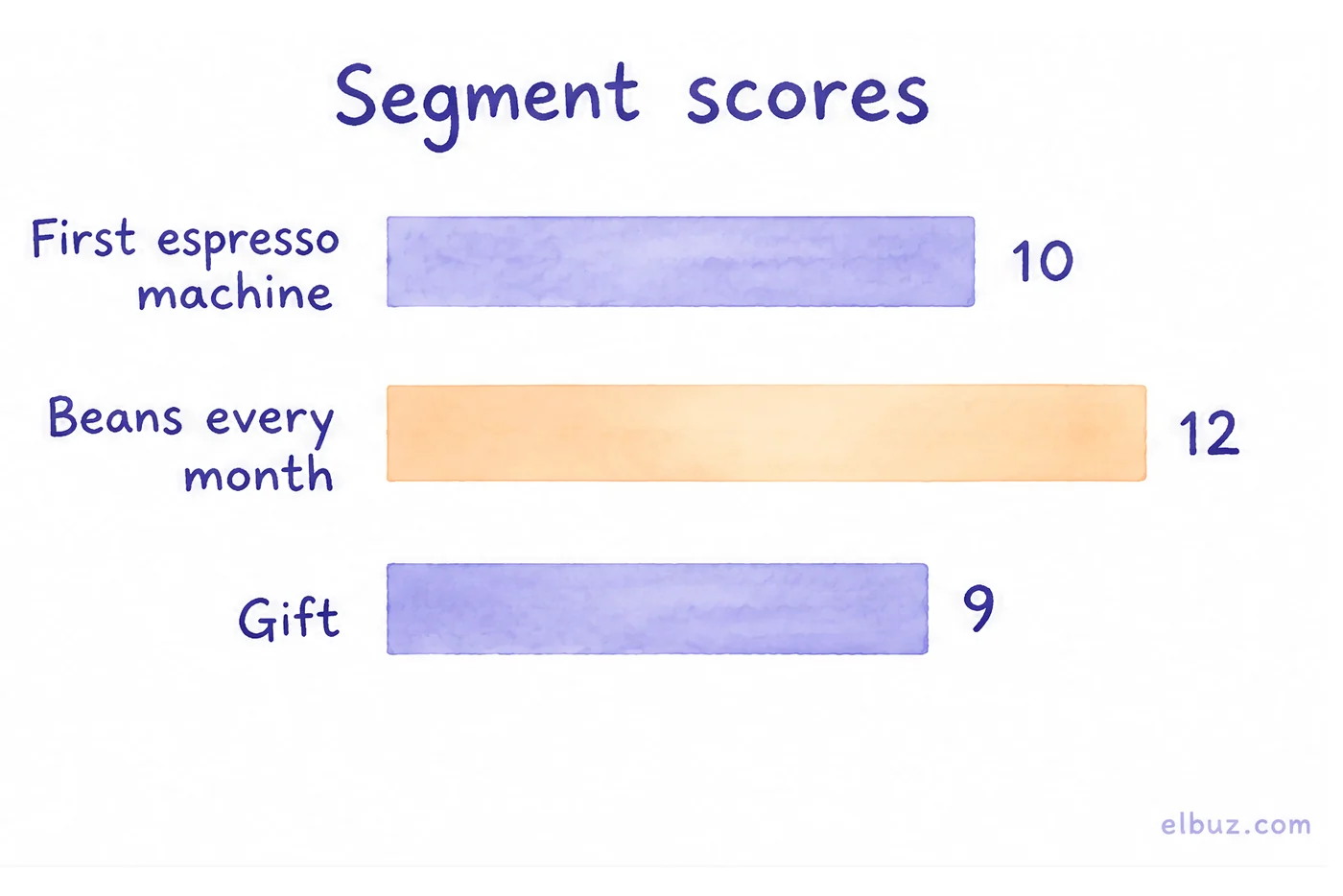
Illustrative example: the scores show the method, not an assessment of the coffee market. "First espresso machine" is the largest segment, but it is a one-time purchase of equipment where prices are easy to compare, so the margin is low and competition is strong. "Beans every month" is smaller, but it buys regularly and values freshness, which the store can deliver. We make it the main segment and keep "First espresso machine" as a secondary one: the first machine is where the path to regular beans starts.
You can weight the criteria: if the ad budget is small, multiply "Channel" by 2. The one rule is to score every segment the same way. Marketing textbooks also describe broad coverage strategies: one offer for the whole market (undifferentiated), separate offers for several segments (differentiated) or a focus on one segment (concentrated). A small store usually fits the last one: one main segment and one secondary.
Positioning: the template and an example
Positioning is the place your store takes in the mind of a buyer in the chosen segment, compared with the alternatives. You write it as one sentence using the template Geoffrey Moore proposed in "Crossing the Chasm":
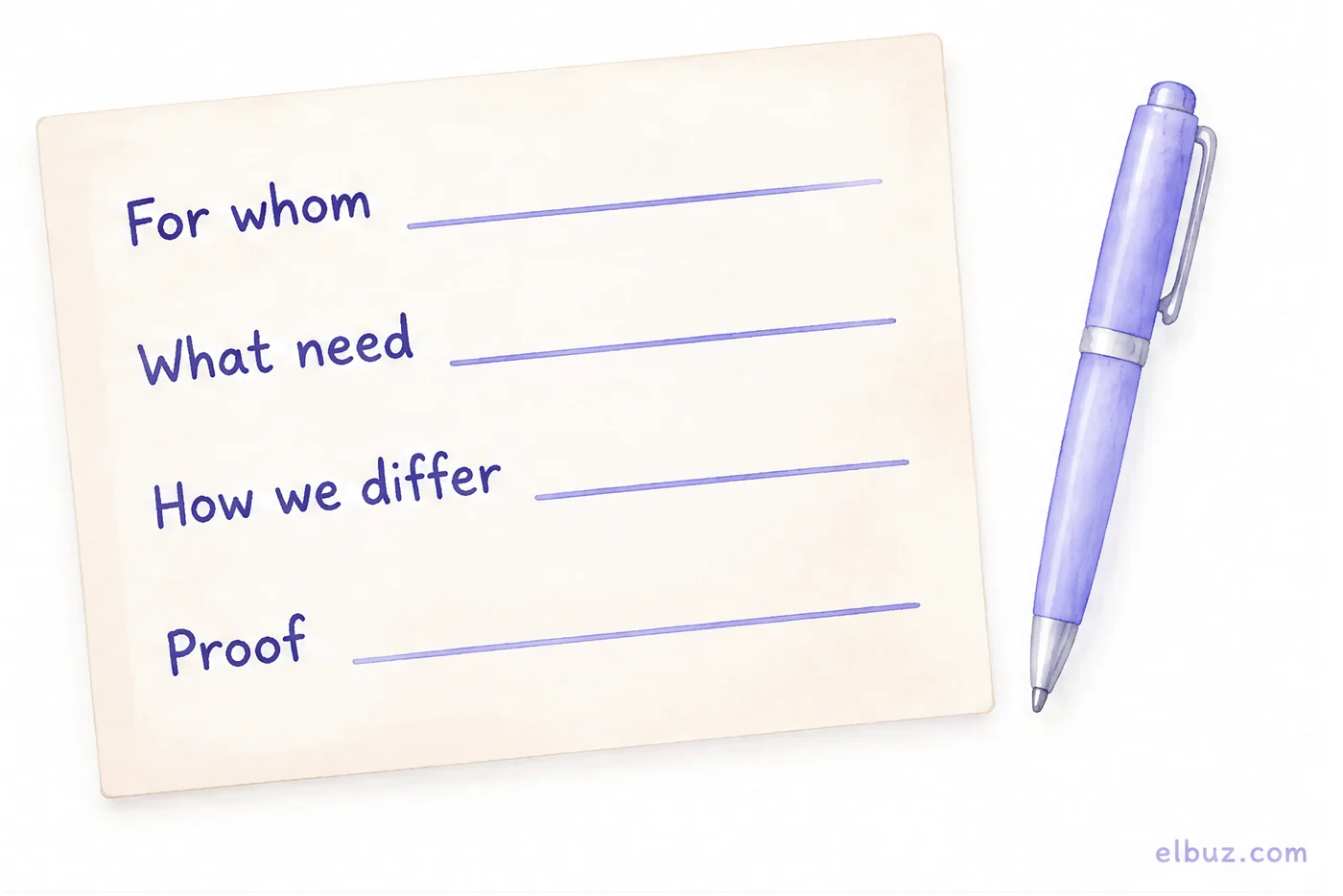
For the illustrative coffee store: "For people who drink whole-bean coffee at home every day, [store] is a roaster that delivers your coffee before the bag runs out. Unlike the supermarket, we roast every week and print the roast date on every bag."
A positioning statement is an internal document, not a banner slogan. Decisions follow from it: which products to stock (fresh beans, not everything), which service to build (reorder reminders, a subscription) and what to say on the first screen of the website.
An online store can usually position itself on one of five bases. Each one demands something different from operations, and choosing more than two at once rarely works.
| Basis | Promise to the buyer | What you have to keep up every day |
|---|---|---|
| Price | Cheaper than elsewhere | Low purchase prices, tracking competitor prices, cheap logistics |
| Specialization | Everything for one task or niche | A deep range in the niche, staff who know the products |
| Speed and convenience | You get it fast and without hassle | Accurate stock, same-day dispatch, easy returns |
| Advice | We help you choose right | Descriptions and comparisons, consultations, reviews |
| Wide choice | Everything in one place | A large catalog, updated supplier price lists, filters on the website |
Positioning is a choice, not a list of advantages. What exactly to differ in within the chosen basis, and how to prove it to the buyer, is covered in the article on product differentiation.
How to test positioning on a map
A positioning map (also called a perceptual map) puts two criteria that matter to the chosen segment on two axes and shows competitors as points. If your point sits in the same spot as several competitors, your positioning does not set you apart.
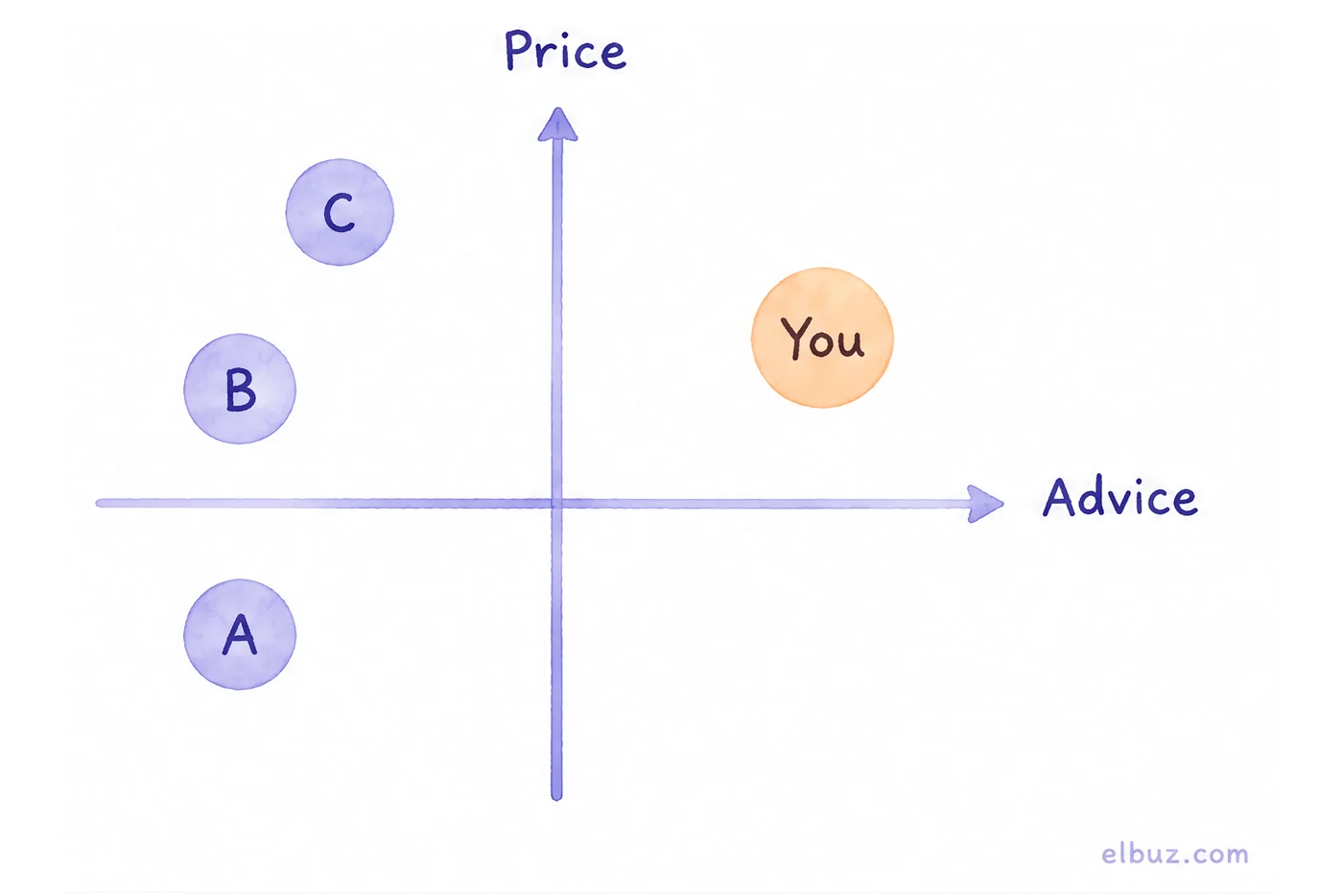
- Choose two axes that matter to the segment: for "Beans every month" these could be price and advice (help with choosing a roast and grind).
- Place 3–6 competitors where this segment actually buys, based on their prices, websites and service, not their ads.
- Find a free zone with demand. An empty spot on the map does not mean there are buyers there: check it against search queries and orders. Why buyers in a segment choose your competitors you can hear first-hand in customer discovery interviews.
- Test the statement: if you can put a competitor's name into it and it stays true, it is not positioning.
STP mistakes
- Positioning for everyone. "Quality products at affordable prices with fast shipping" is three bases in one sentence, and none of them is delivered better than by competitors.
- Choosing the segment by size. The largest segment is usually the most competitive; margin and store resources matter just as much.
- A promise without proof. "The freshest coffee" without a roast date reads as advertising.
- Positioning only on the website. If the support chat or a marketplace listing says something else, the buyer remembers neither.
- Confusing positioning with a value proposition. A value proposition (or USP) is a specific offer in an ad; positioning is the frame from which you can make several such offers.
When your position depends on competitor prices
If your basis is price, or you sell the same products as others, your position is set by the gap between your prices and competitors' prices. Checking it by hand across hundreds of products is impossible: prices in other stores change every day.
In Elbuz, competitor prices are collected from their websites and shown in the product record next to your cost and your selling price: you see where you are more expensive than the market and by how much. You can tie your price to competitor prices with a formula that has a floor such as "not below cost plus N%". Details are on the competitor price monitoring page.
Who does not need it: if you position on advice or on your own products that nobody else sells, price comparison tells you little about your position.
Competitor price monitoring in ElbuzOther stores' prices next to yours in the product record
Frequently asked questions
What is the STP model of marketing?
It is an order of decisions: first you split buyers into groups, then you choose which groups to serve, and finally you decide why you are better for them than the alternatives. The result is a positioning statement.
What does STP stand for?
Segmentation, Targeting and Positioning.
What are the main positioning strategies?
For an online store the most common are price, specialization, speed and convenience, advice, and wide choice. What each one demands every day is in the table of positioning bases.
What is the difference between a positioning statement and a value proposition?
A positioning statement is the overall frame: who the store is for and how it differs. A value proposition is a specific offer in an ad or on a page that follows from that frame.
How do you make a positioning map?
Choose two criteria that matter to the segment, turn them into axes and place the competitors where this segment buys. A free zone with demand is a candidate for your position.
Who created the STP model?
Its parts appeared at different times: market segmentation was described by Wendell Smith in 1956, positioning by Al Ries and Jack Trout. Marketing textbooks, above all Philip Kotler's, combined them into a single STP model.
Sources
- Smith W. R. Product Differentiation and Market Segmentation as Alternative Marketing Strategies. Journal of Marketing, 1956, vol. 21, no. 1 — doi.org.
- Ries A., Trout J. Positioning: The Battle for Your Mind. McGraw-Hill, 1981.
- Moore G. A. Crossing the Chasm. HarperBusiness, 1991 — the positioning statement template.
- Kotler P., Keller K. L. Marketing Management. Pearson — chapters on segmentation, target market selection and positioning.
Checked on October 31, 2026. The coffee store segments and scores are an illustrative example.


