

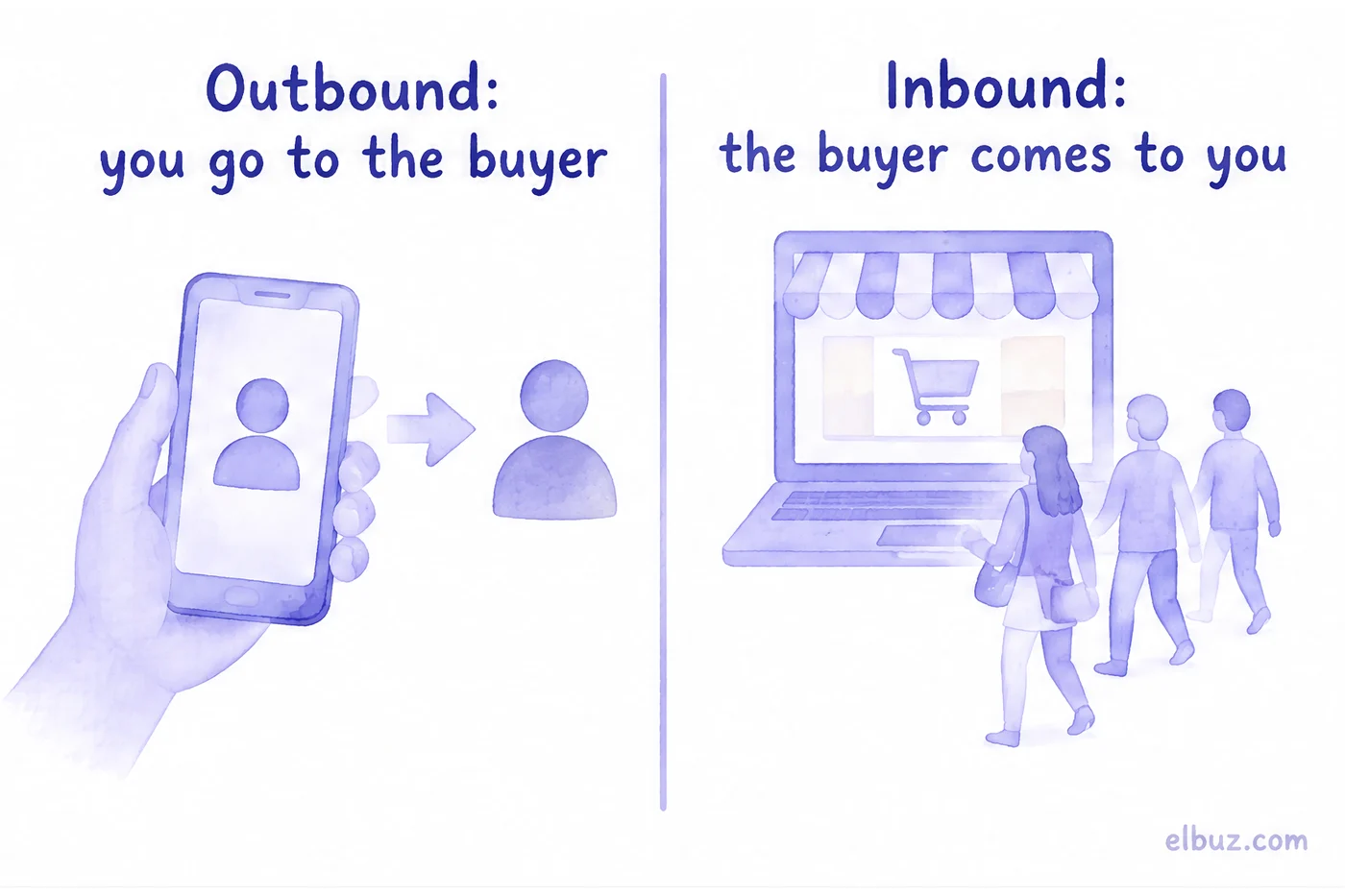
Outbound sales (also called active selling) means the seller starts the contact: calls, writes or offers a product to someone who was not looking for it. Inbound sales (passive selling) means the buyer comes on their own from search, ads or a marketplace, and the store responds. In an online store most orders are inbound; an outbound channel pays off when its cost per order is lower than the margin on that order.
The usual mistake is treating it as either-or: a store hires a rep to cold-call consumers about a cheap retail product, or does not even contact people who abandoned a cart. Below: a comparison table, examples of both kinds of sales in a store, a "which one when" table and the payback math on illustrative numbers.
When people look up inbound vs outbound sales
Usually when ads bring too few orders or get more expensive, and the owner wonders whether to hire someone who will look for buyers. The second common trigger is a job ad for an "outbound sales rep" and the wish to understand what that person does. People search for "inbound vs outbound sales", "what counts as outbound sales", "active selling".
"Which is better" is the wrong question here: an online store almost always uses both, and the difference is for which buyers and at what moment. The answer comes from the cost per order of each channel, calculated below.
The difference between inbound and outbound sales
The main difference is who takes the first step and what you pay for. In outbound sales the seller takes the first step, and you pay for their time. In inbound sales the buyer takes the first step, and you pay for being found: ads, marketplace commission, content.
| Factor | Outbound sales | Inbound sales |
|---|---|---|
| Who starts the contact | The seller | The buyer |
| Channels | Outgoing calls, emails and messages, visits, offers to existing customers | Search, ads, marketplaces, social media, incoming chats and calls |
| What you pay for | The rep's time: salary, telephony, contact data | Being found: ads, marketplace commission, SEO |
| Buyer readiness | Low or medium: interest has to be created | High: they are already looking for the product |
| Control over volume | More calls, more conversations; volume depends on the team | Depends on budget and demand, season, competitors |
| Load on the rep | High: rejections, call targets, objections | Lower: advice and checkout |
Neither term means "better" or "worse". Inbound does not mean the seller does nothing: replying within a minute, presenting the product for the buyer's task and suggesting an add-on is work too; the buyer just came on their own.
Examples of inbound and outbound sales in an online store
Inbound sales in a store are everything the buyer comes to by themselves:
- orders on the website after a search result or an ad;
- orders on a marketplace;
- incoming chat, messenger and social media messages, incoming calls;
- purchases straight from the product page without talking to anyone.
Outbound is when the store reaches out first:
- a call or message to someone who abandoned a cart;
- a call or personal offer to a customer who has not bought for a long time;
- calls to businesses that may buy wholesale: cafés, offices, other shops;
- an add-on offer during the order confirmation call;
- an email with an offer based on purchase history.
The line is not always sharp. A confirmation call started because of the buyer's order, so it is inbound, but offering to add to the order during that call is an outbound step. How to build such a call is covered in the article on sales scripts, and what to offer, in the article on cross-selling and upselling.
When an online store needs outbound sales and when inbound
Outbound is justified where one deal brings a lot of margin or the buyer already knows the store; inbound is the base where orders are small and buyers are many. The other situations are in the table.
| Situation | Main channel | Why |
|---|---|---|
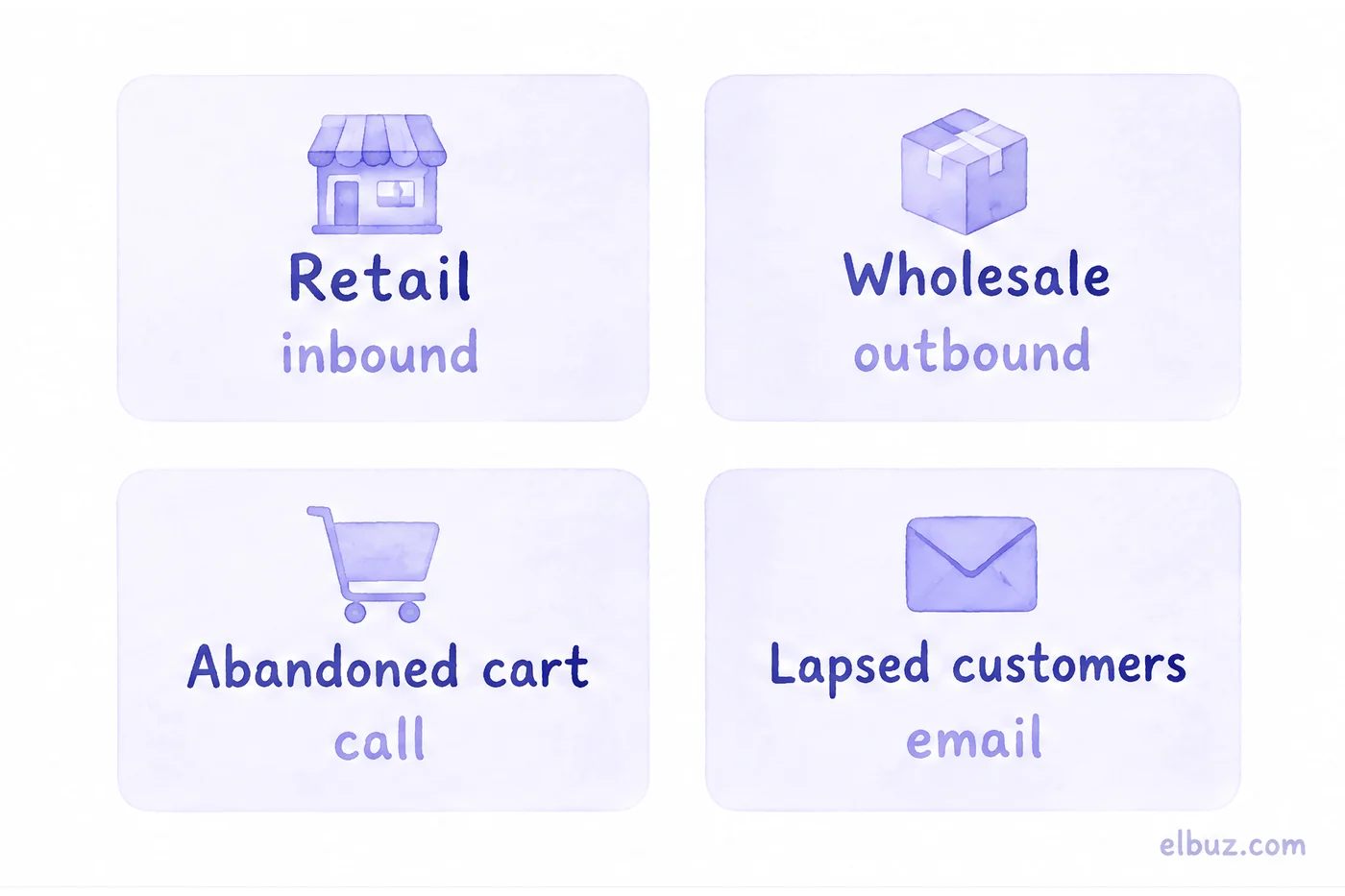
| Retail, mass-market product, small order | Inbound | A call to a stranger costs more than the margin on their order |
| Wholesale and B2B | Outbound | Large orders and repeat purchases pay for the rep's time |
| Abandoned cart | Outbound | The buyer has already chosen; only a doubt is left |
| Customer has not bought for a long time | Outbound: email first, then a call | They know the store; winning them back is cheaper than finding a new buyer |
| Expensive or complex product | Inbound entry, outbound follow-up | The buyer comes on their own but decides after advice |
| A new product nobody knows | Outbound for the first buyers | Nobody searches for it yet |
Cold-calling retail consumers is the most expensive option for an online store, and the law limits it. In the US, the FTC's Telemarketing Sales Rule forbids sales calls to numbers on the National Do Not Call Registry unless you have an established business relationship (up to 18 months after the customer's last purchase, 3 months after an inquiry) or written permission; most calls to businesses are exempt. In the EU, persistent and unwanted phone, email or fax solicitation is listed as an aggressive practice in the Unfair Commercial Practices Directive. When cold calls make sense and how to prepare is covered in the article on cold calling; retail vs wholesale selling, in the article on B2B vs B2C.
How to tell whether an outbound channel pays off
Compare channels by cost per order: Cost per order = Monthly channel cost ÷ Orders from the channel. A channel pays off when this is lower than the margin on one order; the difference is what you keep.
Illustrative example for the arithmetic; the numbers are not market benchmarks. A retail store with an average order of €60 and a 30% margin keeps €18 of margin per order.
- Ads (inbound): €2,000 a month, 250 orders, €8 per order.
- Abandoned cart calls (outbound): part of a rep's time worth €300, 300 carts, 20% complete the order: 60 orders, €5 per order.
- Cold calls to retail consumers (outbound): a rep costing €2,400, 1,000 conversations, 6% buy: 60 orders, €40 per order.
- Cold calls to wholesale buyers (outbound): the same rep, 1,000 conversations, 2% buy: 20 orders, €120 per order; but a wholesale order is €1,000 with a 15% margin, so €150.
| Channel | Cost, € | Orders | Cost per order, € | Margin per order, € | You keep per order, € |
|---|---|---|---|---|---|
| Ads | 2,000 | 250 | 8 | 18 | 10 |
| Abandoned carts | 300 | 60 | 5 | 18 | 13 |
| Cold calls, retail | 2,400 | 60 | 40 | 18 | −22 |
| Cold calls, wholesale | 2,400 | 20 | 120 | 150 | 30 |
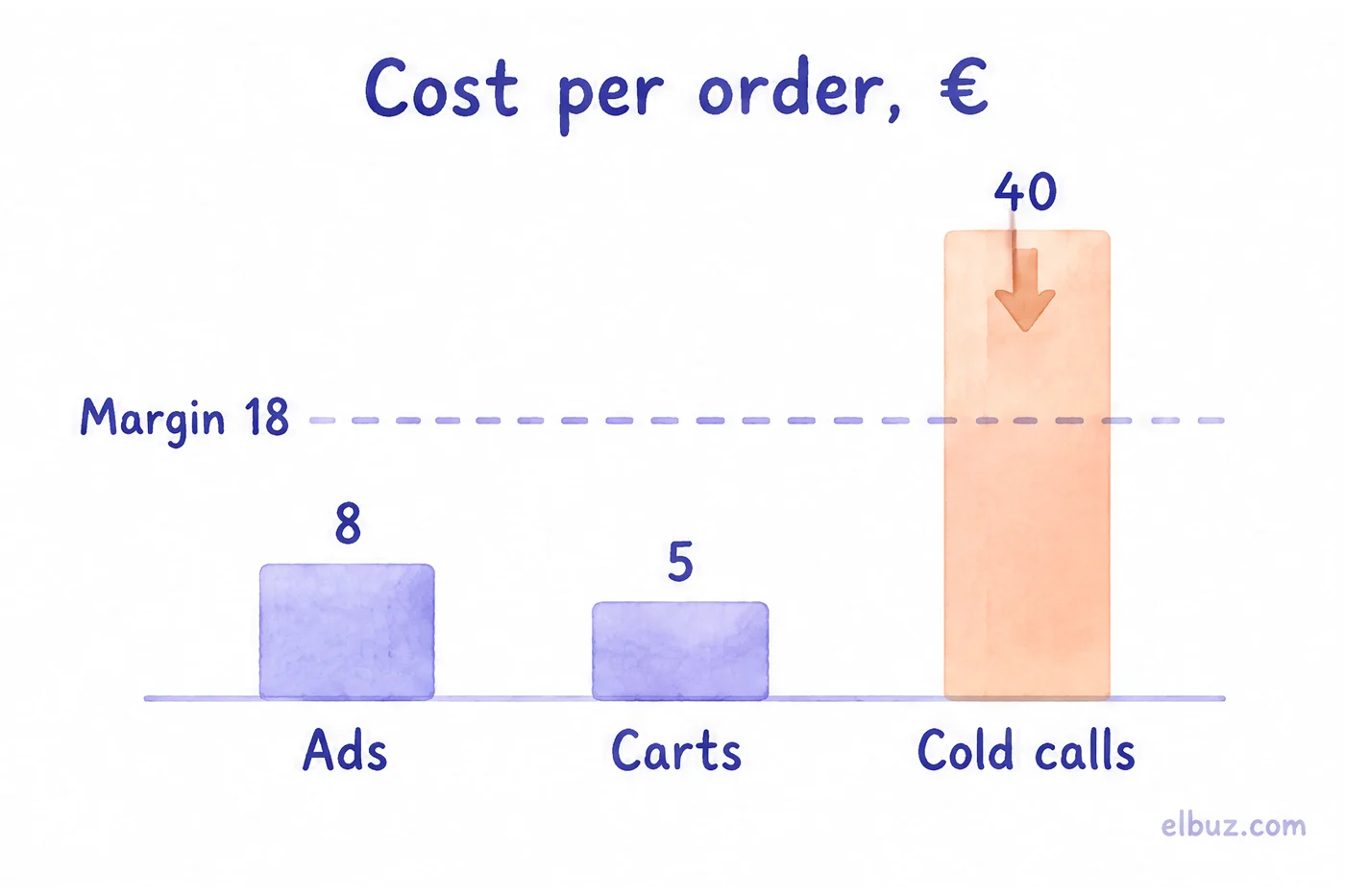
The conclusion from these numbers: outbound contact with people who already know the store is the cheapest channel, cold-calling retail consumers loses money, and cold-calling wholesale buyers pays off from the first order. Repeat wholesale orders improve the math further: the second order from the same customer does not need another 1,000 calls. Plug in your own costs, conversion and margin.
How to combine inbound and outbound sales
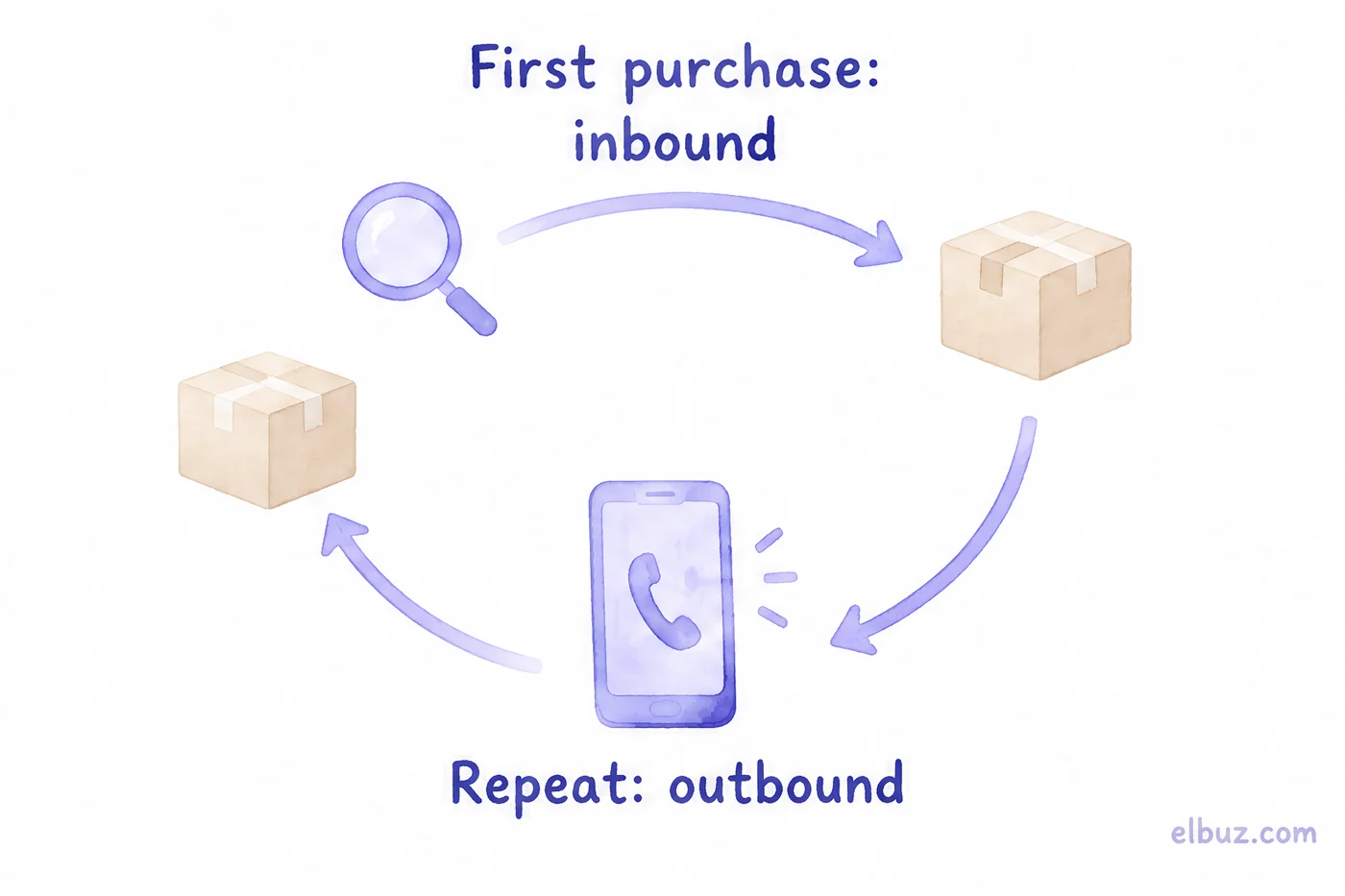
The pattern that works for most stores: the first purchase comes inbound, the repeat one comes from an outbound step. Ads and marketplaces bring a new buyer, and then the store reaches out: reminds them about the cart, suggests an add-on, wins back someone who stopped buying.
- Split incoming and outgoing. A rep working through a call list answers incoming chat late, and a buyer in chat will not wait. Even in a small team, decide who takes incoming first.
- Start outbound with warm contacts. Abandoned carts and lapsed customers give results at lower cost than cold contacts.
- Measure each channel separately. Cost per order by channel, once a month, as in the table above.
- Record the outcome of every contact. Without a note like "called, call back Friday", outbound sales turn into repeated calls to the same people.
Mistakes that make outbound sales lose money
- Cold-calling for a cheap retail product. As in the math above, every order costs more than it brings.
- A target for calls instead of results. The rep makes 80 calls, but half go to the same people or to people who do not need the product.
- Calling with no reason. "Just checking in" gives the buyer no reason to buy; an offer based on their purchase history does.
- Being pushy. A third call in a week after a "no" puts off someone who might have bought later on their own.
- Unanswered incoming. While the rep is busy with outgoing calls, inbound enquiries you already paid for with ads go unanswered.
When outbound sales to your customer base belong in a CRM
When you have hundreds or thousands of buyers and orders come from the website and several marketplaces, a spreadsheet can no longer tell you whom to call today: who has not bought for a while, who abandoned a cart, who was already called.
In Elbuz, orders from your website and marketplaces land in one list, and the customer record holds the purchase history, messages, emails and calls. The customer stage (lead, regular, dormant) is calculated from purchases, so the list for outbound calls is visible right away. In a store on Elbuz CMS, abandoned cart reminders are sent by a CMS module, and with telephony connected, calls are logged in the customer's history. More on the ecommerce CRM page.
Who does not need it: if you get a few orders a week and remember every buyer, a spreadsheet with the date of the last purchase is enough.
Elbuz CRMOrders, customers and calls in one system, 14 days free
Frequently asked questions
What is the difference between inbound and outbound sales?
Who starts the conversation. In inbound sales the buyer contacts you after finding the store through search, ads or a referral; in outbound sales the seller contacts a person who was not looking at that moment.
What counts as outbound sales?
Any contact the seller starts: cold calls and emails, calls to people who abandoned a cart, offers to customers who stopped buying, calls to potential wholesale buyers.
What is active selling?
Another name for outbound sales: the seller approaches the buyer first instead of waiting for an enquiry. Passive selling is the inbound side, where the buyer comes on their own.
Which is better for an online store, inbound or outbound?
It depends on the order size and the buyers: for retail with small orders the base is inbound; for wholesale and existing customers, outbound. Most stores combine both; see which one when.
What does an outbound sales rep do?
Finds potential buyers, calls and writes to them first, finds out the need, presents the product, handles objections and closes the order, then keeps the customer buying again. How to present a product for the buyer's task is covered in the article on product presentation.
Do cold calls pay off for an online store?
In retail with small orders, usually not; in wholesale and B2B, often yes. Check with the math: channel cost divided by the number of orders must be lower than the margin on one order.
Sources
- FTC, "Q&A for Telemarketers & Sellers About DNC Provisions in TSR" — established business relationship (18 months after a purchase, 3 months after an inquiry), B2B exemption — ftc.gov.
- Directive 2005/29/EC on unfair commercial practices, Annex I, point 26 (persistent and unwanted solicitation by telephone, fax, e-mail), text checked on the official copy at legislation.gov.uk — legislation.gov.uk; the directive on EUR-Lex — eur-lex.europa.eu.
Checked on October 31, 2026. All other numbers in the article are illustrative examples for the arithmetic.


