

For an online store, four holiday promotion formats do most of the work from Black Friday to Christmas: a time-limited discount, a free gift over a set order value, free shipping over a set order value, and a bundle priced below its items bought separately. Choose not by what is popular but by what is left from an order: a discount takes money from every sale, while "over a set amount" offers only cost you when the shopper raises the basket.
The second trap is the law. In the EU, a price reduction must show the lowest price of the previous 30 days; in the US, the FTC treats an inflated "was" price as deceptive. Below are the ideas with when each one works, the math of four formats on illustrative numbers, the price rules in the EU and the US, and a calendar from preparation to the January clearance.
When a store looks for holiday promotion ideas
Usually it is late October or November: competitors announce Black Friday deals, and the store still has no plan for the season. People search for "holiday promotion ideas", "black friday promotion ideas", "christmas sale ideas", and almost at once — "is a discount or a free gift better".
"What discount should we give" is a premature question. First decide what you want from the holidays: more orders, a bigger basket or clearing stock. That decides the format, and the format decides how much you earn on it.
Holiday promotion ideas: what works and when
Match the promotion to the goal: a discount brings more orders, "over a set amount" offers raise the basket, bundles sell related items, and a delayed reward brings the shopper back in January.
| Format | When it works | Risk |
|---|---|---|
| Discount on a category until a set date | Shoppers compare prices, competitors cut theirs too | You give money away on every order, including those that would happen anyway |
| Early access for subscribers before Black Friday | You have an email or SMS list that opens messages | The same discount for everyone a day later makes the "early" part meaningless |
| Free gift over a set order value | The average order is a little below the threshold, you have a cheap related item | The threshold is too high — nobody reaches it |
| Free shipping over a set order value | Shipping is a visible part of the order, shoppers hesitate at checkout | You pay to ship large or heavy items |
| Bundle at a discount, "buy 2, get 1" | Items are bought together or given as a set | Slow movers end up in the bundle, and it looks like a clearance |
| Gift cards | The shopper does not know what to give | You need to set the validity period and track balances |
| Gift guides, "gifts under €50" | A wide range where shoppers get lost | Almost none: it is navigation, not a discount |
| January bounce-back coupon | You want a repeat purchase after the holidays | Some shoppers will not return, but it costs you nothing |
| Gift wrapping | Products are bought as gifts | Extra work in the warehouse on the busiest days |
Daily deals in a "12 days of Christmas" countdown, giveaways and spin-to-win wheels also draw attention, but each is a separate mechanic with its own terms. If you choose one, publish the terms in advance, and count every daily deal by the same math as a discount below.
Which is better: a discount, a free gift or free shipping
The better format is the one that takes money only from the orders the promotion changed. A 10% discount cuts the profit of every order, while a gift and free shipping over a threshold cost you only when the shopper reaches the threshold.
Illustrative example for the arithmetic, not market prices. The average order is €100, the cost of goods is 60% of the price. The threshold for the gift and for free shipping is €120. The gift costs you €10, shipping costs €8. "Left" is before ads and taxes.
| Format | Order, € | Cost of goods, € | Promotion cost, € | Left, € |
|---|---|---|---|---|
| No promotion | 100 | 60 | 0 | 40 |
| 10% off | 90 | 60 | 10 | 30 |
| Free gift over €120 | 120 | 72 | 10 | 38 |
| Free shipping over €120 | 120 | 72 | 8 | 40 |
For the discount, the €10 promotion cost is already inside the lower order value.
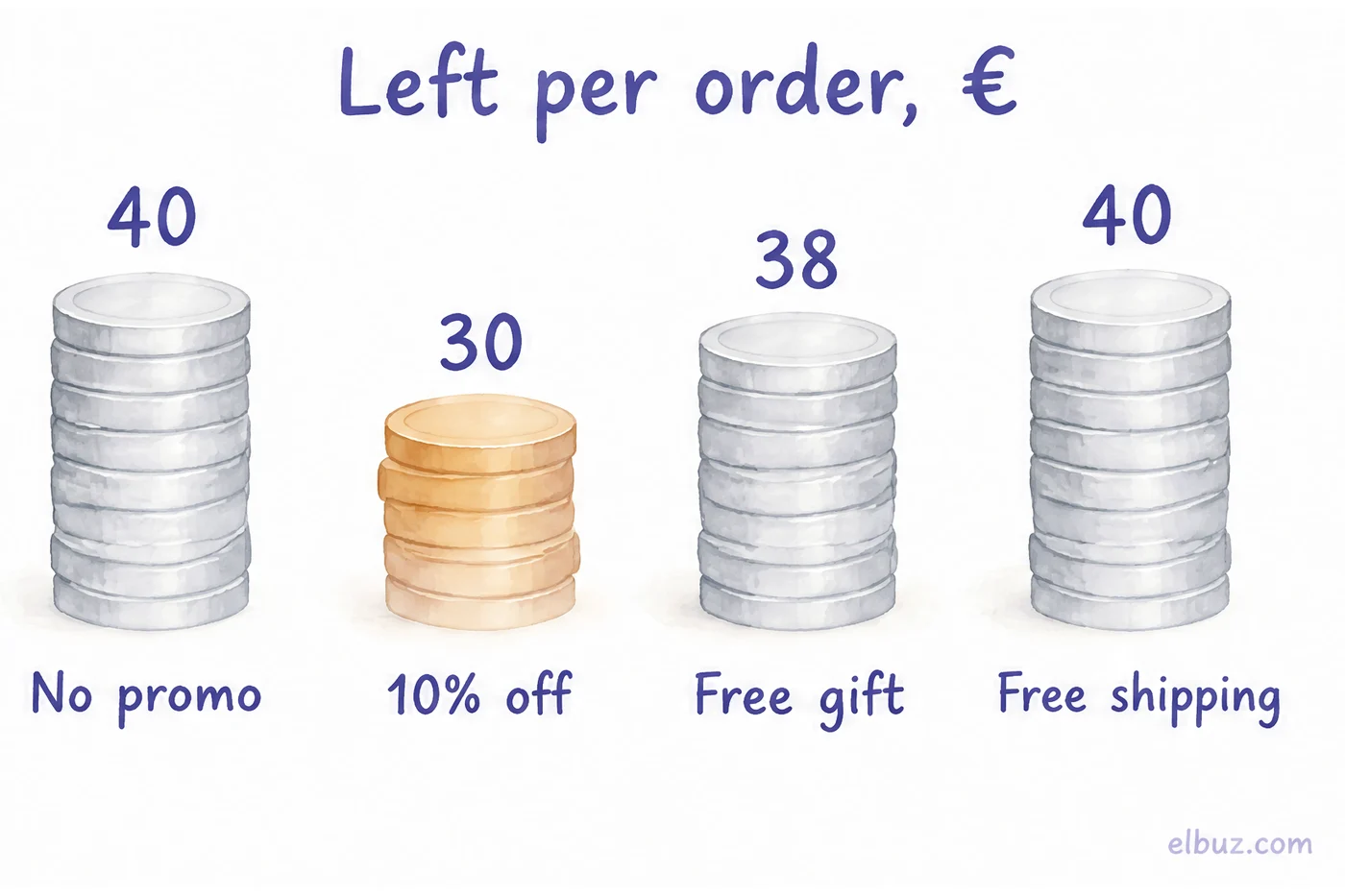
Threshold offers leave almost as much as an order without a promotion, because the amount added to the basket covers the cost. But only while the threshold is a little above your usual order: if most shoppers already spend €120, the gift becomes a discount for everyone. Set the threshold so that a typical shopper is one inexpensive item short of it, and check your order history for how many orders already exceed it.
How many more orders a discount needs to pay off
For a discount not to reduce profit, the number of orders must grow by as much as the profit per order fell. The formula: required growth = profit per order without the discount ÷ profit per order with the discount − 1.
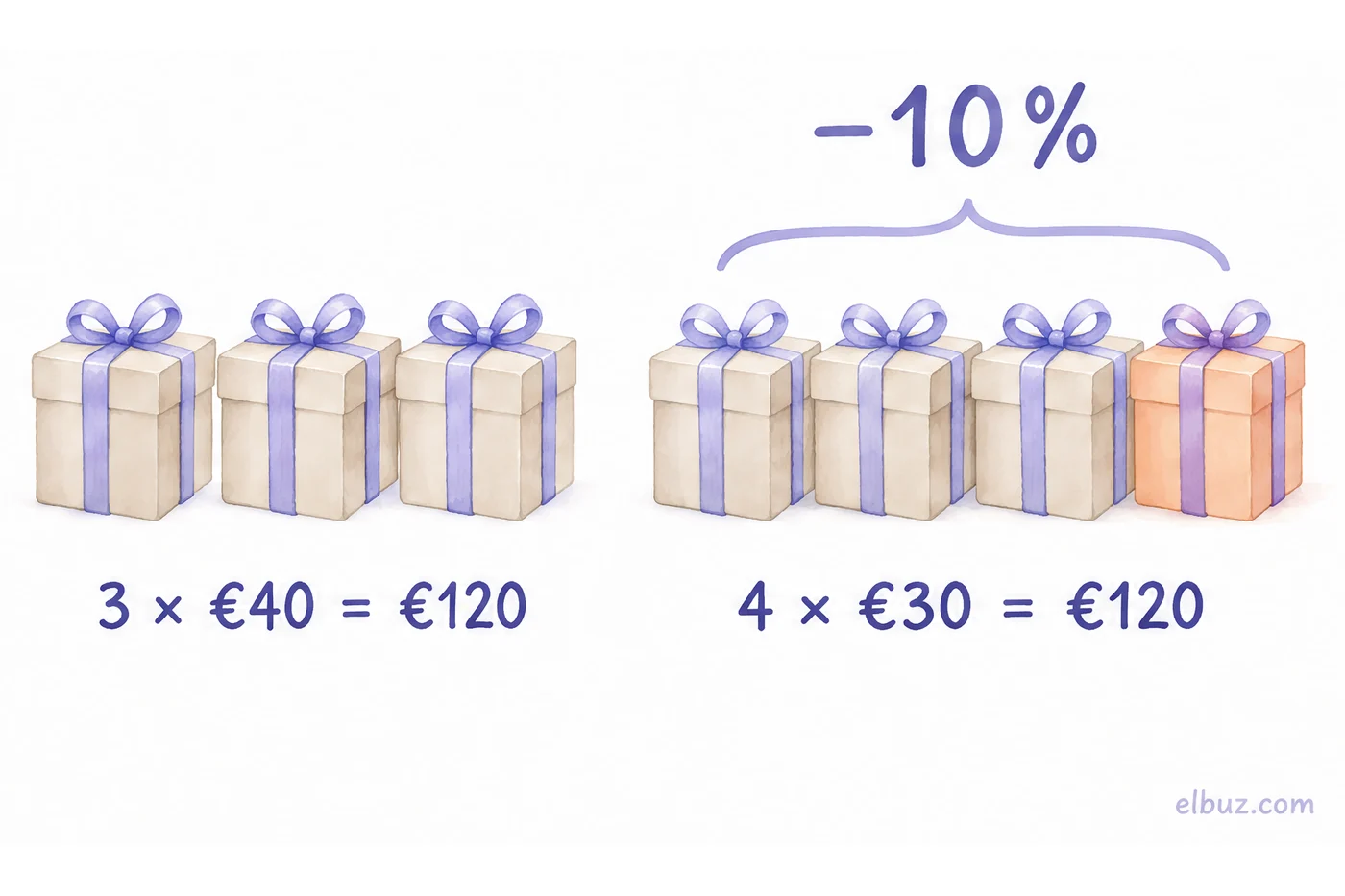
In the example: 40 ÷ 30 − 1 ≈ 0.33. With 10% off, you need a third more orders: where there were three orders, you now need four to earn the same €120. A 20% discount at the same cost of goods leaves €20 per order — and you need twice as many orders.
So give the discount not on the whole catalog but on categories where shoppers compare prices, and on items with a higher margin. How to calculate the margin of a category is covered in what is gross margin; the same math for promotions all year round, including promo codes, is in ecommerce promotions and discount strategy.
Price rules for holiday sales in the EU and the US
In both markets the "was" price must be real. In the EU, any announcement of a price reduction must show the prior price, which is the lowest price you applied in at least the 30 days before the reduction (Article 6a of Directive 98/6/EC, added by the Omnibus Directive 2019/2161). In the US, the FTC's Guides Against Deceptive Pricing accept a former price only if you openly and actively offered the item at it for a reasonably substantial period (16 CFR 233.1).
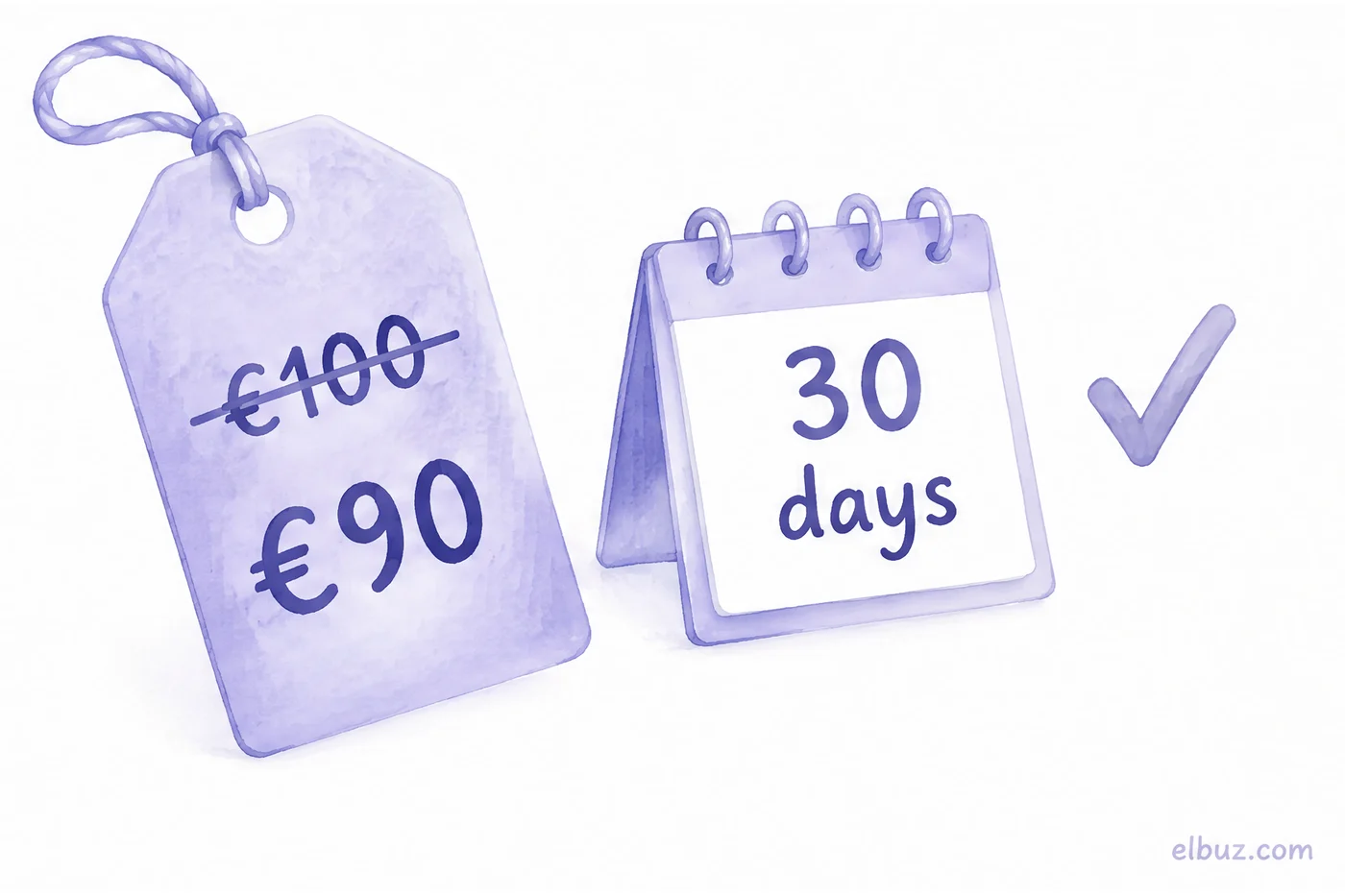
- Do not raise the price before the holidays to "cut" it. In the EU the prior price would then be the lowest of the last 30 days anyway. In the US the FTC calls a price inflated in order to advertise a large reduction a fictitious former price.
- An early-November sale changes your Black Friday "was" price in the EU. The regular price is €100, from November 1 to 10 you sell at €90, and on Black Friday at €80. The lowest price of the 30 days before Black Friday is €90, so the honest reduction is 11%, not 20%. Member states may treat a progressively increasing reduction differently — check the national rules of the countries you sell to.
- "Free" means free. In the EU you cannot call an item free if the shopper pays anything beyond the unavoidable cost of responding and delivery (Directive 2005/29/EC, Annex I, point 20). In the US, for "buy one, get one free" you must not raise the regular price of the item to be bought or cut its quantity or quality (16 CFR 233.4), and the conditions of a "free" offer must be stated clearly at the outset, not in a footnote (16 CFR 251.1).
- No fake urgency. Falsely stating that an offer is available only for a very limited time to push an immediate decision is banned in the EU in all circumstances (Directive 2005/29/EC, Annex I, point 7). The FTC guides likewise say a "limited" offer must actually be limited (16 CFR 233.5). A countdown timer that restarts for every visitor is exactly that.
- Enough stock. Advertising a price when you expect not to have the goods in reasonable quantities is a banned bait practice in the EU (Annex I, point 5).
This is a summary of the EU directives and the FTC guides, not legal advice: EU countries transpose the directives into national law with their own details, and US states have their own pricing laws.
When to launch holiday promotions
Prepare in October, run Black Friday and Cyber Monday at the end of November, push gifts in December and announce the last order date for delivery before Christmas in advance. After the holidays, run a clearance of seasonal stock.
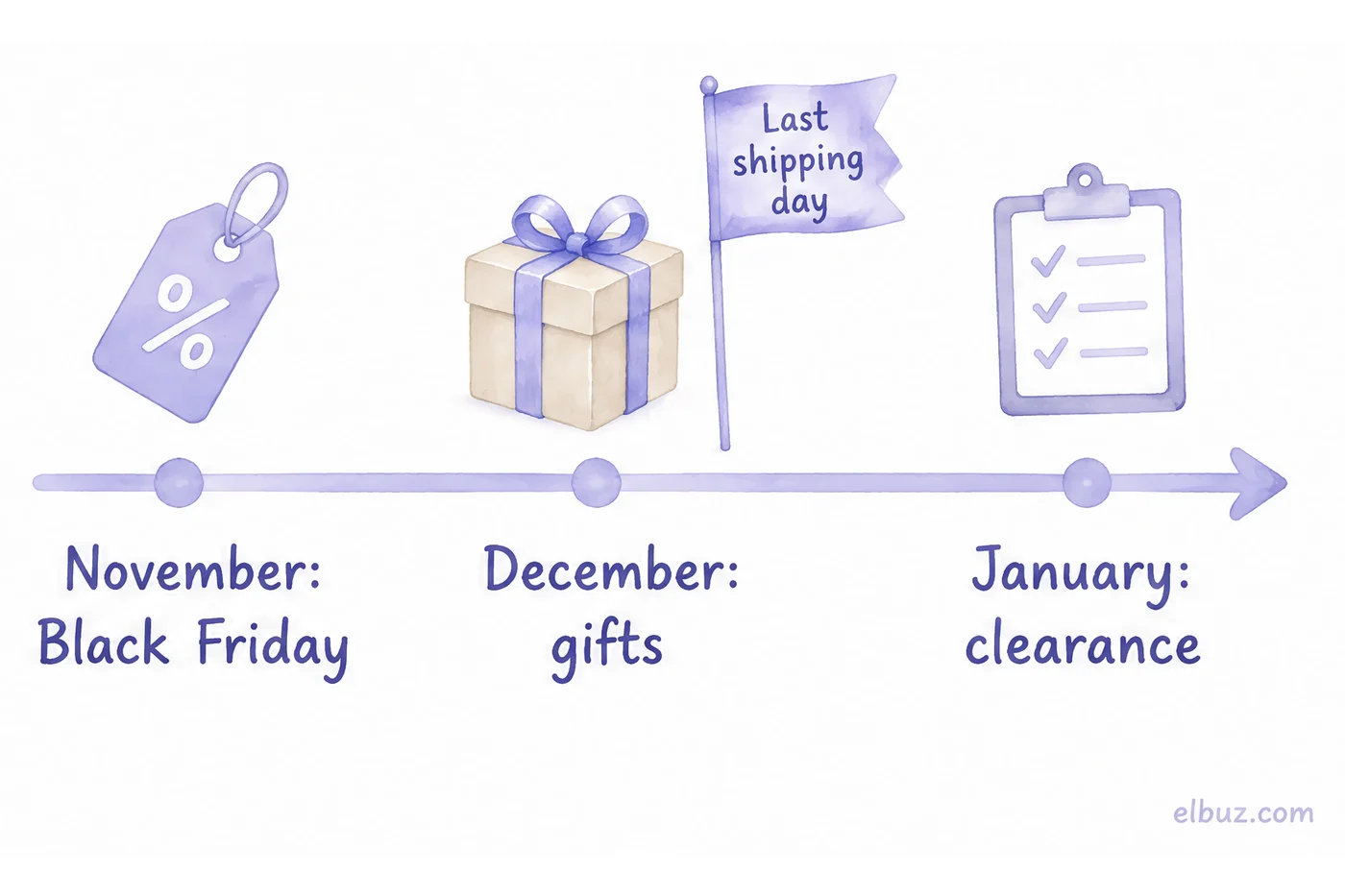
- October — preparation. Pick the goal and the format, run the numbers from the table above, check stock of best-sellers and agree on availability with suppliers. In the EU, keep regular prices stable from late October: they become the 30-day reference for Black Friday.
- Late November — Black Friday and Cyber Monday. In 2026 Black Friday falls on November 27 and Cyber Monday on November 30. Category discounts work best here, when shoppers actively compare prices.
- December — gifts. Gift guides and threshold offers from the start of the month. Find out your carriers' holiday shipping deadlines and state on the website the date by which an order arrives in time. In the US, the FTC's Mail, Internet, or Telephone Order Merchandise Rule requires a reasonable basis for any shipping time you state (16 CFR 435.2). After the last shipping day, offer gift cards.
- January — clearance. Put the remaining seasonal stock on a time-limited sale and remind December shoppers of their bounce-back coupon.
What to check before launch
- Sale prices are the same on the website, in marketplace and Google Shopping feeds, and in ads.
- The prior price is kept and shown next to the new one; in the EU it is the lowest price of the last 30 days.
- The end date of the promotion is shown on the website, and prices return after it.
- Promotion items are actually in stock in the needed quantity, not only on the product page.
- The threshold and the gift terms are stated in the cart, not only on a banner.
- Emails and banners lead to a page with the same terms.
How to run a promotion on hundreds of products and not forget to end it
When the discount covers a category or brand with hundreds of products, setting prices by hand takes long, and removing them after the holidays gets forgotten. In Elbuz a sale price is set by a rule: product selection by category, brand or price, a discount as a percentage, a fixed amount or a fixed price, rounding — and an end date, after which sale prices are removed the next time rules are applied and the rule itself is switched off. The regular price stays next to the sale price, so the storefront shows both. How prices are calculated in general is on the pricing and markup rules page.
One caveat: the start date does not delay the promotion — the price appears as soon as the rules are applied. A promotion "from Monday" is created as a disabled rule and switched on that day.
Promotions and prices in ElbuzDiscount rules with an end date, prices before and after, 14 days free
Frequently asked questions
What are some creative holiday promotion ideas for an online store?
Early access for subscribers before Black Friday, a free gift or free shipping over a set order value, bundles, gift guides by budget, gift cards after the last shipping day and a January bounce-back coupon. Choose by goal: more orders, a bigger basket or clearing stock.
Is a discount or a free gift better?
Usually a gift over a set order value: it costs you only when the shopper raises the basket. In the illustrative example, 10% off leaves €30 per order and a gift over €120 leaves €38.
When should holiday promotions start?
Prepare in October, launch Black Friday deals at the end of November and gift offers in early December. Announce the last order date for delivery before Christmas in advance, and move to a clearance after the holidays.
Can I show a "was" price if I never sold at it?
No. In the EU the prior price is the lowest price you applied in the 30 days before the reduction; in the US the FTC treats a former price you did not genuinely offer for a reasonably substantial period as fictitious.
How do I make free shipping profitable?
Offer it over an amount slightly above your average order, so a typical shopper is one inexpensive item short. Then the amount added to the basket pays for shipping, not your profit.
How many more orders does a discount need to pay off?
Profit per order without the discount ÷ profit per order with it − 1. If an order left €40 and leaves €30 with the discount, you need a third more orders.
Sources
- Directive (EU) 2019/2161, Article 2 — inserts Article 6a into Directive 98/6/EC (prior price, lowest price of at least 30 days, exceptions) — legislation.gov.uk/eudr/2019/2161/article/2 (text as adopted).
- Directive 2005/29/EC on unfair commercial practices, Annex I, points 5, 7 and 20 — legislation.gov.uk/eudr/2005/29/annex/I.
- FTC Guides Against Deceptive Pricing, 16 CFR Part 233 — ecfr.gov/current/title-16/part-233.
- FTC Guide Concerning Use of the Word "Free", 16 CFR Part 251 — ecfr.gov/current/title-16/part-251.
- FTC Mail, Internet, or Telephone Order Merchandise Rule, 16 CFR Part 435 — ecfr.gov/current/title-16/part-435.
Checked on October 31, 2026. All other numbers in the article are illustrative examples for the arithmetic.


