

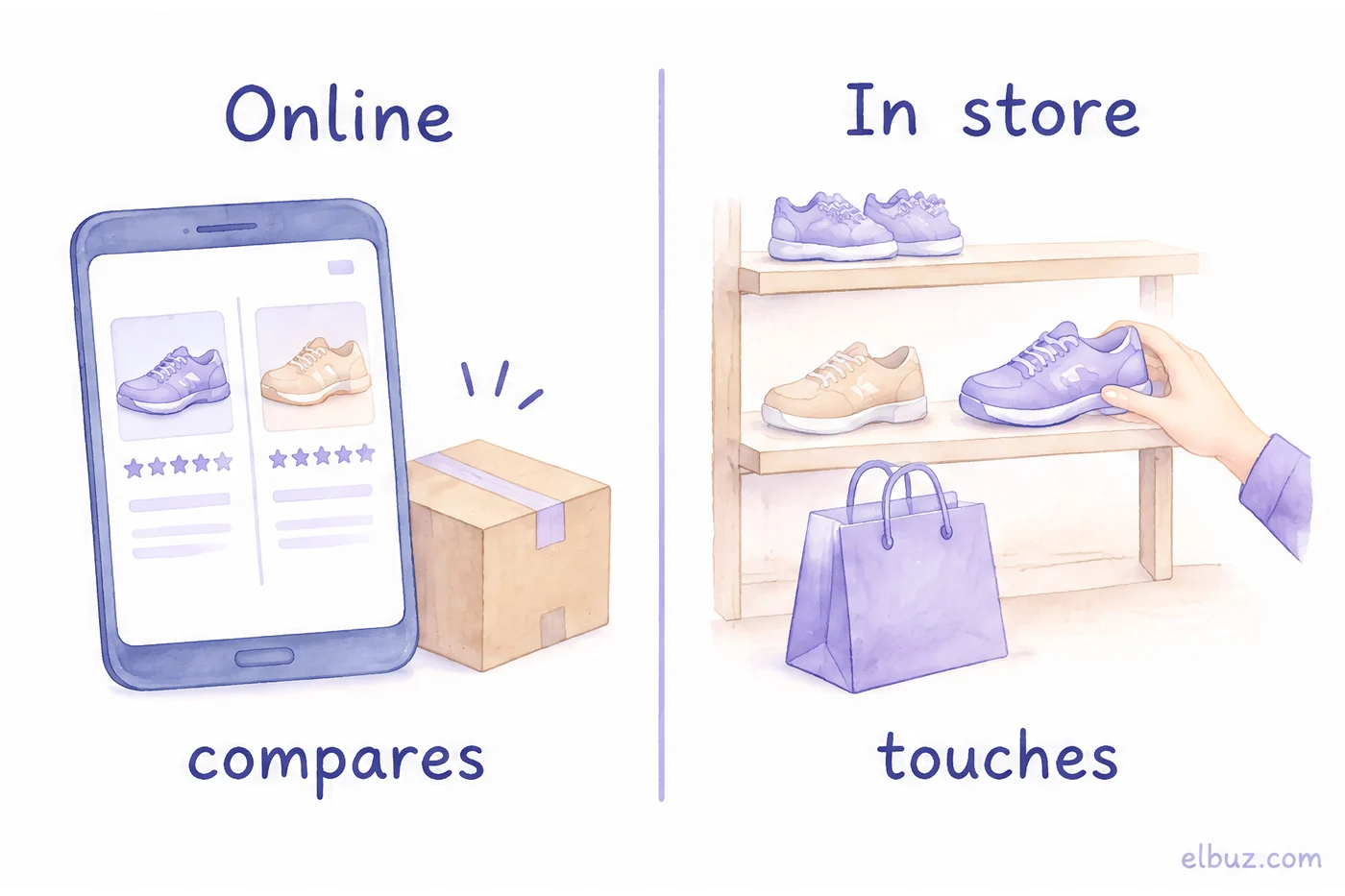
An online shopper decides before ever contacting you: compares prices in several tabs, reads reviews, checks the delivery time and cost and the return terms. An in-store shopper decides on the spot: touches, tries on, asks the staff and takes the item home right away. For the seller the difference is also in money: in a physical store most costs are fixed (rent, staff); online they are variable (ads, shipping, returns).
That is why "where it pays more" depends not on fashion but on sales volume and the product itself. The mistake is to carry one channel's habits into the other: opening a shop with an online range of thousands of items, or selling online a product people need to try on, without easy returns. Below: how the buyers differ, the profit from one sale in each channel, a "which product where" table, and what breaks when you combine channels.
When people compare online and in-store selling
Usually one of two situations. There is a physical shop, and the owner wonders whether to launch a website or sell on a marketplace. Or an online store is already running, customers ask whether they can see the product in person, and the idea of a showroom appears. People search for "online shopping vs in store shopping", "online vs offline sales", and then ask "which is more profitable", "what sells better online", "how to combine a shop and a website".
"Which is better in general" has no answer. This one does: how many sales a month you will realistically get in each channel and how much each sale leaves you.
How online and in-store shoppers differ
An online shopper buys information about the product; an in-store shopper buys the product in their hands. The other differences follow from that: what convinces them, what they fear and what the seller should do about it.
| What we compare | Online | In store | What the seller should do |
|---|---|---|---|
| How they choose | compare several stores and marketplaces | choose from what is on the shelf | online: price and terms in line with the market; in store: good merchandising |
| What convinces them | photos, specifications, reviews, seller rating | the product in hand, advice from staff | online: a complete product page; in store: staff who know the product |
| When they get it | in a day or a few days, by delivery | immediately | online: an honest dispatch time on the site |
| What they fear | the item is not as pictured, and returning it is a hassle | paying more than online | online: clear return terms; in store: a price close to online |
| Impulse buying | less often; more often leave it in the cart | more often, at the checkout and shelves | online: cart reminders; in store: add-ons near the checkout |
| Repeat purchase | can switch to a competitor in one click | come back if the shop is nearby | online: a customer list and email; in store: a convenient location |
In the EU there is also a legal difference: for online purchases the buyer can cancel within 14 days of delivery without giving a reason, while that statutory right does not cover ordinary purchases in a shop. Plan online prices with returns in mind. The line between the two buyers is blurry anyway: the same person looks at a product in the shop and buys online, or finds it online and picks it up in person. It is more useful to think not of "two types of people" but of two buying situations everyone is in at different times.
How much one sale leaves you online and in store
With few sales, more is left online; with many, more is left in the shop. The reason is the cost structure: you pay the rent and the staff regardless of sales, and ads and shipping with every order.
Illustrative example for the arithmetic; the numbers are not market prices. A product sells for €100 and costs €60. Online (your own website): payment fee 2%, €2; ads €8 per order; shipping paid by the store €5; returns €1 per order on average (one in ten comes back, and you pay €10 for shipping both ways); fixed website and order handling costs €900 a month. In store: card fee 2%, €2; rent €1,800 and a salary of €2,700 a month.
| Sales per month | Online, € | In store, € |
|---|---|---|
| 150 | 18.00 | 8.00 |
| 300 | 21.00 | 23.00 |
| 600 | 22.50 | 30.50 |
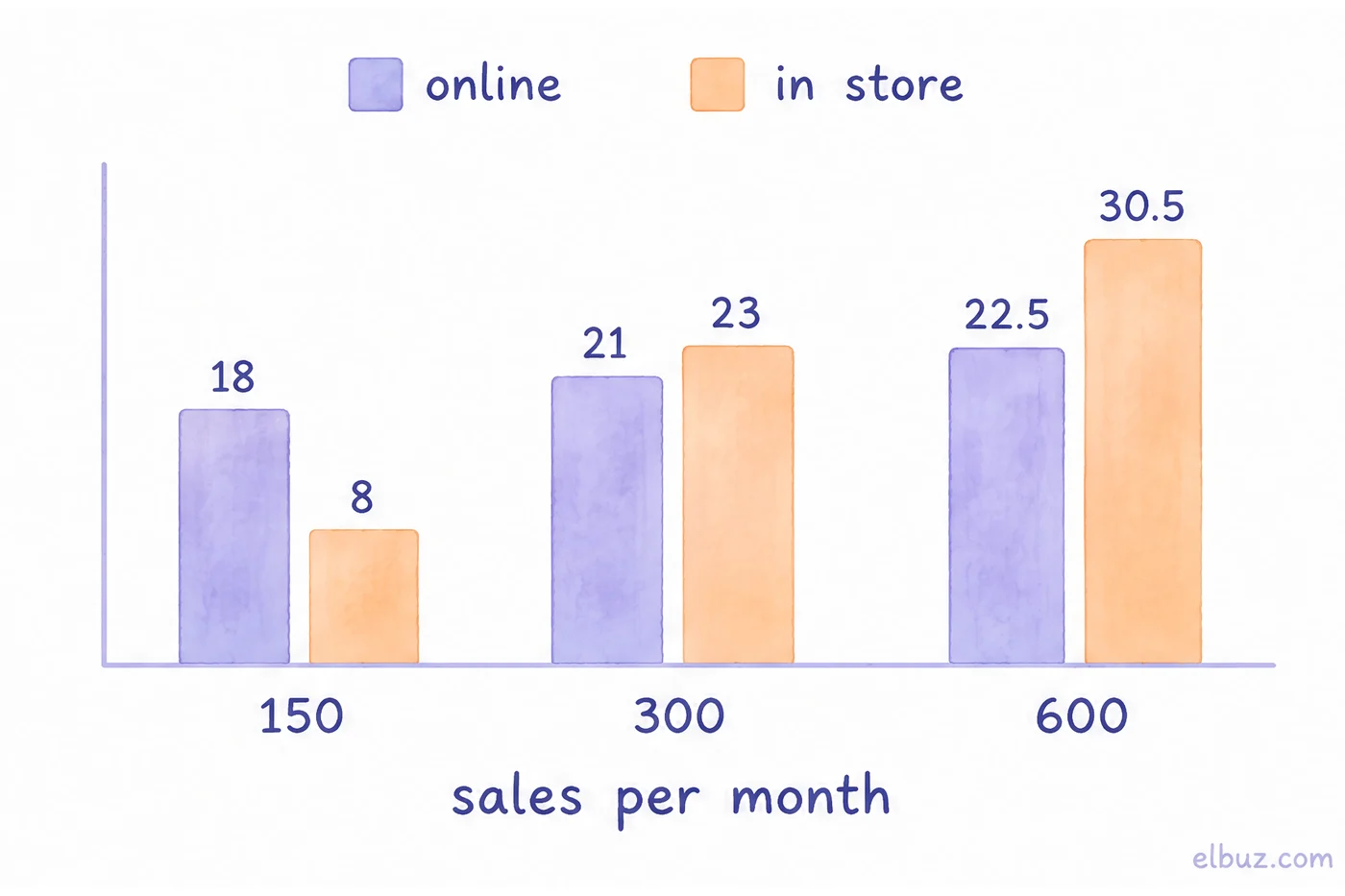
Two conclusions. First, the online store breaks even sooner: 900 ÷ 24 = 38 sales a month against 4,500 ÷ 38 = 119 for the shop. So online is the cheaper way to test demand. Second, from 258 sales a month the shop in this example earns more per sale, because the rent is spread over more buyers, while online ad spend grows with the orders.
Plug in your own numbers: how to calculate margin and what is left after fees is covered in the article on profit margin, and how many sales cover fixed costs, in the article on the break-even point.
Which products sell better online and which in store
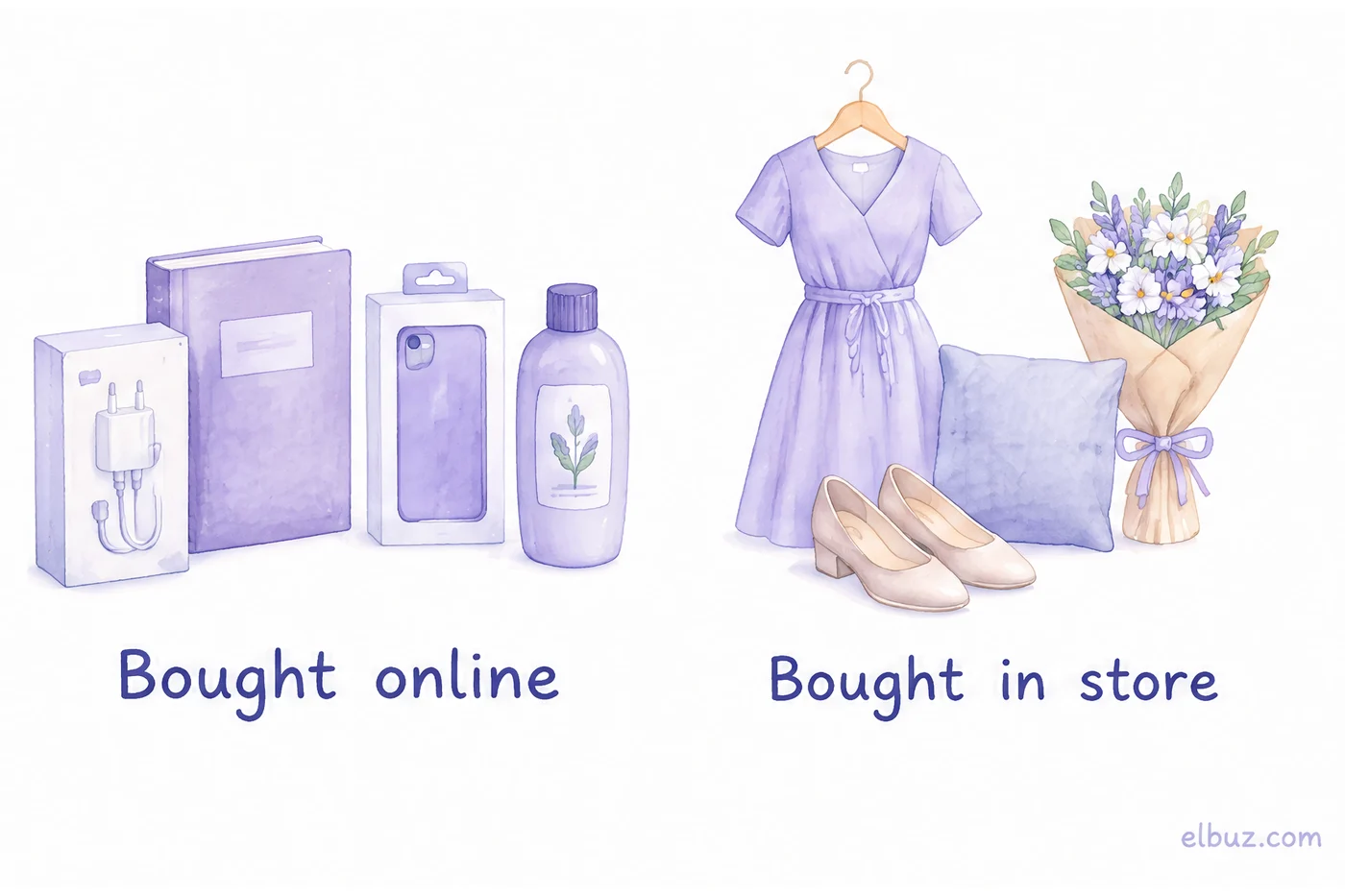
Online, it is easier to sell a product people can choose by specifications and photos; in store, one they need to feel, try on or take home immediately. Check your product against the signs below.
| Product trait | Better | Why |
|---|---|---|
| The same at every seller, has a model number or SKU | online | the buyer knows what they are buying and compares prices |
| A large range, thousands of items | online | a shop runs out of shelves, a website does not |
| Needs trying on: clothing, shoes | in store, or online with easy returns | online, part of the orders come back after trying on |
| Texture, smell or taste matter | in store | a photo cannot show it |
| Needed today: flowers, medicine, a repair part | in store, or same-day delivery | the buyer will not wait for shipping |
| Cheap, shipping comparable to the price | in store, or online as part of a larger basket | shipping eats the margin of a single-item order |
| Large and fragile | a showroom sample + online order | the buyer wants to see it, while stock and delivery are handled separately |
How to combine online and in-store sales
Combining works when both channels share the same stock, similar prices and one customer history. The most common setups:
- Buy online, pick up in store. The buyer pays no shipping, you pay for no returns, and in the shop they often buy something else.
- A showroom for an online store. Samples of best sellers on display, stock kept elsewhere. It removes the "not as pictured" fear for expensive and large items.
- A website and marketplaces for a shop. The shop's stock is also sold online, and slow-moving items find buyers in other cities.
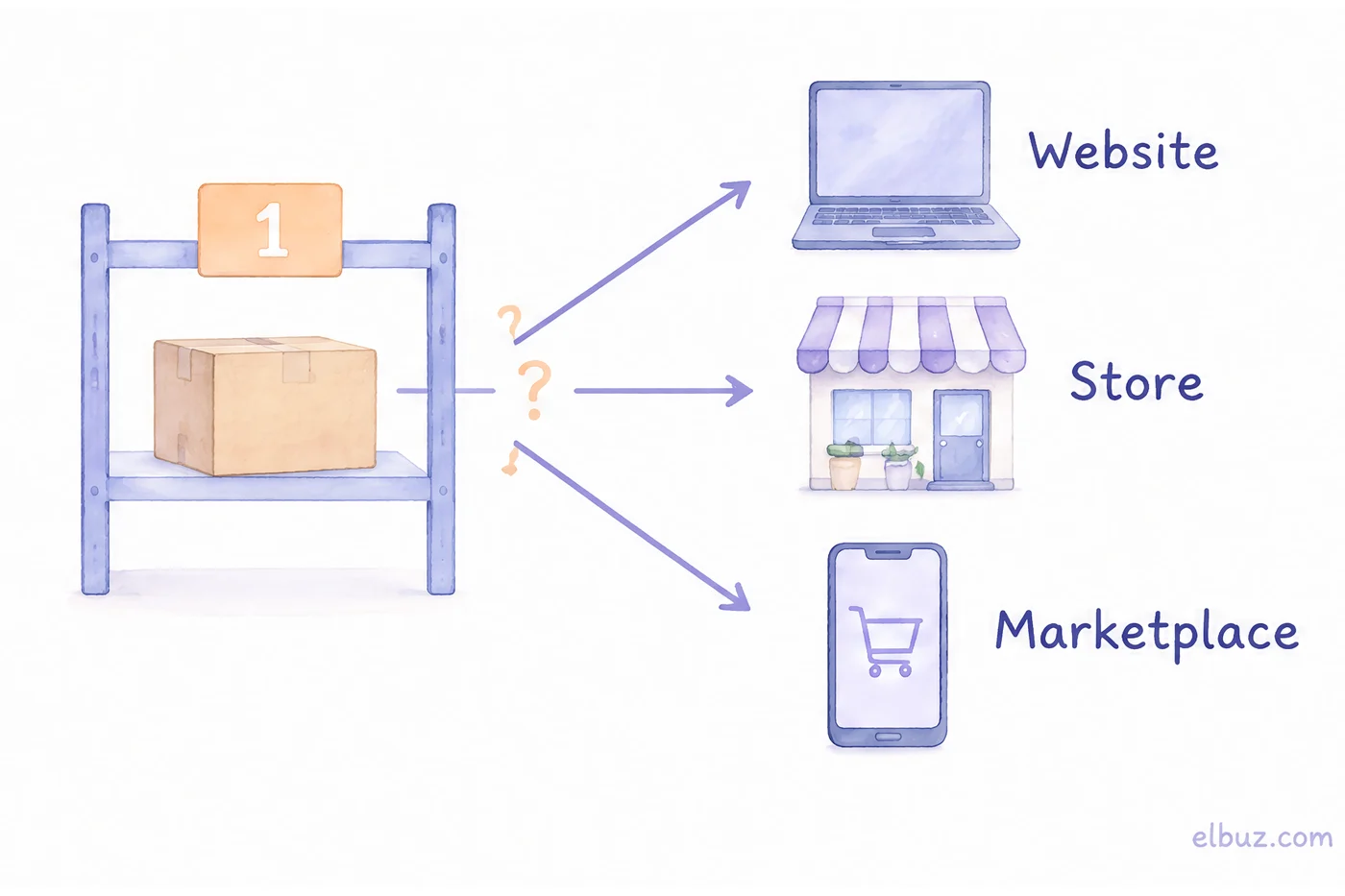
It all breaks in one place: stock. The last unit is sold in the shop, but on the website and the marketplace it is still "in stock", and you have to call the buyer to cancel. The second typical problem is different prices: a buyer sees a higher price in the shop than on your own website and stops trusting both. If prices differ on purpose, say so plainly, for example "online price with online payment".
When the shop, the website and marketplaces sell from one stock
With more than one channel, stock levels and orders kept in separate dashboards and spreadsheets drift apart within a week. In Elbuz, orders from the website and marketplaces arrive in one order list, and the shop can be a separate warehouse with its own stock: a confirmed order reserves the item, a sale in the shop recorded as a sales receipt writes it off the shop's stock, and the free stock is visible before the unit is sold twice.
Elbuz does not replace your POS: the receipt at the till, including any fiscal receipt your country requires, still comes from your cash register. If you have one shop and no website, you do not need order management software yet.
Orders from every channel in one listWebsite, marketplaces and shop stock in Elbuz, 14 days free
Frequently asked questions
What is the difference between online and in-store shopping?
Online, the buyer chooses by photos, descriptions and reviews and gets the item by delivery; in store, they see it in person and take it right away. For the seller, online costs are mostly variable (ads, shipping), in-store costs mostly fixed (rent, wages).
Is it better to buy clothes in store or online?
In store if fit matters and you want the item today; online if you know your size in that brand and the seller has easy returns. That is why clothing sold online comes back more often than items chosen by specifications.
What are the disadvantages of buying online?
You cannot touch or try the product, you wait for delivery, and returns take effort. Sellers reduce these with complete product pages, honest dispatch times and clear return terms.
Which is more profitable, an online store or a physical store?
It depends on sales volume and the product. An online store breaks even sooner because of lower fixed costs; a busy shop can earn more per sale. See how much one sale leaves you.
Can you combine online and in-store sales?
Yes, and it usually pays: buy online and pick up in store, a showroom for an online store, selling the shop's stock on a website and marketplaces. One condition: shared stock records, otherwise the same item gets sold twice.
Which products sell better online?
Those chosen by specifications: electronics, accessories with a model number, books, household products, and ranges of thousands of items. Products that need to be tried on or felt sell online with a higher share of returns.
Sources
- Your Europe (European Commission), "Guarantees and returns": 14-day right to cancel online purchases from the date of delivery — europa.eu.
Checked on October 31, 2026. All other numbers in the article are illustrative examples for the arithmetic.


