

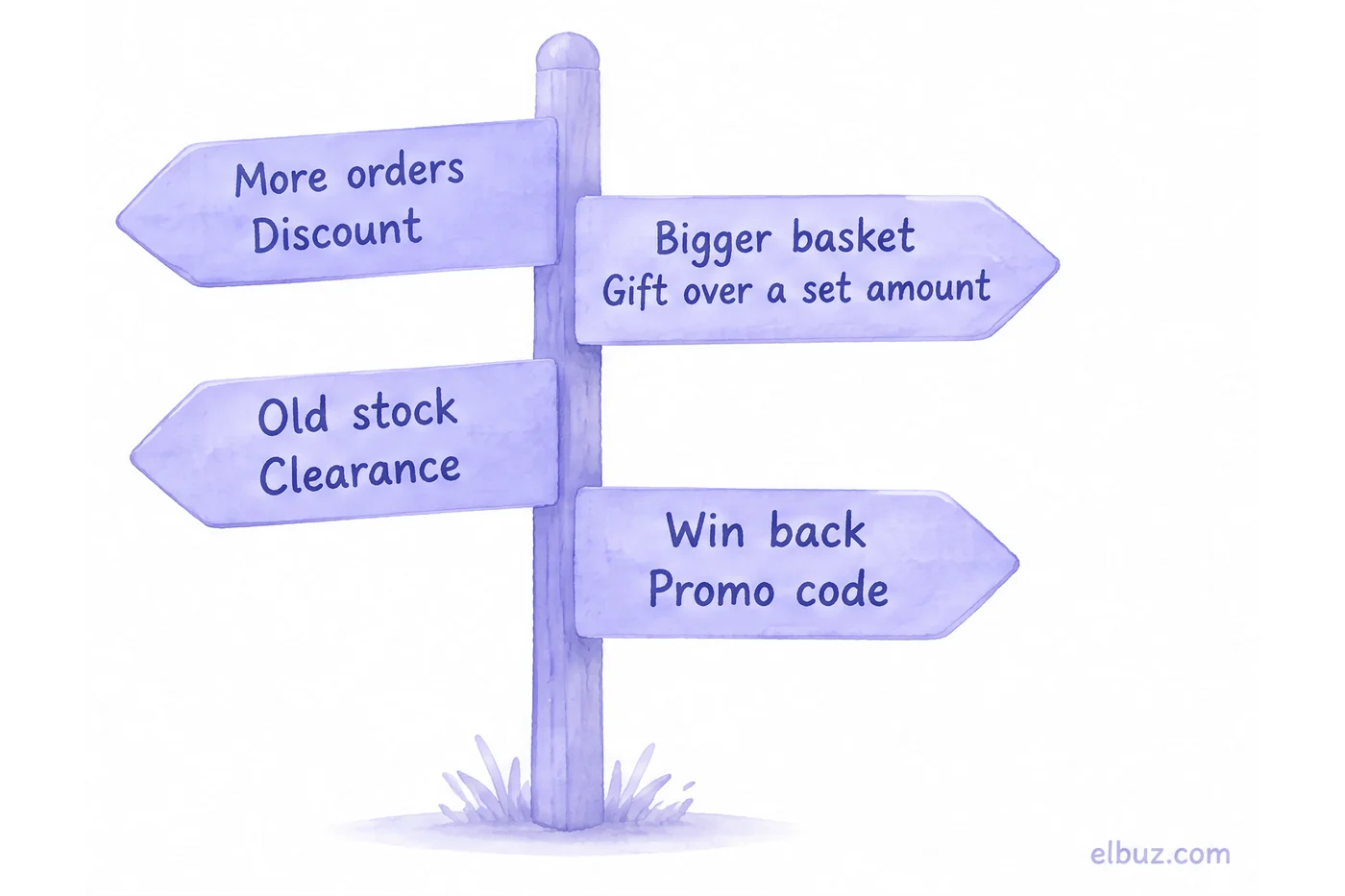
An ecommerce promotion is a temporary benefit for shoppers with one goal: more orders, a bigger basket, clearing stock or a repeat purchase. A discount strategy follows from that goal: you pick the promotion type, calculate how big a discount your margin can take and how much sales must grow, and after the end measure how many orders the promotion added over your normal sales.
Stores usually go wrong in two places: they give a discount the margin cannot carry, and they judge the promotion by revenue rather than by what is left. Below are the promotion types with the goal of each, a "discount vs required sales growth" table, the math of a promo code, a calendar of occasions for the year and how to measure the result.
When a store thinks about a promotion
Usually one of three things: sales have dropped, stock is sitting in the warehouse, or competitors have launched a sale. People search for "ecommerce promotions", "discount strategy", "discount code ideas" and "promo code strategy", and then ask whether promo codes stack and how to create one.
The first question is almost always "what discount should we give". It is premature: first decide what the promotion must change, because the goal decides the format, and the format decides what it costs.
Types of ecommerce promotions and what each is for
Each promotion type moves one number of the store: the number of orders, the average order value, stock or the share of repeat purchases. Choose the type by the number you need to move:
| Type | What it changes | When it works | Risk |
|---|---|---|---|
| Time-limited discount on a product or category | Number of orders | Shoppers compare prices across several stores | People who would buy anyway get the discount too |
| Clearance sale | Stock, cash tied up in goods | The season is over, a model is discontinued | Shoppers learn to wait for the sale |
| Volume discount, "buy 2, get 1", bundle | Average order value | Items are bought in multiples or with an accessory | Slow movers end up in the bundle |
| Free gift or free shipping over a set amount | Average order value | A typical shopper is one inexpensive item short of the threshold | A threshold below the usual order is a discount for everyone |
| Promo code | Orders from a specific channel, repeat purchases | You need to measure an influencer, an email, a first purchase | The code leaks to coupon sites |
| Flash sale for a few hours | A spike of orders from email and social media | You have a subscriber list that opens messages | The warehouse and support cannot keep up with the peak |
| Loyalty discount, price for a customer group | Share of repeat purchases | Goods are bought regularly, you have wholesale customers | The discount is permanent and eats margin unnoticed |
A promotion with one goal is easier to calculate and to measure. "15% off plus a gift plus free shipping" changes everything at once, and after the end you cannot tell what worked. How to calculate a gift and free shipping over a threshold on real numbers is shown in holiday promotion ideas for online stores.
How big a discount your margin can take
A discount cannot be larger than the share of the price left after the cost of goods and other variable costs: at that line the store sells at zero. And long before the line, it requires sales growth the promotion may not deliver.
Illustrative example for the arithmetic, not market prices. An item sells for €100, the cost of goods is €60, shipping, fees and ads take €10 per order. Without a promotion, €30 is left from an order, that is 30% of the price. For simplicity, variable costs are assumed not to change with the discount.
| Discount | Left per order, € | Orders must grow by |
|---|---|---|
| No discount | 30 | — |
| 5% | 25 | 20% |
| 10% | 20 | 50% |
| 15% | 15 | 100% |
| 20% | 10 | 200% |
| 30% | 0 | no growth helps |
At 30% off the promotion breaks even at any volume.
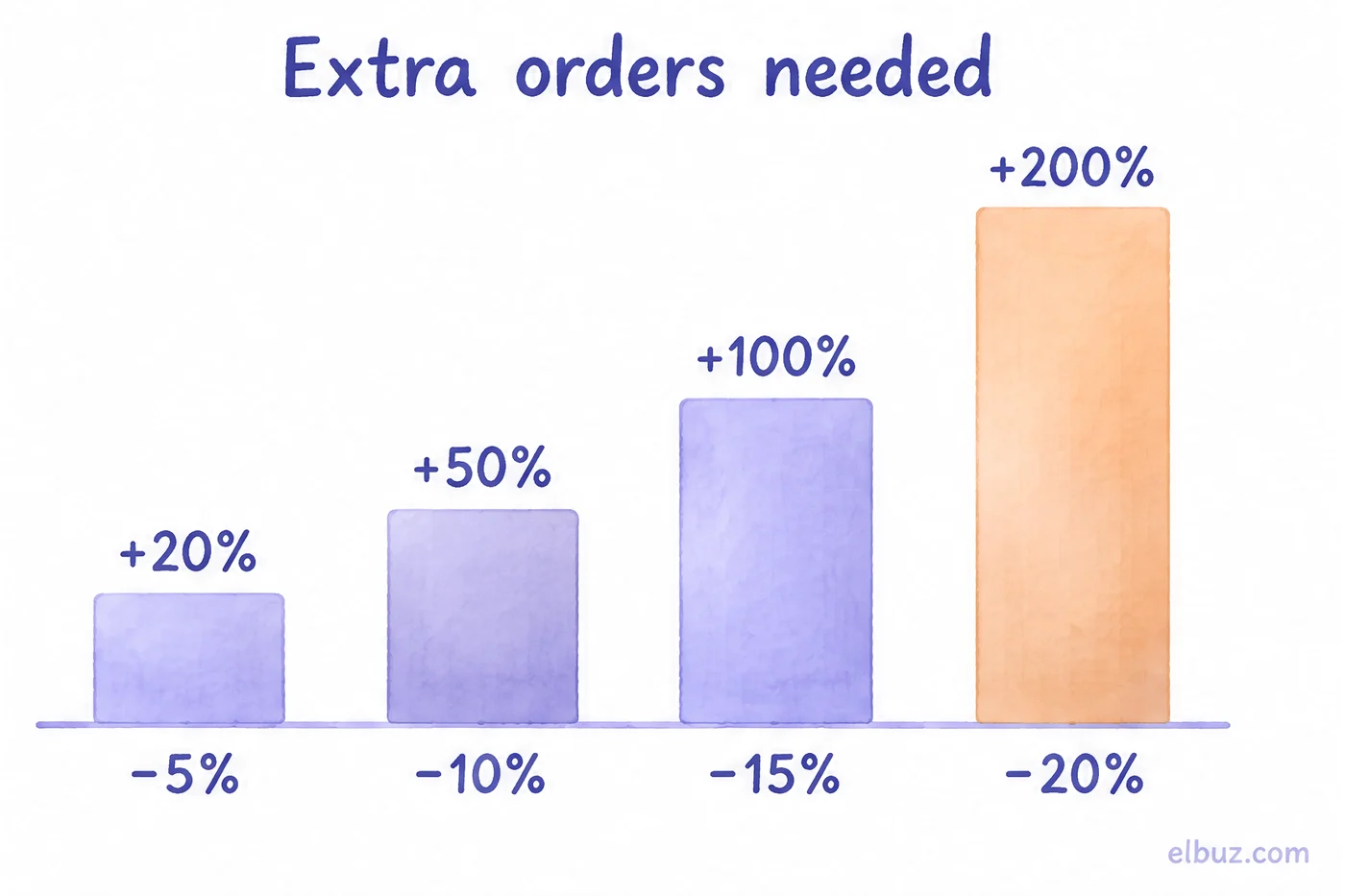
For 15%: 30 ÷ 15 − 1 = 1, so orders must double. Every next 5% of discount costs more than the previous one: at a 30% margin, 20% off requires tripling sales. Hence the rule: give big discounts on high-margin items or on old stock, and a small one or none on a fast-selling low-margin item. The same arithmetic shows why a discount moves the break-even point more than any other change.
A clearance sale is calculated differently. The money for the goods has already been spent, so the question is not "what is left per order" but "is it better to sell now for less or keep the item in the warehouse for another six months". The limit here is the price below which it is better to return the item to the supplier or write it off. How to calculate the margin of a category is covered in what is gross margin.
How promo codes work and when they lose money
A promo code is a discount only for those who enter the code. Its main benefit is measurability: a separate code for each channel shows how many orders an influencer, an email or a printed insert in the parcel brought.
Types of promo codes by who gets them:
- Public — one code for everyone in ads or social media. The simplest and the leakiest: it ends up on coupon sites and is entered by people who would have bought anyway.
- Channel code — its own code for each influencer or email. Shows which channel brings orders.
- Personal single-use — a unique code for one shopper, for example for a second purchase. It cannot be shared and does not leak.
- First-order code — for new customers; check it against an email, phone or account, or regular customers will sign up again. How much a new customer may cost is calculated in customer acquisition cost.
The main question of a promo code is how many shoppers would have bought without it. Illustrative example, numbers for the arithmetic. The same €100 item, a 10% code: an order with the code leaves €20 instead of €30. In a month 100 shoppers used the code.
| Would have bought anyway | Without the code, € | With the code, € | Result of the code, € |
|---|---|---|---|
| 40 | 40 × 30 = 1,200 | 100 × 20 = 2,000 | +800 |
| 67 | 67 × 30 = 2,010 | 100 × 20 = 2,000 | −10 |
| 80 | 80 × 30 = 2,400 | 100 × 20 = 2,000 | −400 |
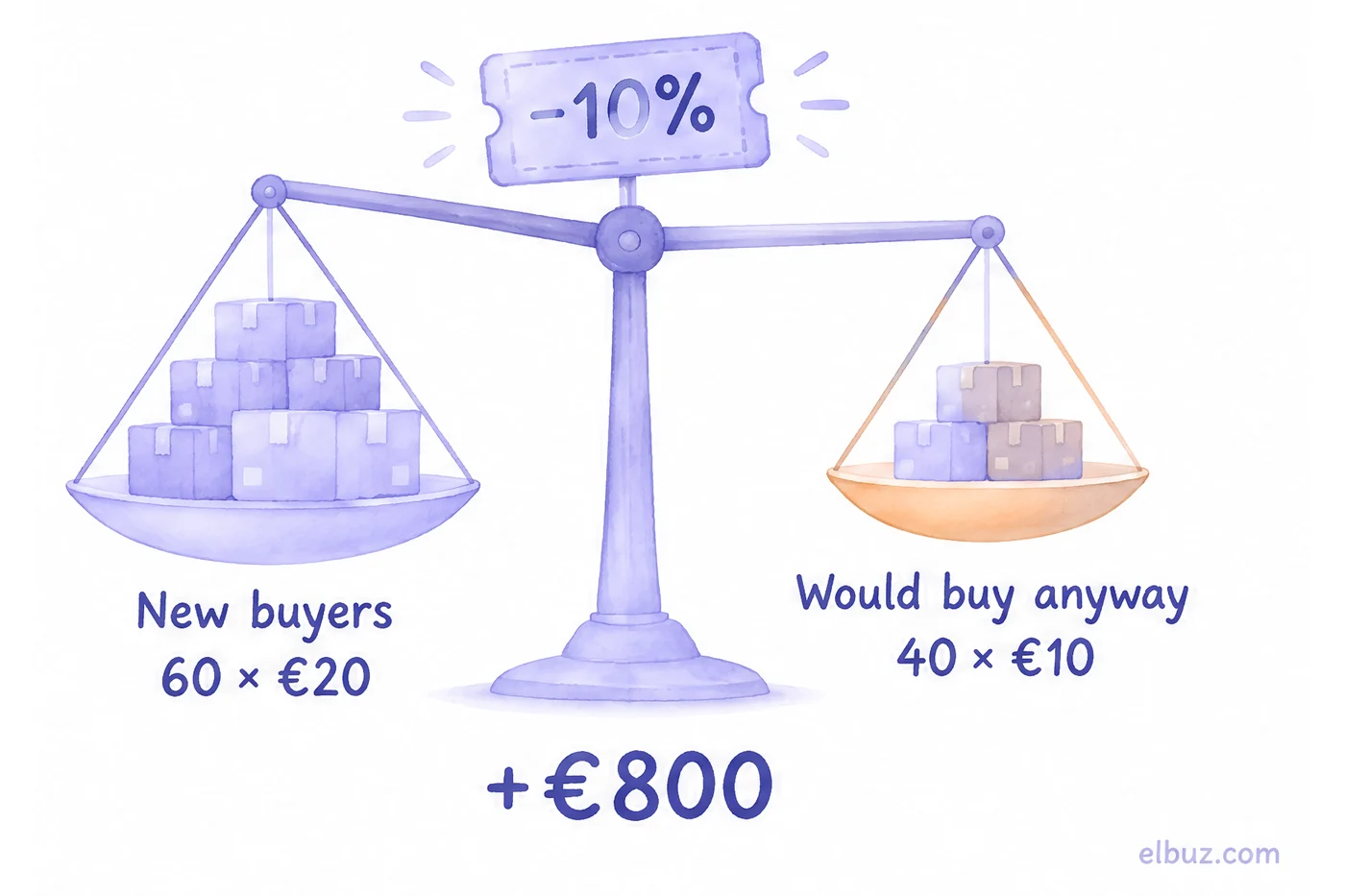
The same another way: 60 new shoppers bring 60 × 20 = €1,200, and the 40 "anyway" shoppers take €10 of discount each, €400 in total — €800 ahead. In this example the code pays off while "anyway" shoppers are fewer than two thirds: 100 × 20 = 30 × 66.7. The higher the margin and the smaller the discount, the more "extra" shoppers a code can carry. That is why public codes with a big discount usually lose money, while channel and personal codes make it: they reach people who would not have come without the code.
Limits worth setting on every code: validity period, minimum order value, categories it applies to, usage limit, and whether it stacks with other discounts. Codes stack only if you allow it, so decide this before launch, not after the first order with two codes. To see which channel a shopper came from, add UTM parameters to your links.
When to run promotions during the year
Run a promotion when shoppers are already thinking about buying: at the change of season, before holidays and events people buy your product for. The occasion is not a date in the calendar but a moment of demand in your niche:
- Change of season. At the end of a season — a clearance; at the start of the next — bundles and volume discounts on seasonal goods.
- Gift holidays — Christmas, Valentine's Day, Mother's Day (the date differs by country): a gift or free shipping over a set amount, gift guides. A Christmas plan with preparation dates is in holiday promotion ideas.
- Black Friday and Cyber Monday — the Friday after US Thanksgiving and the Monday after it. Shoppers compare prices actively, so the discount must be real and measured from your regular price.
- Marketplace events — such as Amazon Prime Day: if you sell there, decide in advance whether to take part and with which items.
- Niche events — back to school, gardening season, heating season: a discount on the category people are searching for right now.
- Your own occasions — the store's anniversary, a new collection: a promo code for your customer list.
Leave a pause between big promotions. If there is always a discount, shoppers stop buying at the regular price, and the word "sale" stops meaning anything.
How to run a promotion without breaking price rules
A "was" price must be one you really charged. In the EU, any announced price reduction must show the prior price — the lowest price of at least the previous 30 days (Article 6a of Directive 98/6/EC). In the US, the FTC's Guides Against Deceptive Pricing treat an inflated former price as deceptive (16 CFR 233.1). Fake urgency is banned in the EU outright (Directive 2005/29/EC, Annex I, point 7). What this means for a promotion:
- do not raise the price before a promotion to "cut" it later;
- state the end date and return the price after it;
- state the terms of a bundle, gift or promo code before checkout: what is included, what it costs separately, what the limits are;
- a countdown timer or "only 2 left" — only if it is true.
Each rule with the exact articles, and how an early sale changes your Black Friday "was" price in the EU, is in the price rules section of holiday promotion ideas for online stores.
How to tell whether a promotion worked
Compare not revenue during the promotion with revenue before it, but the profit from extra orders with what you gave away to every shopper in the promotion. The order:
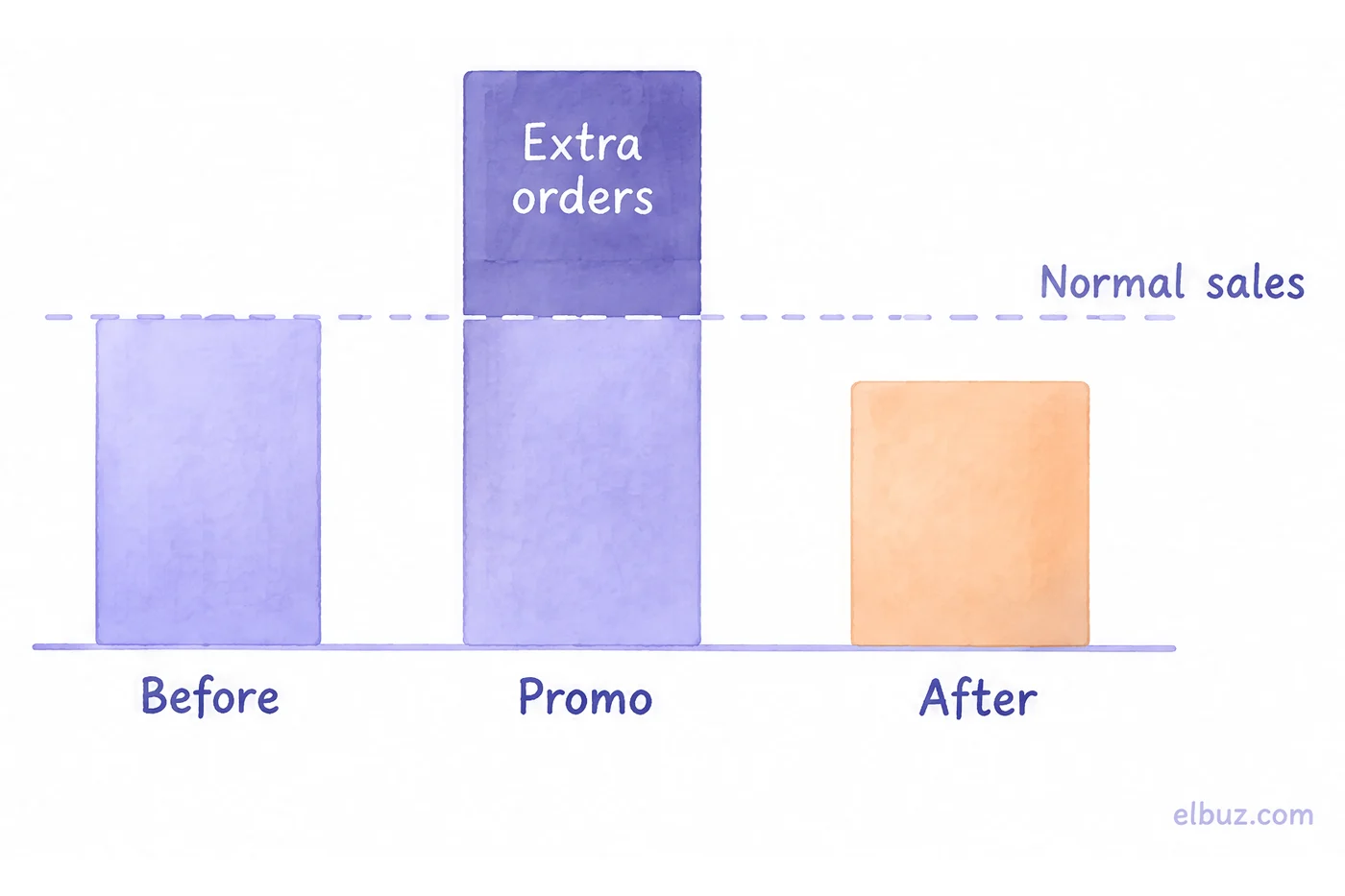
- Baseline. How many orders the store would have had without the promotion: the average for the same weekdays over the 2–4 weeks before it.
- Extra orders. Orders during the promotion minus the baseline.
- The dip after. For a few days after a promotion, sales are often below normal: some shoppers simply bought earlier. Subtract this gap from the extra orders.
- Result. What was left from all promotion orders minus what the baseline orders would have left at the regular price — as in the promo code table above.
Record the result of every promotion in one table: type, discount, dates, extra orders, result in euros. After a year it shows which formats make money in your store and which only move sales from one week to another.
How to run promotions on hundreds of products
When the discount covers a category, brand or price range with hundreds of products, setting sale prices by hand takes long, and removing them after the end is easy to forget. Another problem: the supplier changed prices, and the sale price stayed calculated from the old one.
In Elbuz, sale prices are set by rules: product selection by category, brand, availability or price range, a discount as a percentage, a fixed amount or a fixed price, rounding to a "nice" price and an end date, after which the rule's prices are removed. A separate rule sets a price for a customer group, such as wholesale buyers, or a volume discount "from 5 items". After each supplier price list update, sale prices are recalculated from the new supplier prices. How prices are calculated in general is on the pricing and markup rules page.
An honest caveat: the start date does not delay a promotion — the price appears as soon as the rules are applied. A promotion "from Monday" is created as a disabled rule and switched on that day.
Frequently asked questions
What is a discount strategy in ecommerce?
A plan for which discount to give, to whom and when, built from the goal of the promotion and your margin. It sets the promotion type, the maximum discount, the sales growth it needs and how you will measure the result.
What types of promotions can an online store run?
A time-limited discount, a clearance, volume discounts and bundles, a gift or free shipping over a set amount, promo codes, flash sales and loyalty discounts. Which one fits which goal is in the table of types.
How much discount can I give without losing money?
Less than the share of the price left after the cost of goods and variable costs. If 30% is left, 10% off requires 50% more orders, and 30% off means selling at zero.
Is a discount or a promo code better?
A promo code, if you need shoppers from a specific channel: not everyone gets it, and you see where the order came from. A discount, if shoppers compare prices and need to see the lower price on the product page right away.
Do promo codes stack?
Only if you allow it. Decide for each code whether it combines with other discounts, and state it in the terms of the promotion.
How often should an online store run promotions?
Around the demand moments of your niche, with pauses between them. A permanent discount stops being a promotion: shoppers wait for it and do not buy at the regular price.
Sources
- Directive (EU) 2019/2161, Article 2 — inserts Article 6a into Directive 98/6/EC (prior price, lowest price of at least 30 days) — legislation.gov.uk/eudr/2019/2161/article/2 (text as adopted).
- Directive 2005/29/EC on unfair commercial practices, Annex I, point 7 — legislation.gov.uk/eudr/2005/29/annex/I.
- FTC Guides Against Deceptive Pricing, 16 CFR Part 233 — ecfr.gov/current/title-16/part-233.
Checked on October 31, 2026. All other numbers in the article are illustrative examples for the arithmetic.


