

An ecommerce loyalty program is a set of rewards that gets customers to buy from your store again: a discount, points or cashback toward the next order, tiers with growing perks, a reward for referring a friend, or a free gift with purchase. It pays off only if members actually buy more often: with a 30% margin and a 5% reward, purchases have to grow by at least 20%.
The most common mistake is picking a percentage "like everyone else" without checking what it costs at your margin. The reward is paid on every purchase a member makes, not only on the ones the program brought in. Below: the types of programs and which fits whom, the payback formula on illustrative numbers, a five-step launch and how to check that the program works.
When a store starts thinking about a loyalty program
Usually when new customers get more expensive to win with ads, and the customer list is full of people who bought once and disappeared. The owner searches for "ecommerce loyalty program", sees airline miles, coffee shop apps and lists of loyalty software, and asks: discount or points, what percentage to give, where to start.
"What percentage do others give" is the wrong question here. The percentage follows from your margin and from how much more often customers have to buy. That is one formula, and it is below.
Types of loyalty programs
Loyalty programs differ in when and how the store pays the customer for coming back:
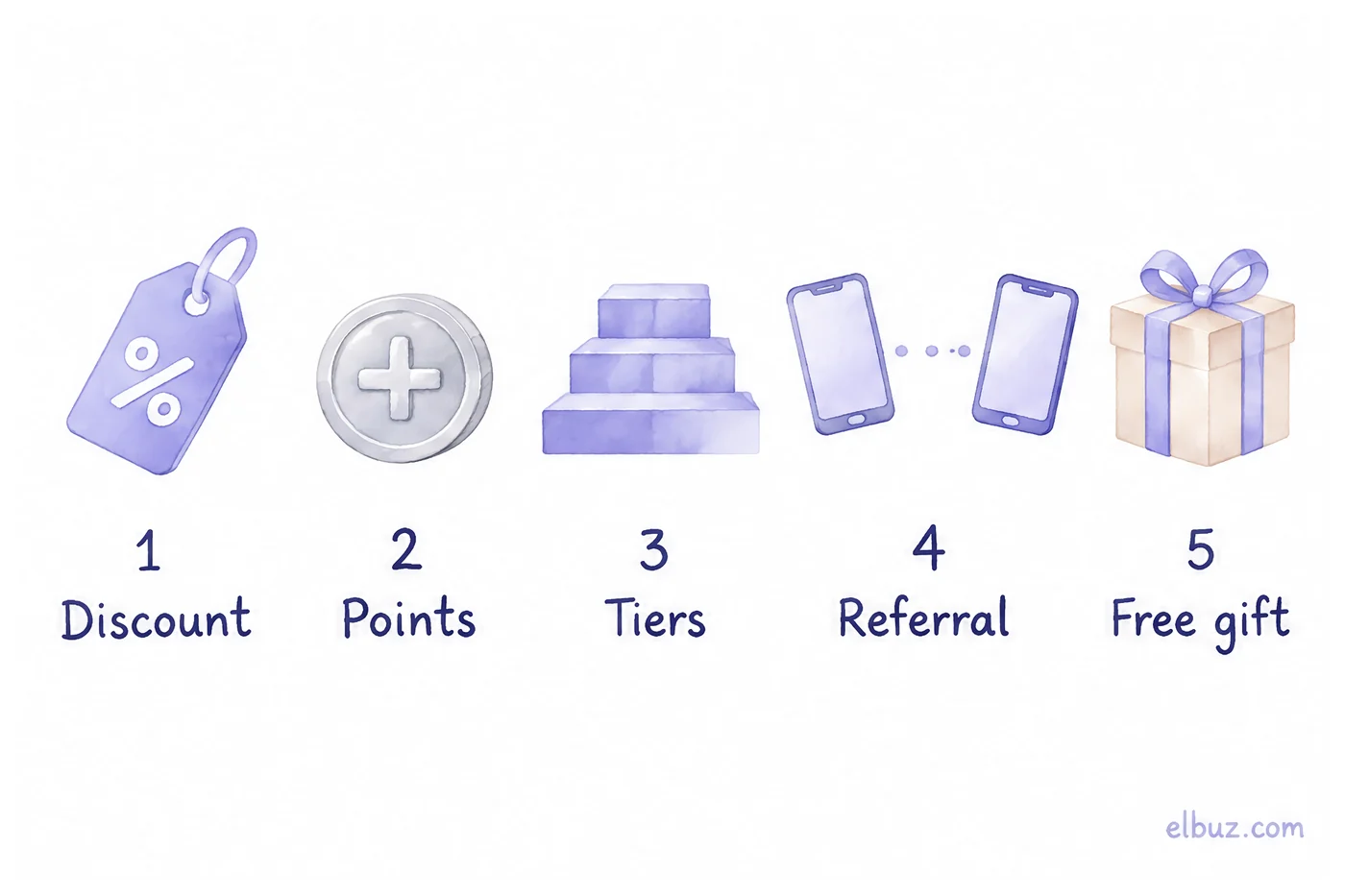
| Type | How it works | Fits | Watch out for |
|---|---|---|---|
| Discount | A standing discount on every order, sometimes growing with total spend | Stores with frequent purchases and a stable margin | You pay on every order right away, including those the customer would have placed anyway |
| Points, cashback | Part of the order value comes back as points the customer spends on the next order | Most online stores | The cost arrives only when points are redeemed; you need expiry rules |
| Tiers (VIP levels) | The more a customer buys in a period, the higher the tier and the bigger the reward | Stores with a wide range and big differences in spend between customers | Harder to explain; tiers need regular review |
| Referral | A reward for a friend who makes a first purchase | Products people recommend to each other | Check that the "friend" is not the same buyer with a new email |
| Free gift with purchase | A gift above an order threshold or with every Nth purchase | Small stores and niches with inexpensive add-on products | Count the gift at cost, not at retail price |
Technically, every program works the same way: the customer is identified (account, email, phone), the store credits the reward by the rules, and the customer sees the balance and uses it on the next order. For an online store the simplest start is points on the customer's balance: they do not lower the price for everyone and cost you only when the customer comes back.
Will a loyalty program pay off: the formula
A program pays off if the margin from a member after rewards is higher than without the program. That gives the minimum growth in purchases:
Required lift in purchase frequency = reward ÷ (margin − reward), with reward and margin as a percentage of the order value.
Illustrative example for the arithmetic, not market data. A customer buys twice a year with an average order of €100, and your margin is 30%, or €30 per order. Without a program that is 2 × €30 = €60 of margin a year. With a 5% points reward, each order brings €30 − €5 = €25.
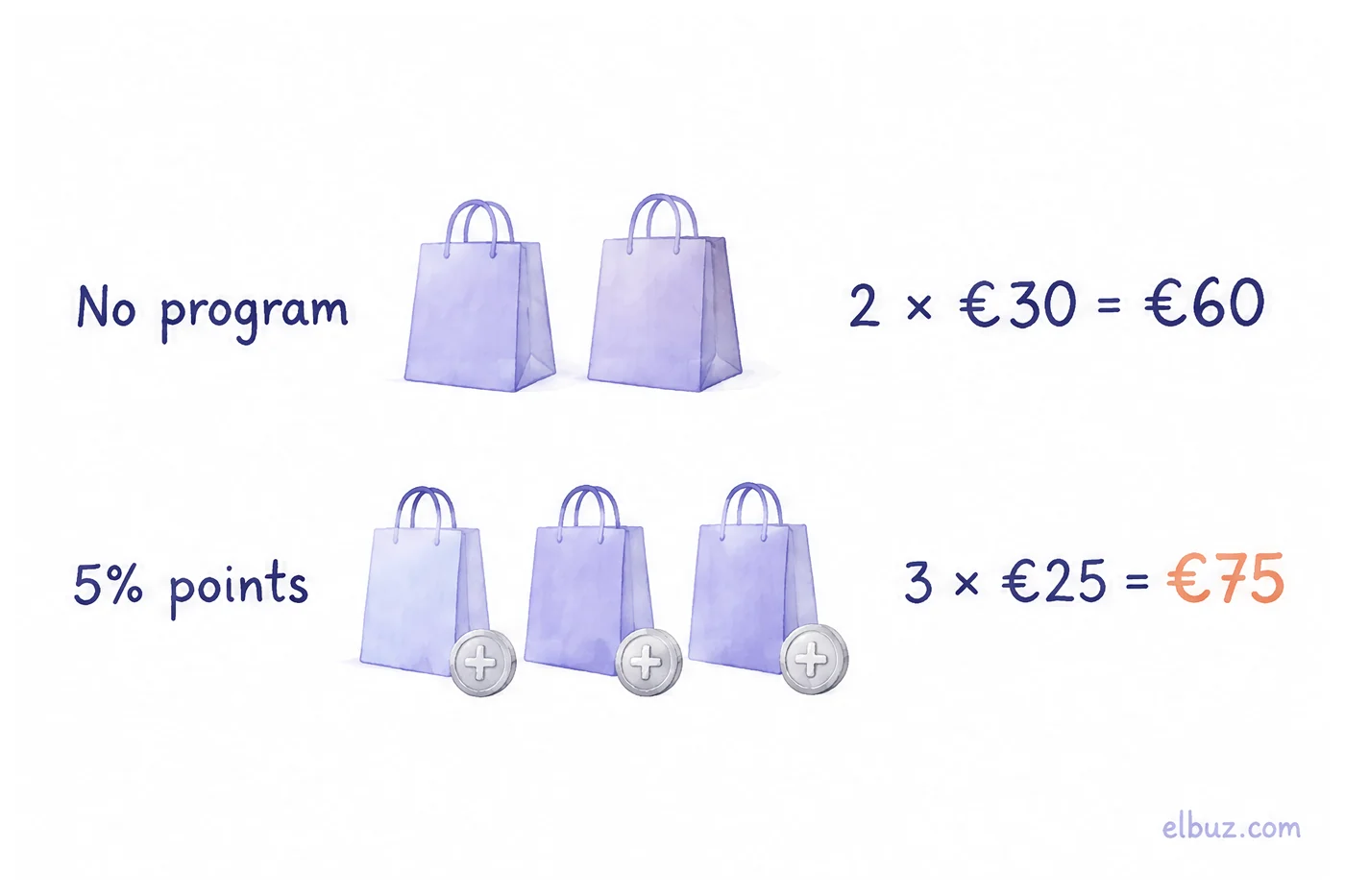
- The customer still buys twice: 2 × €25 = €50 — the program cost you €10.
- The customer buys three times: 3 × €25 = €75 — €15 more margin.
- Break-even: 5 ÷ (30 − 5) = 20%, or 2.4 purchases a year instead of 2.
Margin drives the result more than anything else. The same 5% reward needs very different growth:
| Margin | Reward 3% | Reward 5% | Reward 10% |
|---|---|---|---|
| 15% | +25% | +50% | +200% |
| 30% | +11% | +20% | +50% |
| 45% | +7% | +12.5% | +29% |
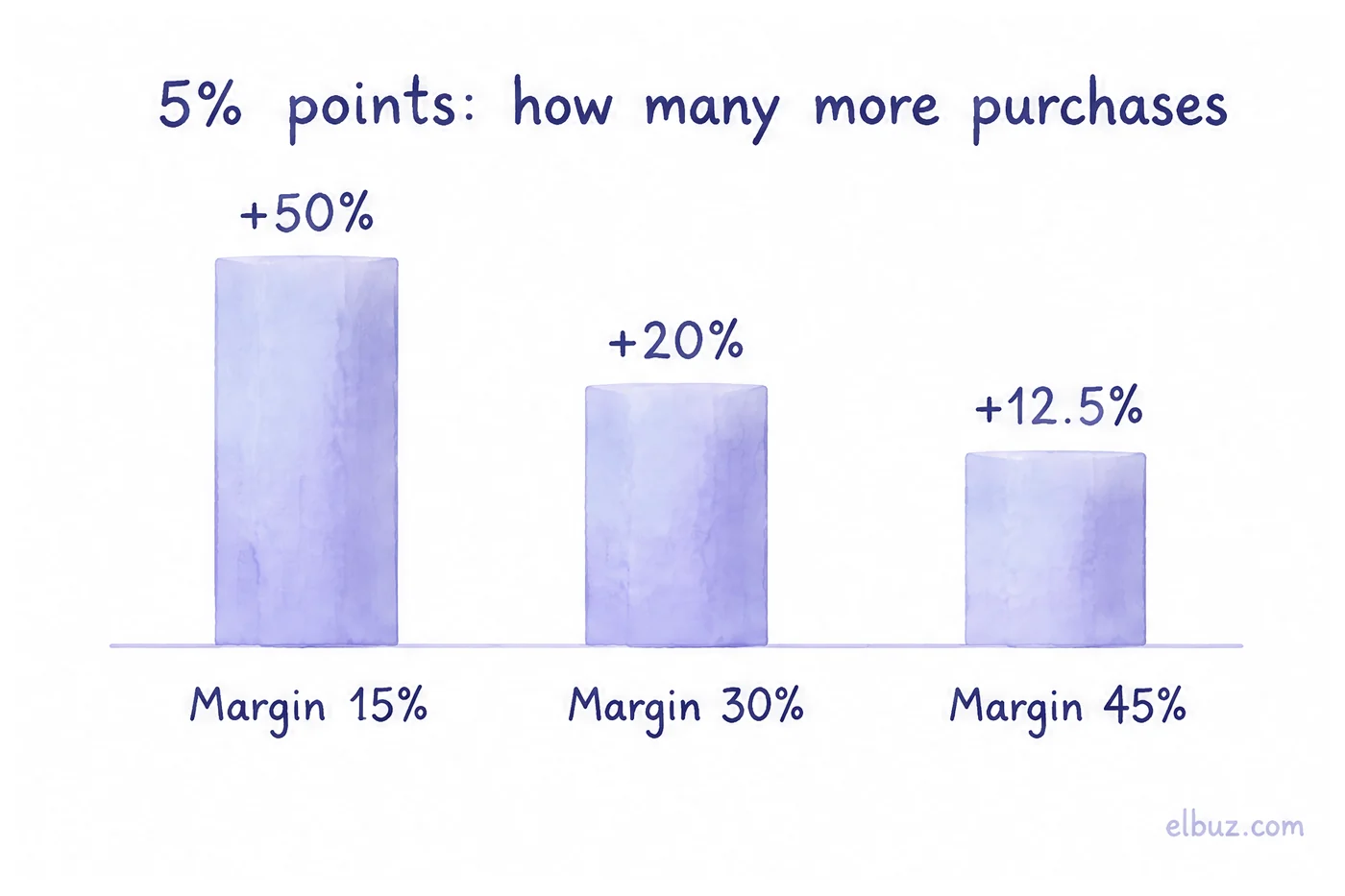
The takeaway: at a 15% margin a 10% reward practically never pays off — customers would have to buy three times as often. A low-margin store is better off with 2–3% or with a reward that costs you less than it is worth to the customer: free shipping, or a gift whose cost is well below its retail price. How to calculate your margin — in gross margin vs markup.
Which is better for the store: discount or points
Points are cheaper for the store than a discount of the same size: you pay only for the points customers redeem, and only when they come back. A discount you give away on every order at once.
Illustrative example. If customers redeem 60% of the points they earn, a 5% reward really costs 3% of the order — €3 on a €100 order. The required lift by the formula: 3 ÷ (30 − 3) ≈ 11% instead of 20%. So track the redemption rate from the first month: it sets the real price of the program.
The flip side: points that expire too fast or that nobody sees do not change behavior. Make the expiry period longer than the usual time between purchases in your niche, and keep the balance visible — in the cart, in the order confirmation email, in reminders.
How to launch a loyalty program in five steps
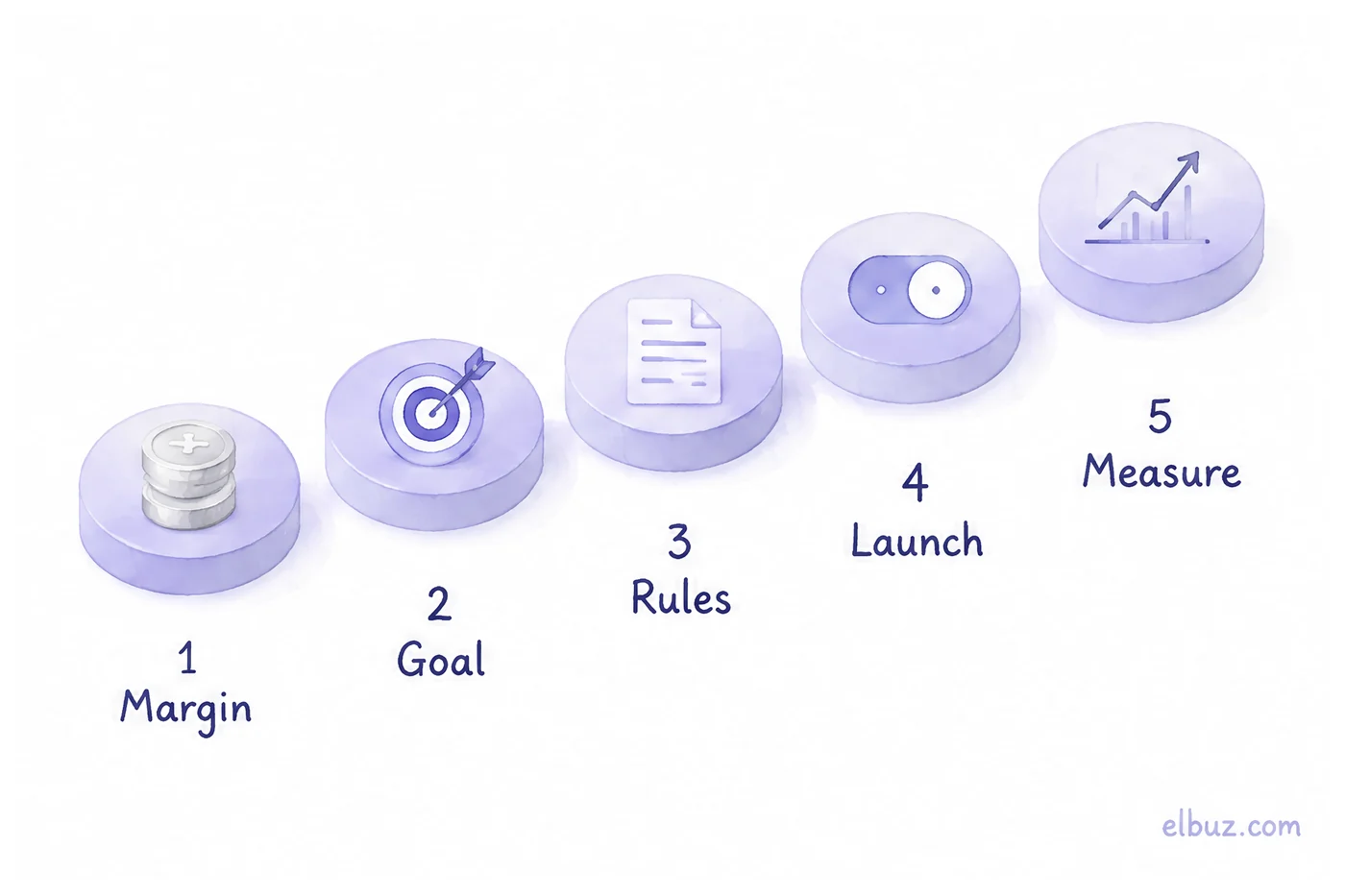
- Calculate the margin. Take the average margin of the categories the program will cover. It sets the maximum reward from the table above.
- Set a goal in numbers. What has to change: purchase frequency, the share of repeat customers or the average order value. One main metric.
- Write down the rules. How much is earned, which products are excluded (sale items, low-margin ones), when points expire, what share of an order points can pay for. Put the rules on a separate page of your site.
- Launch and tell customers. Announce it to existing customers and show earned points in the cart and in the confirmation email. In the US, every marketing email must include a working opt-out, and opt-outs must be honored within 10 business days (CAN-SPAM); in the EU, check that your customers agreed to marketing emails under the rules that apply to you.
- Measure the result. After two or three purchase cycles, compare members with customers who do not use the program — next section.
How to check that the program works
The program works if members buy more often than similar customers without it, and the difference covers the cost of rewards. Sales growth after launch alone proves nothing: it may come from the season or from ads.
- Purchase frequency of members and non-members over the same period.
- Repeat purchase rate — how many customers bought a second time within your usual interval.
- Redemption rate — the real price of the program.
- Margin per customer per year after rewards — the final number that shows whether it paid off.
If members do not buy more often, change the reward or how you remind them, not the percentage. Retention does not rest on rewards alone: what makes a customer come back or leave is covered in ecommerce customer service, and how to raise order value — in cross-selling and upselling.
Mistakes that keep a program from paying off
- The same reward on every product. In categories with a 10% margin the same percentage eats the profit. Exclude low-margin and sale items.
- A discount instead of points "because it is simpler". You pay for purchases the customer would have made anyway.
- The customer cannot see the balance. Points nobody is reminded of do not bring buyers back.
- No comparison with non-members. Without it you cannot tell whether the program changed anything.
- Complicated rules. If the condition does not fit in one sentence, customers will not use it.
Whom to reward: a program starts with your customer base
To measure purchase frequency, repeat customers and "sleeping" ones, you need a base where each customer is one record with an order history. In Elbuz, the CRM calculates this from purchases on its own: the customer stage — lead, regular, sleeping — the segment, the rating and the average order value. You see who buys often and who disappeared long ago, so you know whom to remind about rewards and how frequency changed after launch. How customers and orders are organized — on the ecommerce CRM page.
The AI assistant in your website chat neither offers nor promises discounts: the loyalty programme terms stay with you.
Frequently asked questions
What is an ecommerce loyalty program?
It is a set of rules by which an online store rewards customers for buying again: with a discount, points, a gift or perks. The goal is for customers to come back to you rather than to a competitor.
How do loyalty programs work?
The store identifies the customer by account or email, credits a reward for each purchase according to the program rules, and the customer uses it on the next order as a discount or by paying with points.
What are the most common types of loyalty programs?
Discount, points or cashback, tiered (VIP), referral, and a free gift with purchase. For an online store, points on the customer's balance usually fit best — comparison of types.
How much cashback or points should a store give?
It depends on your margin: required lift in purchases = reward ÷ (margin − reward). At a 30% margin a 5% reward pays off if customers buy 20% more often; at a 15% margin, only if they buy 50% more often.
How much does a loyalty program cost?
Its main cost is the rewards customers actually redeem, plus the software or setup. Multiply the reward by the redemption rate: at 5% points and 60% redemption, the program costs 3% of members' order value.
Is a discount or a points program better?
For the store, points of the same size: you pay only for redeemed points and only when the customer comes back. A discount you give away on every order at once.
How do you create a loyalty program?
Start with your margin and a goal: how much you can give per order and what should change — purchase frequency, repeat customers or order value. Then choose the reward, write the rules in one paragraph and compare members with non-members.
Sources
- Federal Trade Commission, "CAN-SPAM Act: A Compliance Guide for Business" — opt-out in every commercial email, honored within 10 business days — ftc.gov.
Checked on October 31, 2026. All other numbers in this article are illustrative examples for the arithmetic.


