

A CMS (content management system) is software that lets you add and edit pages, products and text on a website from an admin panel, without a developer. By who runs the server and what you pay for, there are four types of CMS: open source on your own hosting (WordPress, OpenCart, PrestaShop), hosted SaaS platforms with a subscription (Shopify, BigCommerce), website builders (Wix, Squarespace) and custom systems built by an agency.
For an online store the choice is usually between open source and SaaS, and the common mistake is to compare only the licence price: a free CMS needs hosting, extensions and developer hours, and a subscription needs paid apps and a plan you outgrow quickly. Below: how a CMS works, a table of the types, an illustrative yearly cost and five checks before you choose.
When people ask what types of CMS there are
Usually someone is about to open an online store or rebuild an old site, and hears "CMS", "platform" or "WordPress or Shopify" from an agency or friends for the first time. The first searches are "what is a CMS" and "types of CMS", followed by "best CMS for ecommerce" and "is there a free CMS".
"Which CMS is best" is the wrong question: there is no single best one. The right one is who will maintain the store and what it will cost per year, with all extensions and developer hours.
What a CMS is, in simple terms
A CMS separates a website into content and design: you add a product in the admin panel, it is stored in a database, and a template displays it on the site in the right design. So you can change a price or add a page without touching code, and change the design without touching the products.
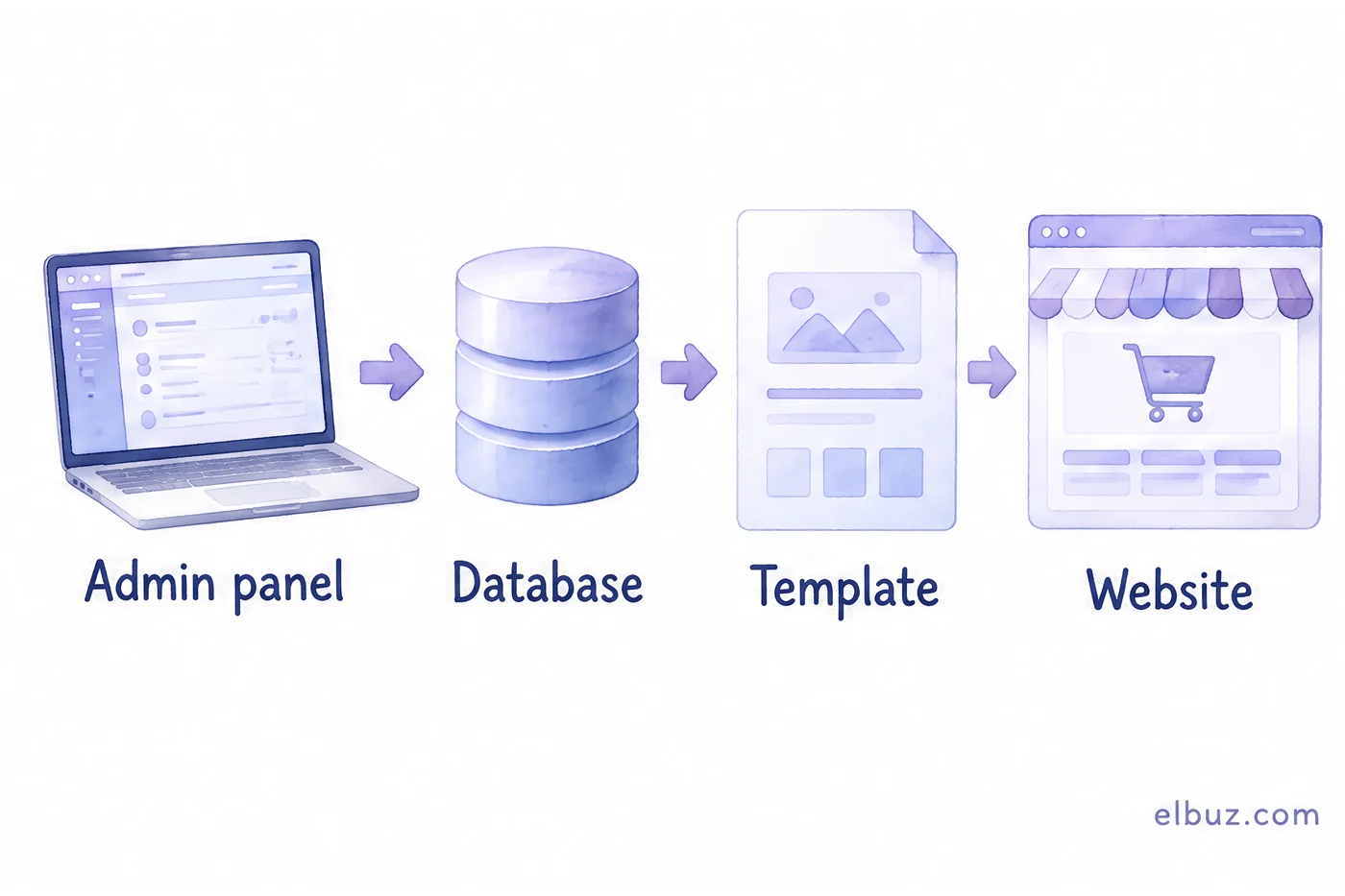
- Admin panel: where you manage products, pages, orders and users.
- Database: where products, text, orders and settings are stored.
- Template (theme): the design that shows data from the database to visitors.
- Extensions (plugins, apps): extra features such as payments, shipping, filters and data exchange with other software.
Types of CMS: the four kinds
The main difference between CMS types is who is responsible for the server, updates and security, and what you pay for. That decides both the cost and how far you can customise the site.
| Type | Examples | Who runs the server and updates | What you pay for |
|---|---|---|---|
| Open source | WordPress + WooCommerce, OpenCart, PrestaShop, Magento Open Source, Joomla, Drupal | You or your developer | Hosting, paid extensions and themes, developer time |
| SaaS platform | Shopify, BigCommerce | The provider | A monthly subscription, paid apps |
| Website builder | Wix, Squarespace | The provider | A subscription; selling usually needs a higher plan |
| Custom | A system built by a web agency | The agency that wrote it | Development and every change |
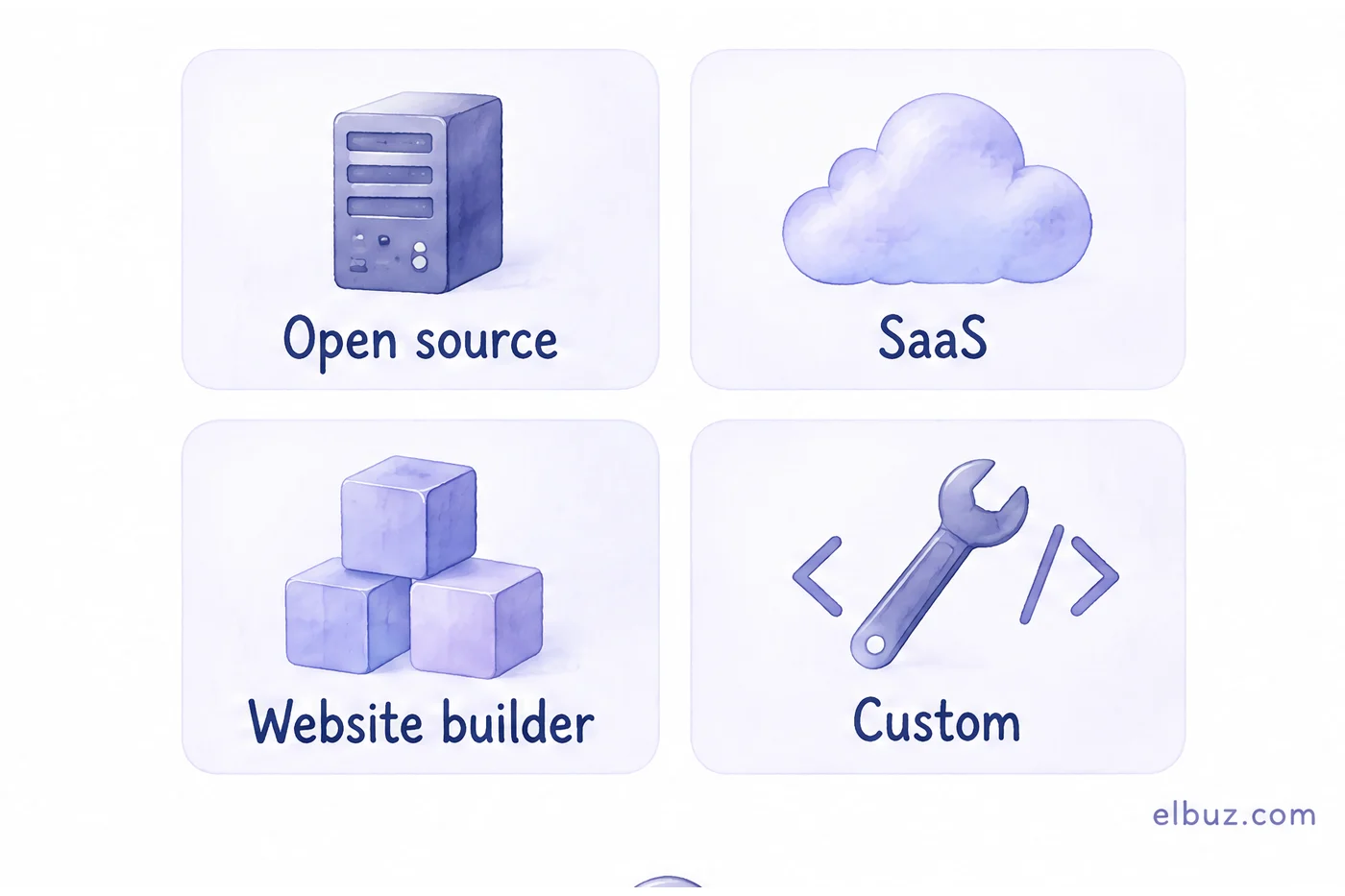
Open source means the code is open: you download the CMS for free and change it as you like. The price of that freedom is that the server, security updates and backups are on you. SaaS takes all of that on, but the site lives within the plan and the platform's features. Website builders are handy for a business card site or a landing page; for a store with thousands of products their features often fall short. A custom CMS fits an unusual task but ties you to one agency: if it stops supporting the system, nobody will update or extend it.
You will also meet the words headless and traditional (coupled) CMS. That is a second axis, about architecture: a traditional CMS stores content and renders the pages itself, while a headless CMS only stores content and serves it through an API to a separate front end, a mobile app or several sites at once. Headless gives developers freedom and needs a development team; for a typical small store, a traditional store CMS is simpler.
Which CMS to choose for an online store
For a store, pick a CMS built for selling rather than a general-purpose one: it already has a cart, product variants, payments, shipping and orders. Among open source options these are WooCommerce (a store plugin for WordPress), OpenCart, PrestaShop and Magento Open Source; among SaaS, Shopify and BigCommerce.
| CMS | Type | Who it suits |
|---|---|---|
| WooCommerce | Open source, WordPress plugin | A site already on WordPress, where the store adds to the content |
| OpenCart | Open source | A small or mid-size store with a developer or contractor at hand |
| PrestaShop | Open source | A store that wants a catalog and extensions from a module marketplace |
| Magento Open Source | Open source | A large catalog with its own development team |
| Shopify, BigCommerce | SaaS | Anyone who does not want to deal with servers and updates |
There is deliberately no "best CMS" ranking here: the difference between them is smaller than the difference between the teams that set them up. Choose by who will maintain the store and by the checks below.
How much a CMS costs per year
Compare all payments for a year, not the licence price; for open source and SaaS they are made of different items:
Yearly cost = licence or subscription × 12 + hosting + domain + paid extensions and apps + developer hours × rate
Illustrative example for the arithmetic; the numbers are not the prices of any specific CMS. Open source: hosting €10 a month, €120; domain €15; paid payment, shipping and filter extensions €200; 20 developer hours at €25, €500. Total €835 a year. SaaS: subscription €39 a month, €468; apps €15 a month, €180; domain €15; 4 developer hours, €100. Total €763 a year.
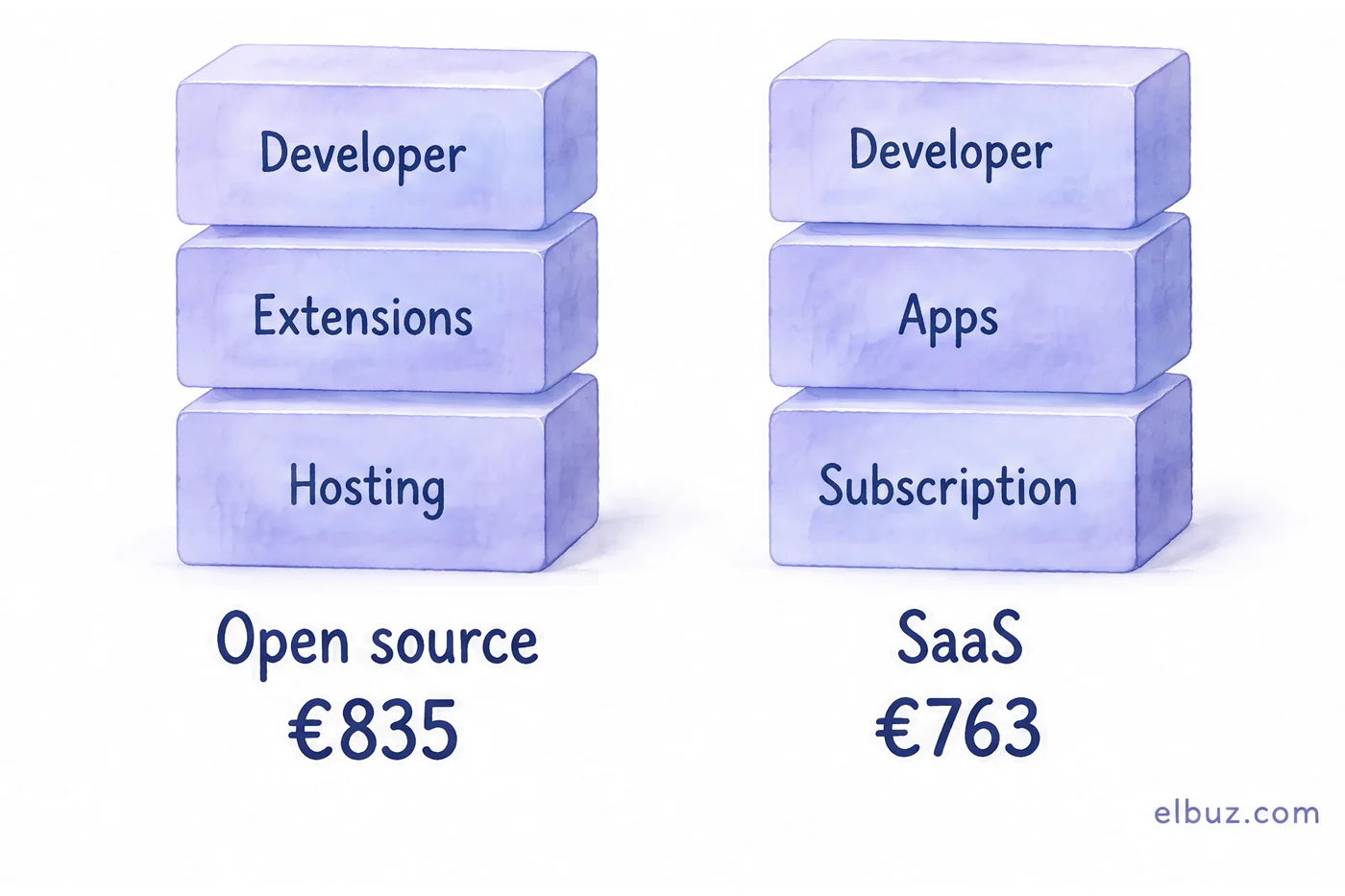
In this example the "free" CMS costs more, because developer hours make up most of the sum. In the second year the picture changes: the extensions are already bought, so open source costs only hosting, the domain and support, while the SaaS subscription is paid every year. Run both options over two or three years with your own developer rate and real plan prices.
How to choose a CMS: 5 checks
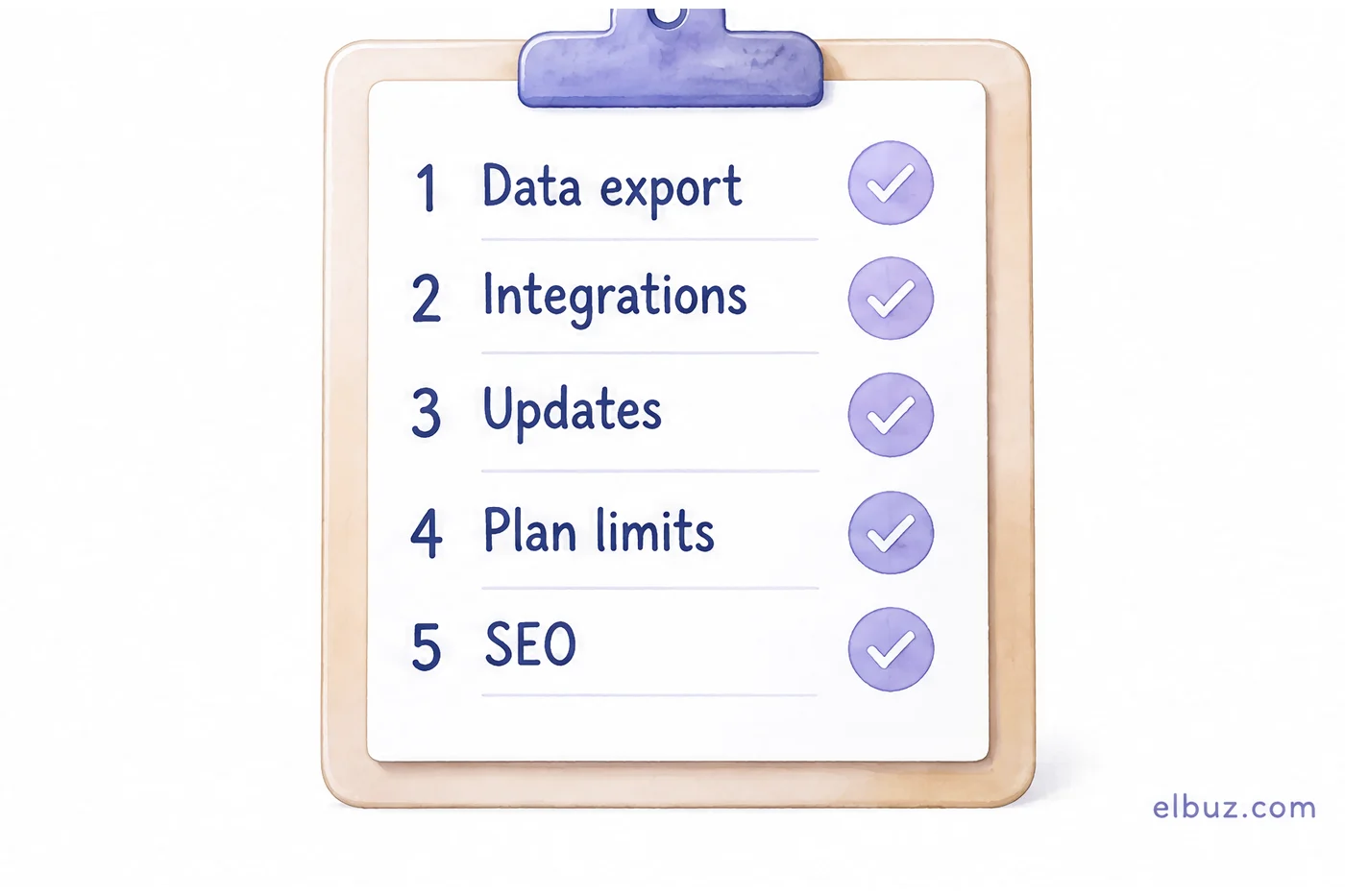
Before you choose, check the five things that cost the most to fix after launch:
- Data export. Can you export products, customers and orders to a file? Without it, moving to another CMS means re-entering everything by hand.
- Integrations. Are there ready extensions for your payment providers, carriers, marketplaces and accounting software, or will you have to commission development?
- Updates and security. Who installs updates, makes backups and is responsible if the site is hacked?
- Plan limits. For SaaS: how many products, staff accounts and languages are allowed, and what the next plan costs.
- SEO. Can you set page URLs, titles, descriptions and redirects without a developer?
Run every check on a demo or during a free trial, not by reading the website: upload 20–30 of your products, place a test order and try to export everything back to a file.
When it is easier to launch the store on Elbuz CMS
When you already keep, or plan to keep, products, prices and stock in Elbuz (from supplier price lists, for product feeds) and do not want to maintain a separate store server.
Elbuz CMS is built on the OpenCart 3 core and runs as a hosted service: the store is created from your Elbuz catalog in about two minutes, the service takes care of SSL, backups and updates, and Elbuz picks up orders from the site every 5 minutes. Products reach the site from the same catalog that feeds your other sales channels. More on the Elbuz CMS page; if your store already runs on WooCommerce, OpenCart or PrestaShop, the same catalog can feed it instead, see product information management.
Who it does not suit: if you need a blog or a company website without products, a store CMS is overkill; WordPress and website builders are made for that.
Elbuz CMSAn online store from your catalog without setting up hosting, 14 days free
Frequently asked questions
What is a CMS in simple terms?
An admin panel for changing a website's content (pages, products, text) without knowing code. The data is stored in a database, and a template shows it to visitors.
What are the different types of CMS?
Four by hosting: open source on your own hosting, hosted SaaS platforms, website builders and custom systems. The difference is who runs the server and what you pay for, see the table above. By architecture, CMSs are also split into traditional and headless.
What are some examples of CMS platforms?
WordPress, Joomla and Drupal for content sites; WooCommerce, OpenCart, PrestaShop, Magento Open Source, Shopify and BigCommerce for stores; Wix and Squarespace among website builders.
What is the best CMS for ecommerce?
There is no single best one: choose among store CMSs (WooCommerce, OpenCart, PrestaShop, Magento, Shopify, BigCommerce) by who will maintain the store and by the cost per year.
Is there a free CMS?
Yes, open source CMSs such as WordPress, OpenCart, PrestaShop, Joomla and Drupal are free to download. You still pay for hosting, paid extensions and developer time.
What is the difference between a CMS and a CRM?
A CMS manages what visitors see on the website: pages, products, text. A CRM manages customers and sales: contacts, orders, conversations and follow-ups. A store usually needs both, connected so that orders from the site reach the CRM.
Can I move a store from one CMS to another?
Yes, if the old CMS can export products, customers and orders to a file. That is why data export is the first of the five checks.
Sources
- OpenCart: "free shopping cart system… open source PHP-based" — opencart.com.
- WooCommerce: "open-source ecommerce platform" — woocommerce.com; WordPress — wordpress.org.
- PrestaShop: free open source edition — prestashop.com.
- Adobe: Magento Open Source — business.adobe.com.
- Shopify: plans and pricing — shopify.com/pricing.
Checked on October 31, 2026. All prices in the article are illustrative examples for the arithmetic.


