

Ecommerce customer service is the set of rules and processes by which an online store answers questions, confirms and ships orders, solves problems and refunds money — equally well every day and with every employee. It is measured with a few numbers: how long the customer waits for the first reply, what share of requests is solved on time, how customers rate the answers, and how many buyers come back for a second order.
Stores usually start improving service with training or scripts, but the place to start is these numbers: without them you cannot see where customers wait and where they leave. Below: where an online store loses customers most often, a calculation of why service pays off through repeat orders, rules you can actually check, the order of improvements, and the metrics.
When stores look into customer service
Usually the store is growing: there are more requests than one person can keep in their head, and the first complaints arrive — "nobody answered", "where is my parcel", "my refund still hasn't come". The owner searches for "ecommerce customer service", "customer service standards examples" and "how to improve customer service", and later "csat vs nps" and "how to measure customer service".
These searches often hide a wrong assumption: that service means a polite rep. Politeness matters, but customers leave for other reasons: the reply never came, the order was not confirmed, the problem was passed from hand to hand. That is a matter of rules and response times, not tone. And how to say “no” so the customer stays — see how to say no to a customer without losing them.
What ecommerce customer service means
Customer service is everything the customer gets from the store apart from the product, and the rules by which it is done. Two neighbouring terms are worth telling apart:
- Customer support — the specific actions: answer, process, ship, refund.
- Customer service — the rules and processes that make these actions predictable, whoever is on shift today.
- Customer experience — the overall impression from every contact with the store, including the website, packaging and ads.
Customers judge service quality not by promises but by how much effort it took them: waiting for a reply, explaining the same problem a third time, tracking down the parcel themselves.
Where an online store loses customers
Most often at the hand-offs between stages: the question did not reach the person responsible, the tracking number was not sent, the problem went to another rep without a description.
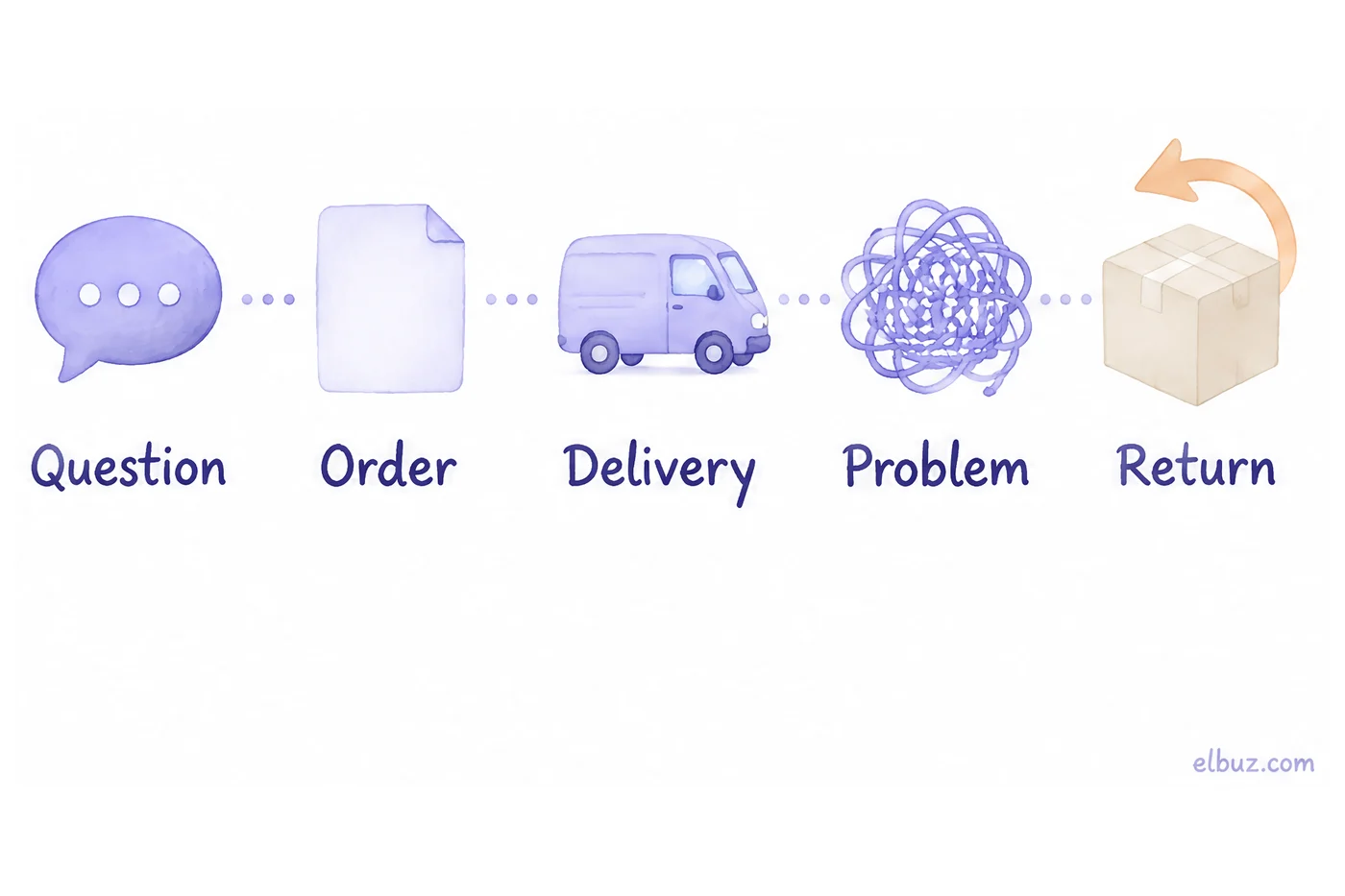
| Stage | What the customer expects | Where stores most often fail |
|---|---|---|
| Question before buying | A fast, precise answer on stock, price, shipping | An answer hours later, "I'll check" with no follow-up |
| Order | A confirmation, clear dates and total | Nobody confirms; the customer does not know if the order went through |
| Delivery | A tracking number and a delivery notice | The customer has to ask "where is my parcel" |
| Problem | One person who sees it through | The customer is passed between reps and explains everything again |
| Return | Clear conditions and a refund date | Terms are not written down, the refund comes "some time" |
Every line in the right column is an incoming request that did not need to happen. "Where is my parcel?" disappears once the customer gets the tracking number and a delivery notice without asking.
Why service pays off: repeat-customer math
Service pays off through repeat orders: you pay for the first purchase with ads, and the second and third come from the same customer without them. Poor service takes away exactly those orders.
Value of a customer per year = (margin − acquisition cost) + margin × number of repeat orders.
Illustrative example for the arithmetic, not market data. Acquiring a new buyer costs €20 in ads, the margin per order is €30.
- The customer bought once and never came back because their parcel question went unanswered for two days: 30 − 20 = €10.
- The customer bought and came back twice: 10 + 30 × 2 = €70.
The difference is €60 from one customer, and it does not depend on the ad budget. How to calculate your own acquisition cost — in CAC: customer acquisition cost.

Customer service rules you can check
A rule is useful only if you can check it. "Be polite" cannot be checked; "reply in chat within 15 minutes during business hours" can. The times in the table are examples — set your own. Outside business hours, a chatbot can give the first reply to typical questions — how to write a script for it.
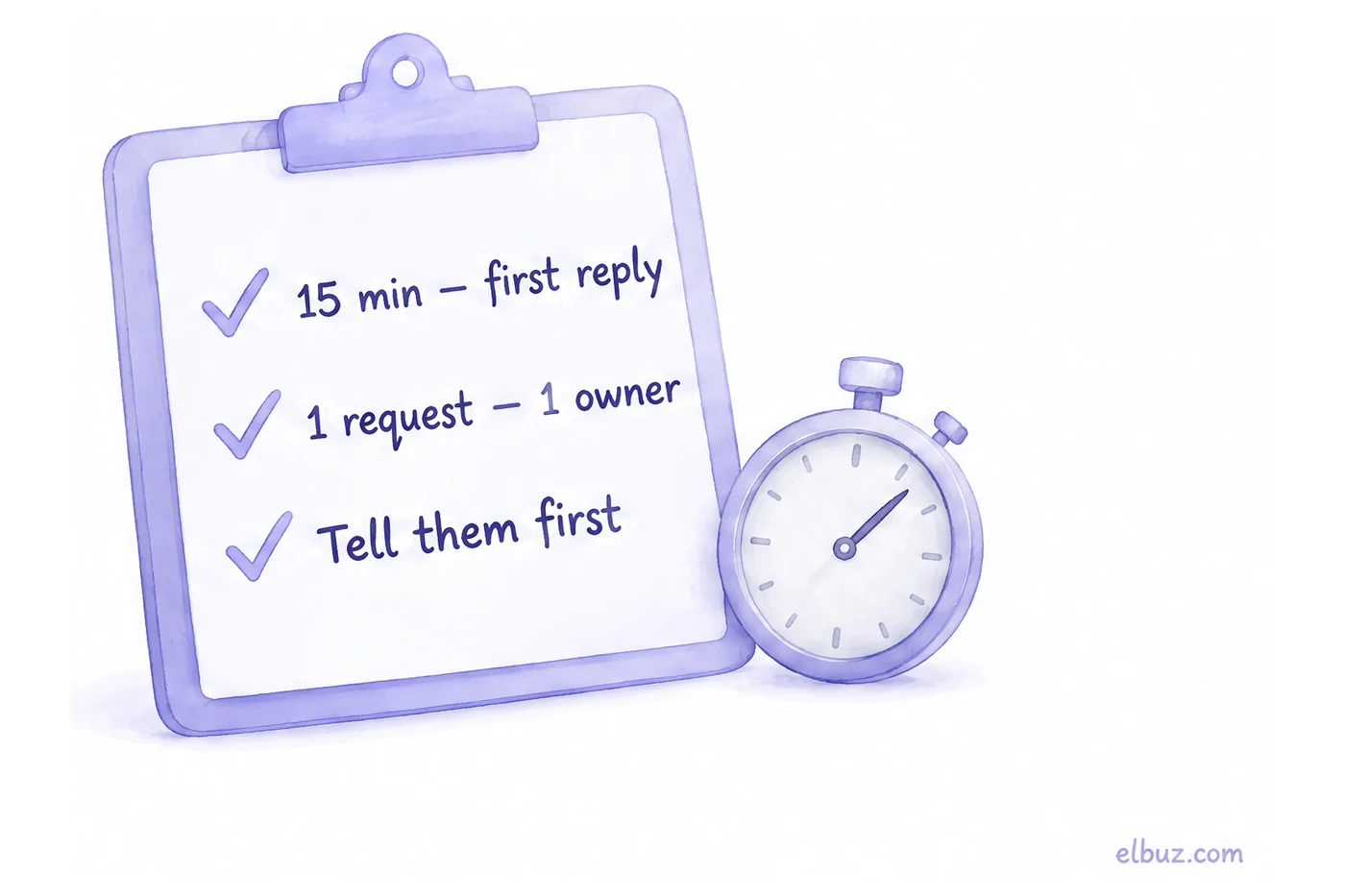
| Rule | How to check |
|---|---|
| A first-reply time for each channel (for example, chat — 15 min, email — 2 hours during business hours) | Share of requests where the time ran out |
| One request — one owner until it is solved | Are there requests without an owner |
| Every reply has a solution or a deadline: "I'll check the warehouse and write back by 2 pm", not "we're looking into it" | Spot-reading closed requests |
| The customer is not asked again for what you know: order number, address, earlier request | Spot-reading, "I already wrote" complaints |
| Reply in the channel the customer used | Spot-reading |
| The customer hears about a delay or an out-of-stock item from you first | "Where is my order" requests you had not yet notified |
| It is written down what a rep decides alone (a different pickup point, a small compensation) and what goes to a manager | How many requests are waiting for a manager's decision |
| Refunds follow the published returns policy; in the EU, a withdrawal refund is due within 14 days | Refunds older than the deadline |
| After a request is solved, the customer is asked to rate the reply | Share of requests with a rating |
How to improve customer service: seven steps
- Bring all requests into one place. While emails sit in a mailbox, chats in three messengers and marketplace questions in seller accounts, some requests get lost and nothing can be measured.
- Measure where you are. How many requests a day, how long until the first reply, how many were left unanswered. This is your baseline.
- Find the five most common questions. Usually "where is my order", shipping, payment, returns and stock. For each — a ready answer, and where possible a message that answers it before it is asked.
- Set response times and owners. Who answers in which channel, and what happens when time runs out.
- Tell customers first. Order confirmation, dispatch with the tracking number, delivery notice — each message removes one incoming question.
- Collect ratings and read the bad ones. A manager reviews every bad rating: what happened, can it be fixed for this customer, does a rule need to change.
- Measure again every month. The same numbers as in step two. Improvement only shows in comparison.
Customer service metrics: CSAT, NPS and response time
Five metrics are enough for an online store, as long as you count them the same way every month.
| Metric | What it shows | How it is calculated |
|---|---|---|
| First response time | How long the customer waits to be noticed | From the request to the first reply by an employee, in business minutes |
| Requests on time | Whether you keep your own rules | Share of requests where the reply time did not run out |
| CSAT | Satisfaction with a specific answer | After a request is solved, the customer rates it "good" or "bad"; share of "good" among all ratings |
| NPS | Willingness to recommend the store | "How likely are you to recommend us?" on a 0–10 scale; share of 9–10 minus share of 0–6 |
| Repeat purchase rate | Whether customers come back | Share of customers with two or more orders a year |
Scores of 7–8 count neither for nor against NPS, but they are part of the total number of responses. Example: out of 100 responses, 60 scores of 9–10 and 10 scores of 0–6 give NPS = 60% − 10% = 50.
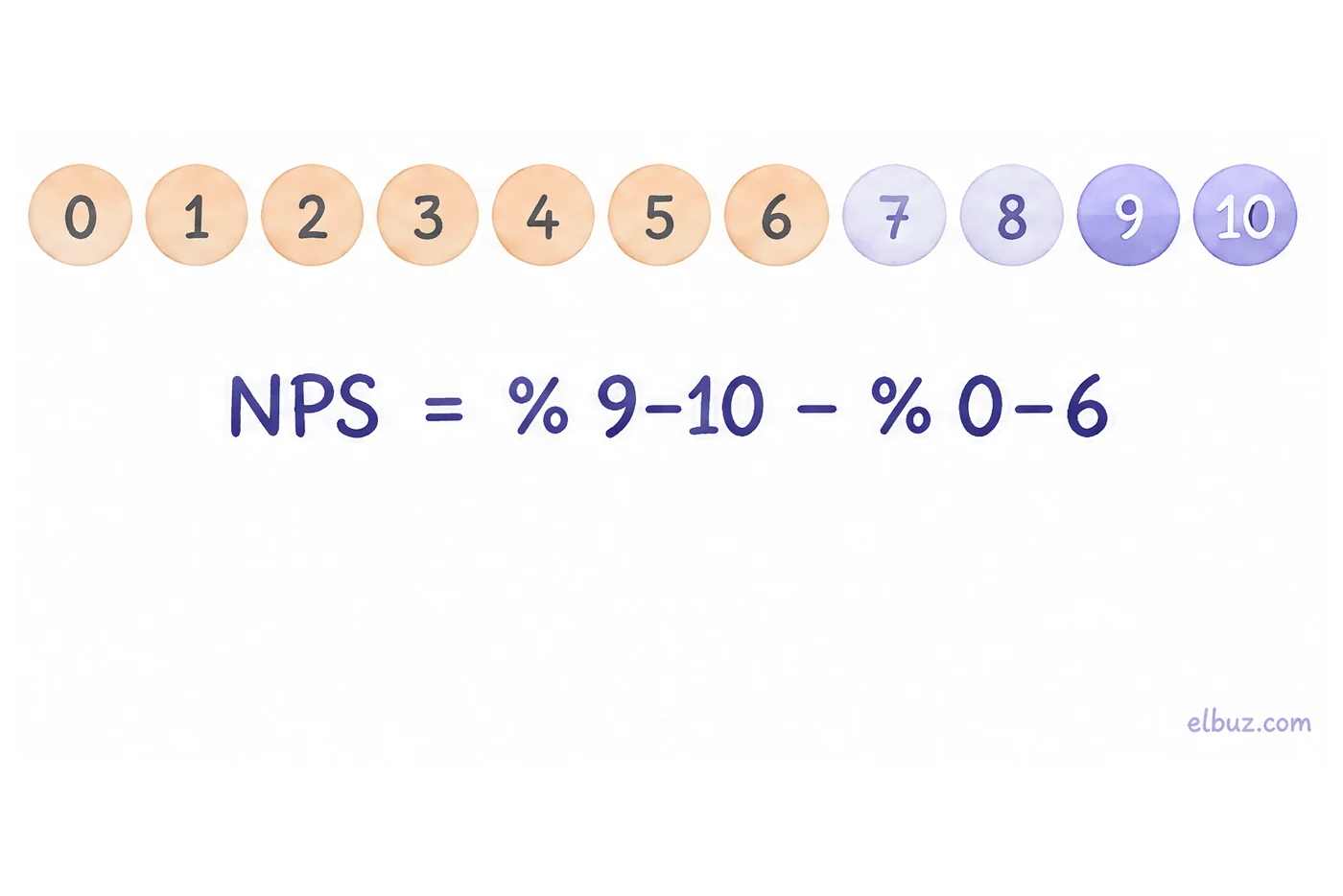
CSAT or NPS? CSAT is asked after every solved request and shows the quality of a specific rep's work. NPS is asked less often, for example a few weeks after a purchase, and shows how customers feel about the store overall. For a support team CSAT is more useful.
How to check your team's work
- Spot-reading. Every week a manager reads several closed requests per employee against the same criteria: did they answer the point, keep to the time, offer a solution, avoid asking again for what is known.
- Bad ratings. Every "bad" rating is followed through to the end.
- Mystery shopping. Write to your own chat and messengers as a customer — during business hours and in the evening — and compare with your rules.
- A spike of identical questions. Many requests about one thing in a day mean a broken process: shipping, payment, a product description. Fix the process instead of answering everyone.
Store customer service standard
How to answer when a customer hesitates or is unhappy — in how to handle customer objections.
When requests belong in a helpdesk
When there are more than two channels and several people answer: then response times, owners and ratings no longer fit in a spreadsheet, and the rules above depend on exactly those.
In Elbuz a customer's emails, messenger chats (Telegram, Viber, WhatsApp, Instagram, Messenger) and calls come together in one request, and the rep answers from one window in the same channel. Every request has an assignee and a deadline based on the work schedule; after "Solved" the system asks the customer to rate the reply and notifies the assignee and the manager about a "Bad" rating right away. More on the helpdesk for online stores page.
Who does not need it: if there are a few requests a day and the owner handles them all, one messenger and a spreadsheet with dates are enough. Come back to a helpdesk when requests start getting lost.
Helpdesk for online storesAll channels in one queue, deadlines and customer ratings, 14 days free
Frequently asked questions
What does ecommerce customer service mean?
Everything an online store gives the customer apart from the product: answers, confirmations, delivery updates, help with problems and refunds — plus the rules that make it equally good every day.
What is an example of a customer service standard?
"We reply in chat within 15 minutes during business hours" or "every request has one owner until it is solved". A standard is useful when you can check it — see rules you can check.
What is the golden rule of customer service?
Make the customer spend as little effort as possible: reply fast, tell them about their order before they ask, and solve the problem on the first contact without asking again for what you already know.
How do you calculate NPS?
Ask "How likely are you to recommend us?" on a 0–10 scale and subtract the share of 0–6 scores from the share of 9–10 scores. 60% of 9–10 and 10% of 0–6 give an NPS of 50.
Is CSAT better than NPS?
For a support team, usually yes: CSAT rates a specific answer right after it, while NPS reflects how customers feel about the whole store and changes slowly.
How do you calculate CSAT?
After a request is solved, ask the customer to rate the answer and divide the number of positive ratings by the number of all ratings.
How can an online store improve customer service?
Bring requests into one place, measure response time, prepare answers to the most common questions, set deadlines and owners, notify customers first, collect ratings and compare the numbers every month.
Sources
- Bain & Company, "Measuring Your Net Promoter Score" — the NPS definition and the 0–6, 7–8, 9–10 groups — netpromotersystem.com.
- Directive 2011/83/EU on consumer rights — right of withdrawal and the 14-day refund deadline — eur-lex.europa.eu.
Checked on October 31, 2026.


