

Cold calling means phoning people or companies that don't know you and never left their contact details. The goal is not an instant sale but a next step: a price list sent to a named person, a meeting, a trial order. For an online store, cold calling works in B2B, with wholesale and corporate buyers. Private shoppers are better called warm: people who have already bought or asked to be contacted.
Two mistakes are typical: calling everyone on a purchased list, and counting dials instead of agreed next steps. Below: who to call, what US and EU rules allow, a stage-by-stage script with phrases, and how to calculate what one new customer from calling costs you.
When people look up how to cold call
Usually the website and ads bring too few orders, while the store has something to offer businesses: wholesale prices, corporate gifts, supplies for offices or workshops. People search "what is cold calling", "cold call script", "cold calling vs warm calling", and soon after, "is cold calling illegal".
The first question is usually the wrong one. It is not "what do I say" but "who do I call": the list decides more than the best opening line.
Cold, warm and hot calls: what's the difference
The difference is whether the person knows you and who started the contact. A cold call goes to someone who doesn't know you; a warm call, to someone who has dealt with you before; a hot call, to someone who reached out first and is waiting for an answer.
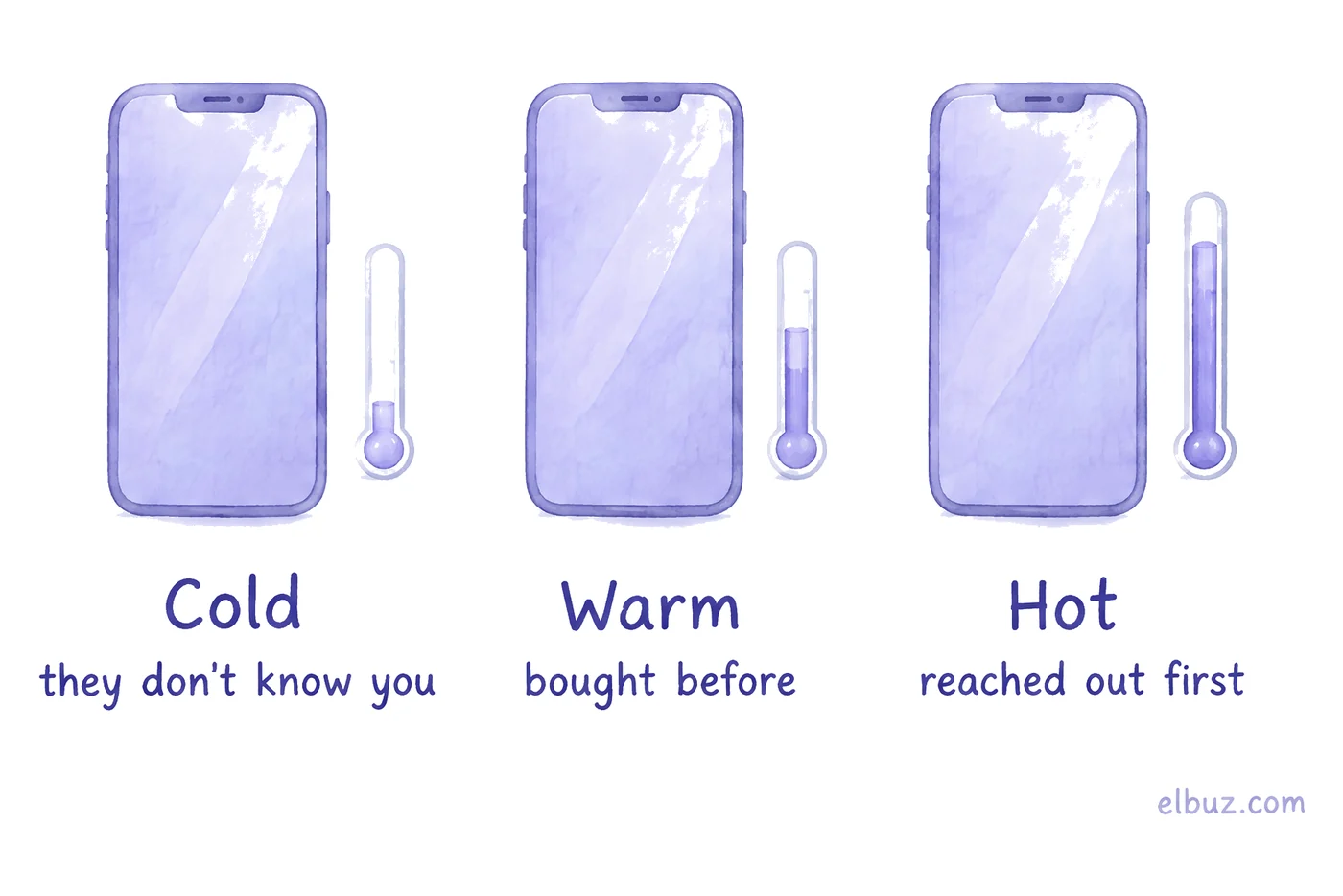
| Call | Who you call | Example for an online store |
|---|---|---|
| Cold | People who don't know you and never left their contact details | The wholesale team calls a retail shop to offer supplies |
| Warm | People who bought, subscribed or sent a request | A call to a customer who bought a vacuum cleaner a year ago, offering filters |
| Hot | People who reached out themselves and are ready to buy | Calling back after a website request or a missed call |
Contact lists split the same way: cold, warm and hot. Before you start on the cold list, check that the hot and warm ones are worked through: a sale there costs less. How to build your own list is covered in how to build a customer database.
When an online store should cold call
When one customer brings many orders: a wholesale buyer, a chain of shops, a company that purchases regularly. The call and the salesperson's time pay off only through a large or repeat purchase.
- Worth it: wholesale supply to shops and salons, corporate orders (gifts, stationery, office equipment), supplies for service businesses and workshops, finding dropshipping partners.
- Not worth it: retail shoppers who don't know you. One purchase of a few dozen euros doesn't cover the call, and a person phoned by an unknown store remembers the annoyance, not the offer. In several countries such calls are also illegal without consent, see the next section.
Retail customers get warm calls from a store: confirming an order, reminding about consumables, bringing back someone who hasn't bought for a while. Ready-made texts for those calls are in sales scripts for an online store.
Is cold calling legal in the US and the EU
Yes, live sales calls are legal in both, but the rules depend on who you call. Calls to businesses are mostly allowed. Calls to consumers are restricted: in the US by the National Do Not Call Registry and the TCPA, in the EU by national laws under the ePrivacy Directive, and in some countries, Germany and, since 11 August 2026, France, only with the consumer's prior consent.
United States
- Do Not Call Registry. Under the FTC's Telemarketing Sales Rule, you may not make sales calls to consumers whose numbers are on the National Do Not Call Registry. Check your list against the registry at least every 31 days. Data for up to five area codes is free; each further area code costs $85 a year, up to $23,425.
- Existing customers. The registry does not block calls to people with an established business relationship: for 18 months after their last purchase, payment or shipment, and for 3 months after an inquiry.
- Calls to businesses. Most calls to a business are exempt from the Telemarketing Sales Rule. The exception matters to stores: calls selling nondurable office or cleaning supplies, such as paper, toner and ink, are covered.
- Hours and disclosure. No sales calls to residential numbers before 8 a.m. or after 9 p.m. in the called person's local time. Before the pitch, say who the seller is, that the call is a sales call, and what you are offering.
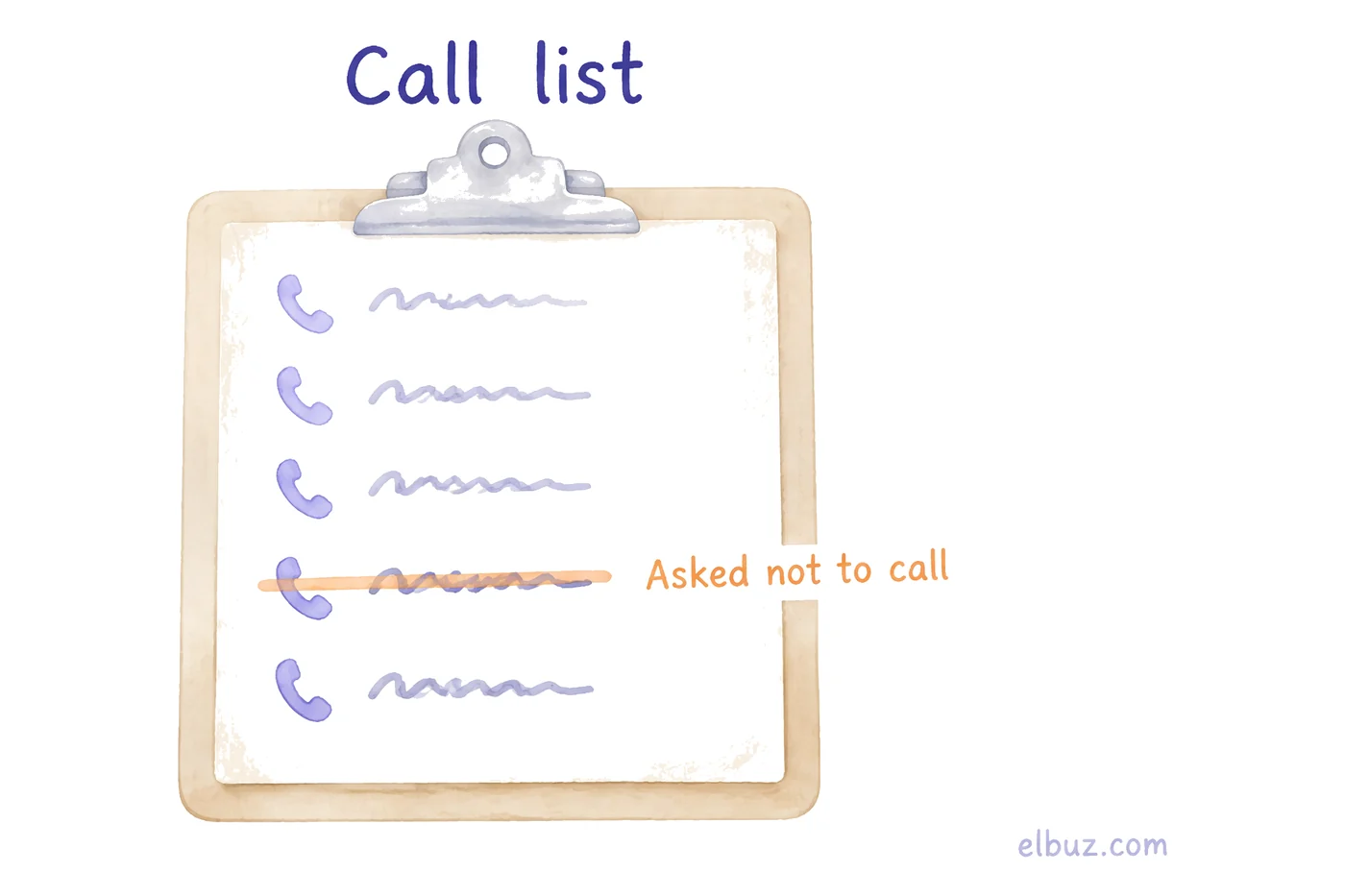
- Your own do-not-call list. If someone asks you to stop calling, the FCC rules give you at most ten business days to honor the request, for every salesperson in the company.
- Autodialers and recorded voices. Sales calls to cell phones made with an autodialer or an artificial or prerecorded voice need the person's prior express written consent.
- What a violation costs. The FTC states fines of up to $53,088 per violation of the Do Not Call rules. Under the TCPA, a person who got more than one illegal call within 12 months can sue for up to $500 per call, and the court can triple that for willful violations.
European Union
- Automated calls need consent everywhere. The ePrivacy Directive (2002/58/EC, Article 13(1)) allows direct marketing by automated calling machines, fax or email only to subscribers who gave prior consent.
- Live calls: each country chooses. For other marketing calls, Article 13(3) lets each member state choose between prior consent and a right to refuse. These rules cover subscribers who are natural persons; for companies, member states protect their "legitimate interests" in their own way (Article 13(5)).
- Germany: consent for consumers. The Unfair Competition Act (UWG, Section 7(2) no. 1) treats a sales call to a consumer without prior express consent, or to a business without at least presumed consent, as an unacceptable nuisance. Under Section 7a, consumer consent must be documented when given and the record kept for five years.
- France: opt-in since 11 August 2026. According to the DGCCRF, calling a consumer for sales is now banned without prior consent, and the Bloctel opt-out list is closed. Consent lasts one year at most. Calls are allowed Monday to Friday, 10:00–13:00 and 14:00–20:00, no more than four times in 30 days. The exception is a call within a current contract about the subject of that contract.
- GDPR applies to B2B too. A buyer's name and mobile number are personal data, even when you call a company. Direct marketing "may be regarded as carried out for a legitimate interest" (Recital 47), but the person can object at any time, and then you stop (Article 21(2)–(3)). Tell them about this right at the first contact at the latest (Article 21(4)); if you got the number from a directory rather than from them, also say where it came from (Article 14).
What follows in practice, for any country:
- Call businesses, not consumers. Consumer cold calls are where most of the restrictions sit, and where a store gains least.
- "Don't call again" is carried out immediately. Mark the number in your list so that no other salesperson dials it either.
- Don't hide who is calling and why. Name, company and reason in the first sentence.
- No purchased consumer lists. You cannot prove consent for them, and in the EU you usually have no legal basis to use them.
The rules differ by country and change: France switched from opt-out to opt-in in 2026. Before a large calling campaign, check the official source for each country you call and, for your specific case, ask a lawyer.
Preparing a calling session
- Describe who you call. Type of company, region, who decides on purchases. "Everyone" means many dials and few conversations.
- Build the list from public sources. Company websites, business directories, marketplaces, trade shows. Record not only the phone number but also the name, website and what the company sells: you'll need it for the opening line.
- Set one goal per call. One action you agree on: a meeting, a price list with a follow-up call, a trial order.
- Put your offer into one sentence about the customer's gain. "We ship the same day, it reaches you in 1–2 days", not "we are a leading supplier".
- Prepare a place for notes. Every call gets a result, a comment and the date of the next contact. Without notes, the same people get called twice and agreements get lost.
Cold call script: stages and phrases
A cold call script is six stages with a few phrase options for each, not a text to read out. The example below is for a store's wholesale team calling a retail shop. Square brackets are your details.
1. Reaching the person who decides
- "Hi, this is Anna from [company], we supply [product category]. Who handles purchasing of [category] at your store?"
- "What's the best way to reach them, and when is a good time to call?"
Don't pretend to know the owner and don't hide the purpose of the call: it shows within a minute and closes the door for good.
2. Introduction and reason for the call
"Hi Mark, it's Anna from [company]. We supply [product] to shops in [region] from our warehouse in [city]. I'm calling because I see [category] on your website. Do you have two minutes?"
Asking for two minutes gives the person control over the conversation. If it's a bad time, agree on a specific time, not "I'll call back later".
3. Two or three questions about the need
- "How do you buy [product] now: from one supplier or several?"
- "What matters more to you: price, delivery time or range?"
- "Has it happened that you ran out and the supplier couldn't deliver quickly?"
4. An offer that matches the answer
"You said delivery time is what matters. We have [product] in stock, we ship the same day, and it reaches you in 1–2 days." Talk only about what the customer named as important.
5. Answers to common brush-offs
- "We're not interested." "Fair enough, I called out of the blue. Do you have a regular supplier for [product] right now? I can send our price list to compare, no strings attached."
- "Send me an email." "Will do. Which items should I include, and whose address? I'll call on Thursday to hear what you think, does that work?"
- "We already have a supplier." "Good. What do you like about them, and what's missing?"
If the person still says no after one clarifying question, thank them and end the call. How to tell what is behind "too expensive" or "I'll think about it" is covered in how to handle customer objections.
6. Closing with a next step
- "Here's what I suggest: I'll send the price list to [email] today, and on Thursday at 11:00 I'll call to answer questions. Deal?"
- "We could start with a trial order of [amount] so you can check delivery and quality."
A conversation without an agreed next step is not a result, however pleasant it was.
What to record after a call
Right after the conversation, write down the result and the date of the next contact, or the agreement disappears with the salesperson's memory.
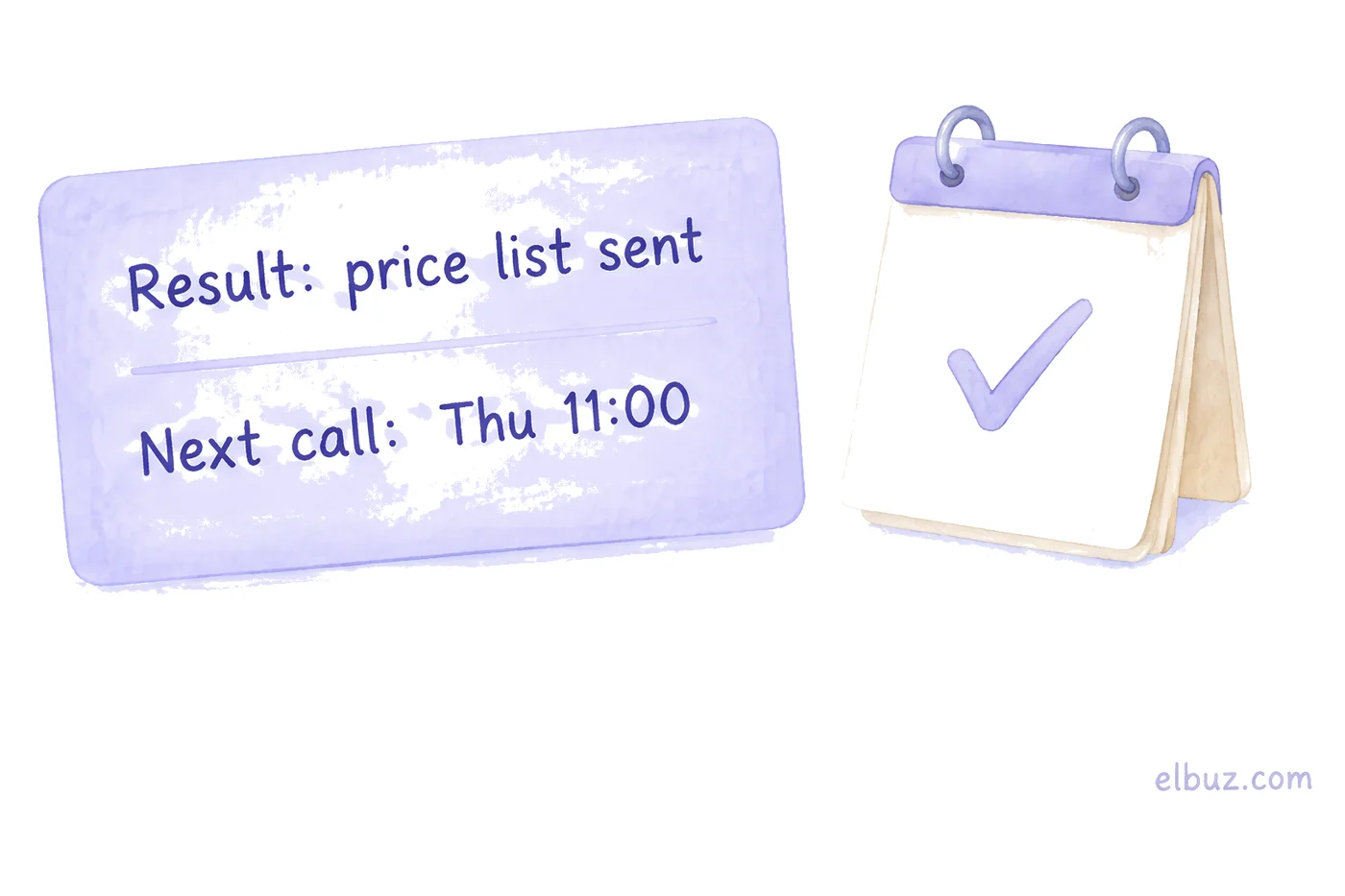
- Result: no answer, not interested, price list sent, meeting, trial order, "do not call".
- What you learned: who decides, who they buy from now, what matters to them.
- Next step and date: "Thu 11:00, feedback on the price list". No answer means the next attempt on another day at another time, not three times within an hour.
What a customer from cold calling costs
Count the cost of one new customer, not the number of calls:
Cost per customer = (numbers dialed ÷ numbers per day) × cost of a salesperson's day ÷ number of first orders.
Illustrative example for the arithmetic, not market data. A salesperson dials 50 numbers a day, and a day of their work costs the store €200. Out of 100 numbers, 60 answered, 20 times they reached the person who decides, 6 agreed to a next step, and 2 placed a first order. Two days of work cost €400, so one new customer costs €400 ÷ 2 = €200.
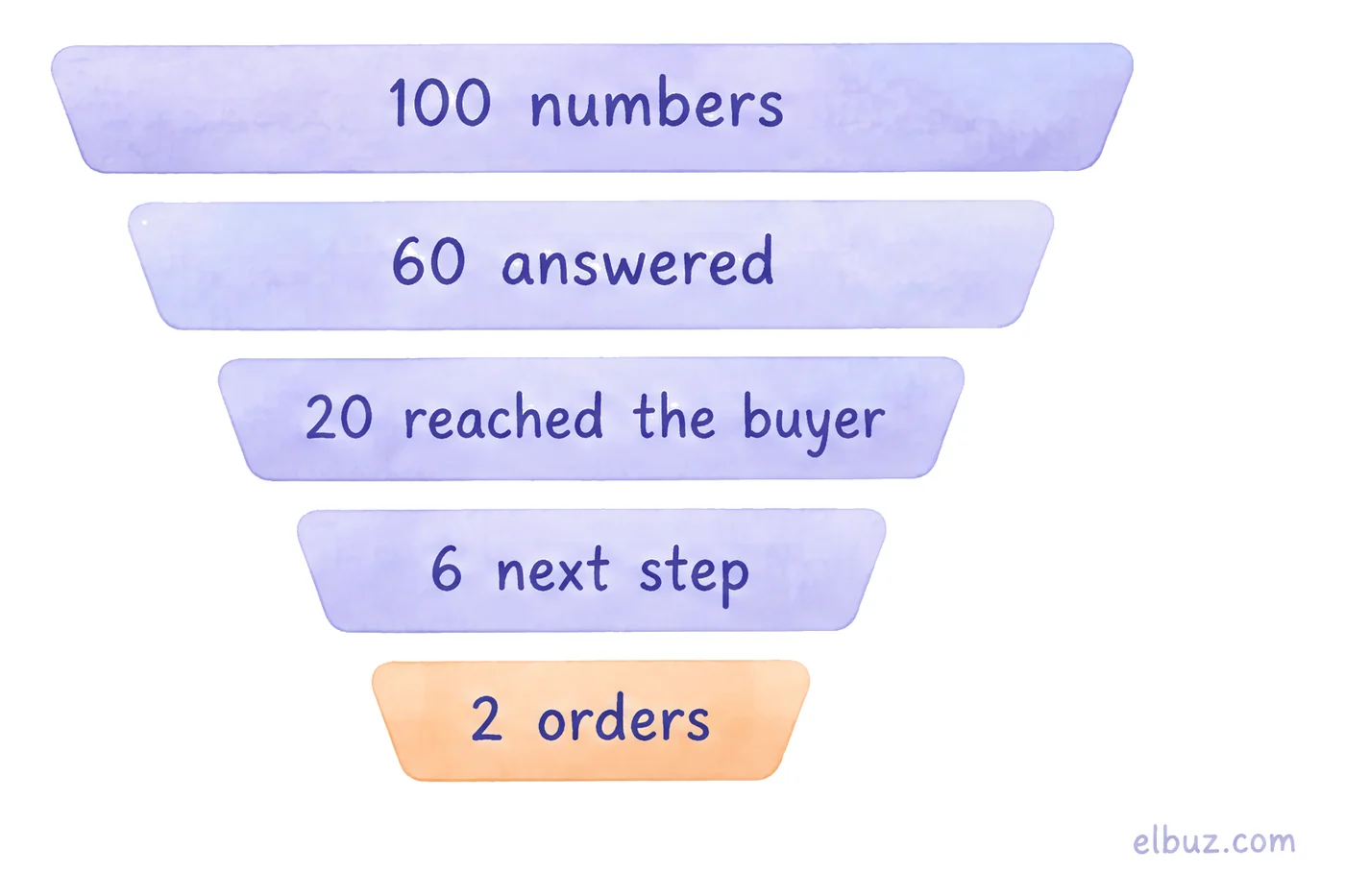
If the first wholesale order brings €300 of margin, the calling paid off with the first purchase, and every repeat order is pure gain. If you call retail shoppers and an order brings €30 of margin, the same €200 customer is a loss. How to work out your margin is explained in how to calculate markup.
The same funnel shows the bottleneck. Few conversations with the decision maker point to the list or the opening line. Conversations without next steps point to the offer or the close.
What affects the outcome of a call most
- The first seconds. Name, company, reason for the call, without a long preamble or "how are you today".
- The other person talks more. If you talked all the time, you learned nothing about the need.
- Specifics. Delivery time, price, terms in numbers. "Great terms" means nothing.
- Timing. Not in the first hour of the working day and not at lunchtime. The best time for your niche shows in your own notes: compare call results by hour.
- Pace. Speak like you would to a colleague, without rushing or a memorized tone.
Before you start calling
When calls are easier to run through telephony in a CRM
When several salespeople call and the list holds hundreds of contacts: then the spreadsheet lags behind the conversations, one contact gets called twice, and "I'll call on Thursday" gets forgotten.
In Elbuz a salesperson calls with one click from the customer record through your cloud phone system (RingCentral, Aircall, Sipgate, Zadarma, 3CX or Asterisk). Every call goes to the call log and the customer's history, and AI writes a short summary of the conversation. How calls, emails and orders sit together in one customer record is shown on the CRM for online stores page.
Who doesn't need it: if one person calls a few times a week, a spreadsheet with "result" and "next call" columns is enough.
Calls in the Elbuz CRMOne-click calls from the customer record and a call log, 14 days free
Frequently asked questions
What does cold calling mean?
Calling people or companies that don't know you and never left their contact details. The goal is not an instant sale but a next step: a meeting, a price list with a follow-up call or a trial order.
What is the difference between cold calling and warm calling?
Whether the person knows you. A warm call goes to someone who bought, subscribed or sent a request; a cold call, to someone who has never dealt with you. Warm calls cost less per sale and face fewer legal restrictions.
Is cold calling illegal?
No, but it is regulated. In the US you may not call consumers on the National Do Not Call Registry without an exemption; in the EU, each country sets its own rules, and Germany and France require the consumer's prior consent. Details are in the section on US and EU rules.
Does the Do Not Call Registry apply to B2B calls?
Mostly no. The FTC says most sales calls to businesses are exempt, except calls selling nondurable office or cleaning supplies such as paper, toner and ink.
What are the stages of a cold call?
Reaching the person who decides, an introduction with the reason for the call, two or three questions about the need, an offer that matches the answer, answers to brush-offs and a close with a next step. Each stage needs a few phrase options, not a fixed text.
How many cold calls a day are normal?
There is no standard number worth chasing. Count the cost of one new customer instead: a salesperson's working days divided by first orders, and compare it with the margin that customer brings.
Does cold calling still work?
In B2B, yes, when one customer buys a lot and regularly and the cost per customer stays below the margin. For retail shoppers it rarely pays off and is restricted by law in many countries.
Sources
- FTC, Q&A for telemarketers and sellers about the Do Not Call provisions of the Telemarketing Sales Rule (31-day sync, area code fees, established business relationship, B2B calls, penalties) — ftc.gov.
- FTC, Complying with the Telemarketing Sales Rule (disclosures, calling hours, business-to-business exemption) — ftc.gov.
- FCC rules on telephone solicitation, 47 CFR § 64.1200 (calling hours, do-not-call requests, consent for autodialed and prerecorded calls) — law.cornell.edu.
- Telephone Consumer Protection Act, 47 U.S.C. § 227(c)(5) — law.cornell.edu.
- Directive 2002/58/EC (ePrivacy Directive), Article 13 — eur-lex.europa.eu.
- Regulation (EU) 2016/679 (GDPR), Recital 47, Articles 14 and 21 — eur-lex.europa.eu.
- Germany, Act against Unfair Competition (UWG), Sections 7 and 7a — gesetze-im-internet.de.
- France, DGCCRF, "Les règles du démarchage téléphonique s'imposant aux entreprises" (27.07.2026) — economie.gouv.fr.
Checked on October 31, 2026.


