

A zaliczka na podatek dochodowy is a prepayment of income tax that a Polish sole trader (JDG) on the tax scale or flat tax pays during the year. The formula: tax on income earned since 1 January minus the advances already paid for earlier months. Pay by the 20th of the next month to your tax micro-account, with no monthly return. While the amount due is 1,000 zł or less, you may wait.
Newcomers usually get two things wrong: they calculate the advance on one month's income instead of the running total since January, and they do not know the 1,000 zł rule, so they either pay small amounts every month or miss a payment that was required. Below: the formula for each tax form, the deadlines, a 12-month illustrative calculation and what happens if you pay late.
When people search for the income tax advance in Poland
Typically someone has just registered a JDG, received the first payments from clients and keeps seeing "the 20th" in every guide. They search for "zaliczka na podatek dochodowy" or "income tax advance payment Poland" and then ask: how much will it be in 2026, what is the formula, and where can I check what I have already paid?
"How much do I pay each month" is the wrong question. The advance is not a fixed amount: it follows your income since January, and in the first months it is often zero.
How to calculate the advance: the formula for the tax scale and flat tax
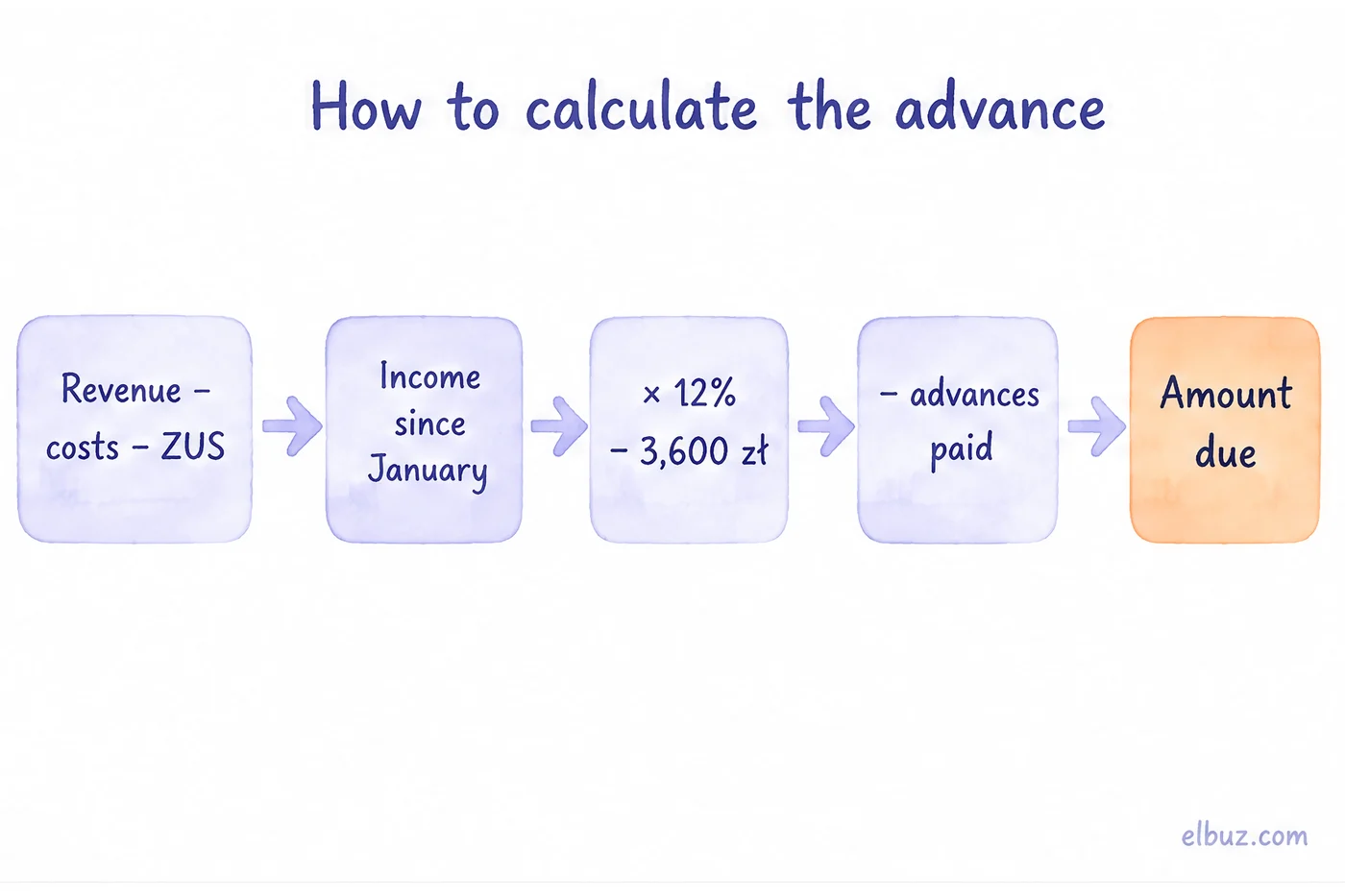
The advance is calculated on a cumulative basis: take all revenue and costs from 1 January to the end of the month, work out the tax on that and subtract what you have already paid.
| Tax form | Base since January | Tax | Due for the month |
|---|---|---|---|
| Tax scale (skala podatkowa) | Revenue − costs − ZUS social contributions | 12% of the base − 3,600 zł; above 120,000 zł: 10,800 zł + 32% of the excess | Tax − advances already paid |
| Flat tax (podatek liniowy) | Revenue − costs − social contributions − health contribution (up to 14,100 zł for 2026) | 19% of the base, no tax-free amount | Tax − advances already paid |
| Lump sum (ryczałt) | Revenue for the month, no costs | Rate depends on the activity, 3% for trade | Ryczałt for the month |
Round the income to whole złoty before applying the rate, and round the advance too. On the tax scale the health contribution is not deducted from either income or tax. How the forms compare and how to choose one is covered in taxes for a sole trader in Poland.
The 1,000 zł rule: when you can skip a payment
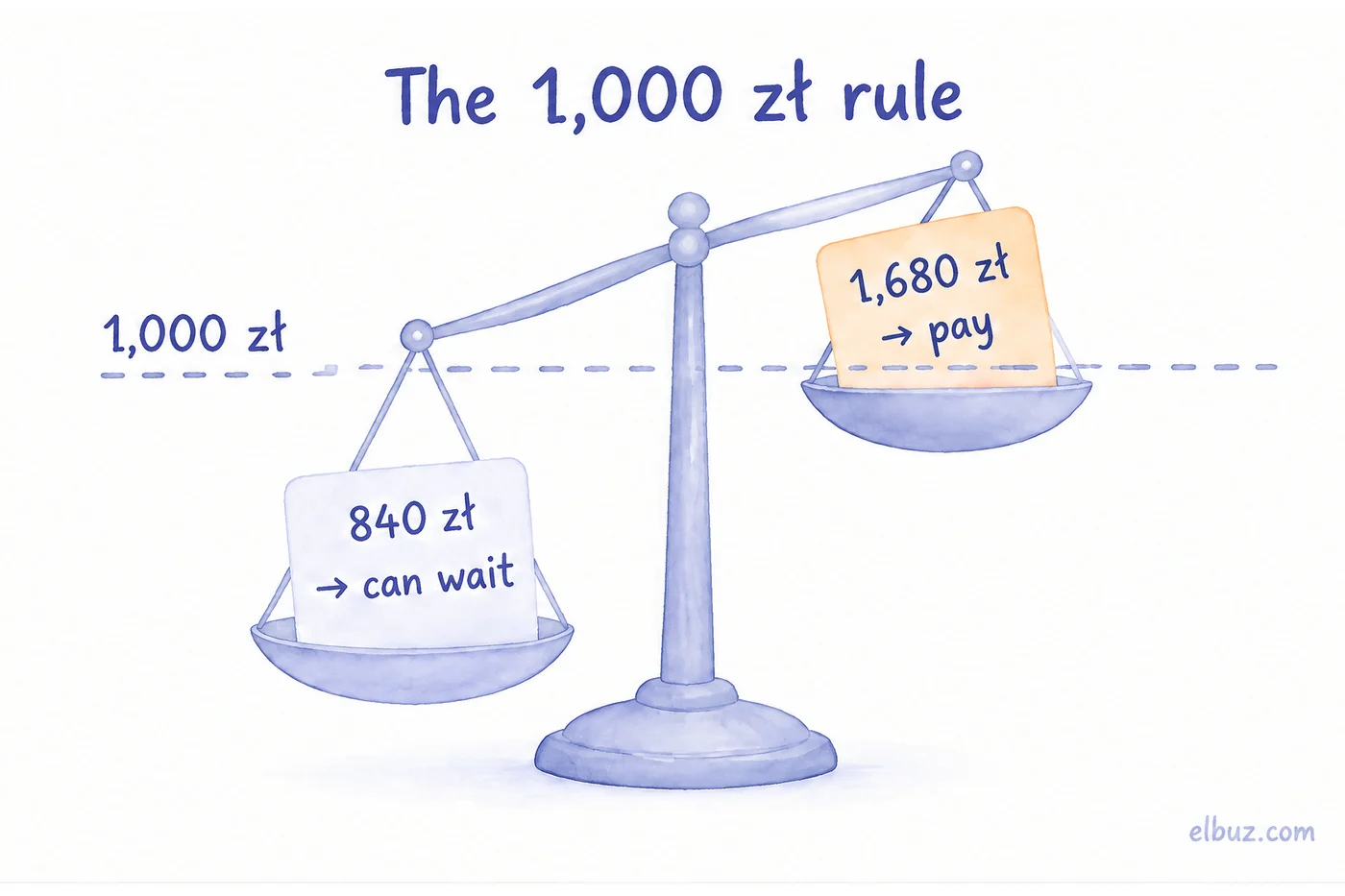
If the tax since January minus the advances you have paid does not exceed 1,000 zł, you may skip the payment for that month. Once the difference goes over 1,000 zł, you pay the whole difference, not just the excess. Nothing is lost: the unpaid amount simply rolls into the next calculation because it is cumulative.
A 12-month illustrative example
Illustrative example for the arithmetic only; the figures are not market data. A JDG on the tax scale earns 7,000 zł a month after ZUS social contributions. The first 30,000 zł of income produce no tax: 12% of it is exactly 3,600 zł, which the tax reduction cancels.
| Month | Income since January, zł | Tax since January, zł | Paid before, zł | Due, zł |
|---|---|---|---|---|
| January–April | 28,000 | 0 | 0 | 0 |
| May | 35,000 | 600 | 0 | 0 (under 1,000) |
| June | 42,000 | 1,440 | 0 | 1,440 |
| July | 49,000 | 2,280 | 1,440 | 0 (840) |
| August | 56,000 | 3,120 | 1,440 | 1,680 |
| September | 63,000 | 3,960 | 3,120 | 0 (840) |
| October | 70,000 | 4,800 | 3,120 | 1,680 |
| November | 77,000 | 5,640 | 4,800 | 0 (840) |
| December | 84,000 | 6,480 | 4,800 | 1,680 |
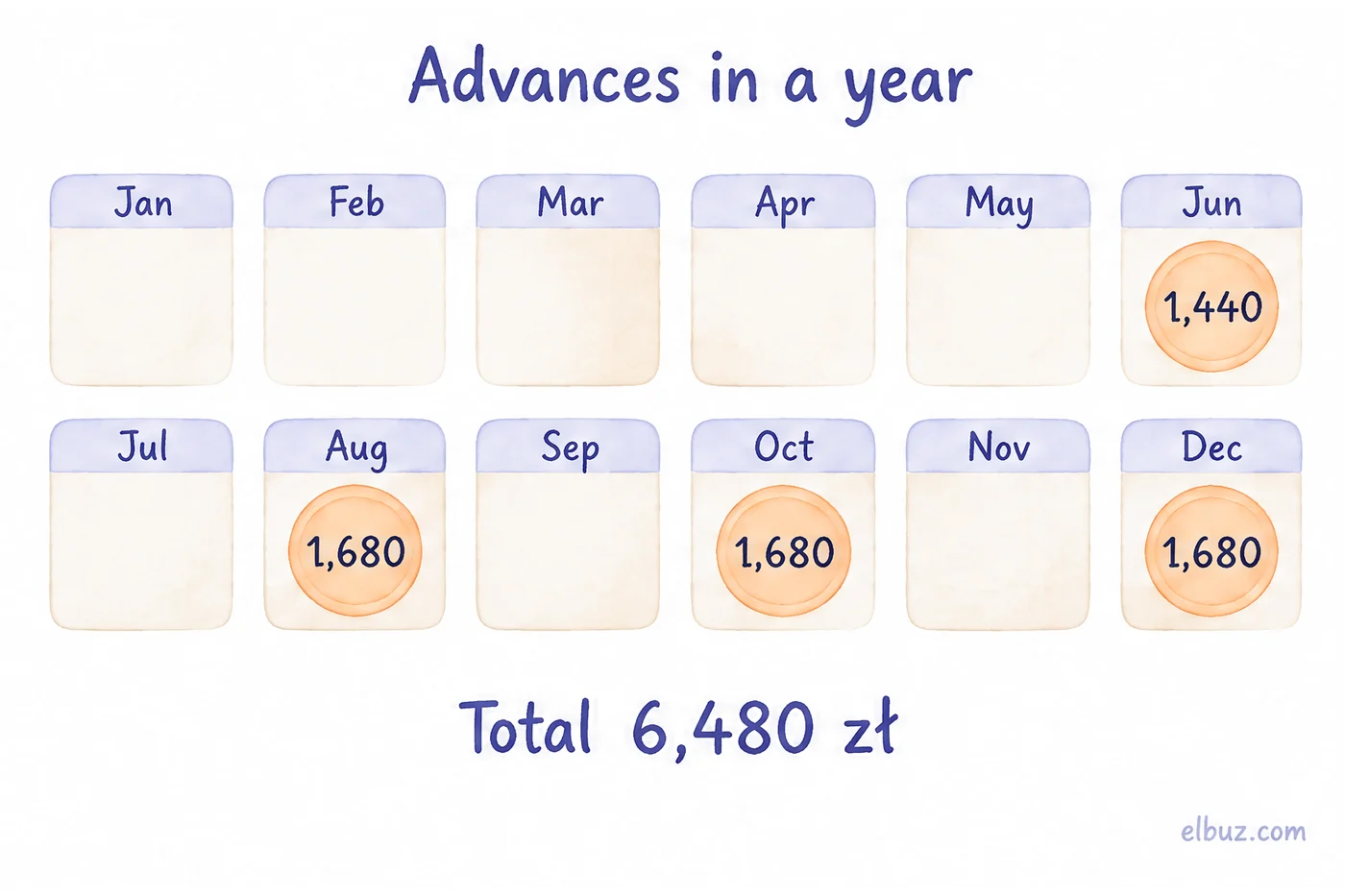
For the year: 84,000 × 12% − 3,600 = 6,480 zł of tax, paid in four instalments: 1,440 + 1,680 + 1,680 + 1,680. A quick check: with steady income, the advances for the year add up to the tax on the annual income. When income fluctuates, the annual return settles the difference.
Deadlines: monthly, quarterly and the annual return
The advance is due by the 20th of the month after the month it covers; for December, by 20 January. The final tax for the year is calculated in the annual return, PIT-36 (tax scale) or PIT-36L (flat tax), by 30 April, and you pay or reclaim the difference.
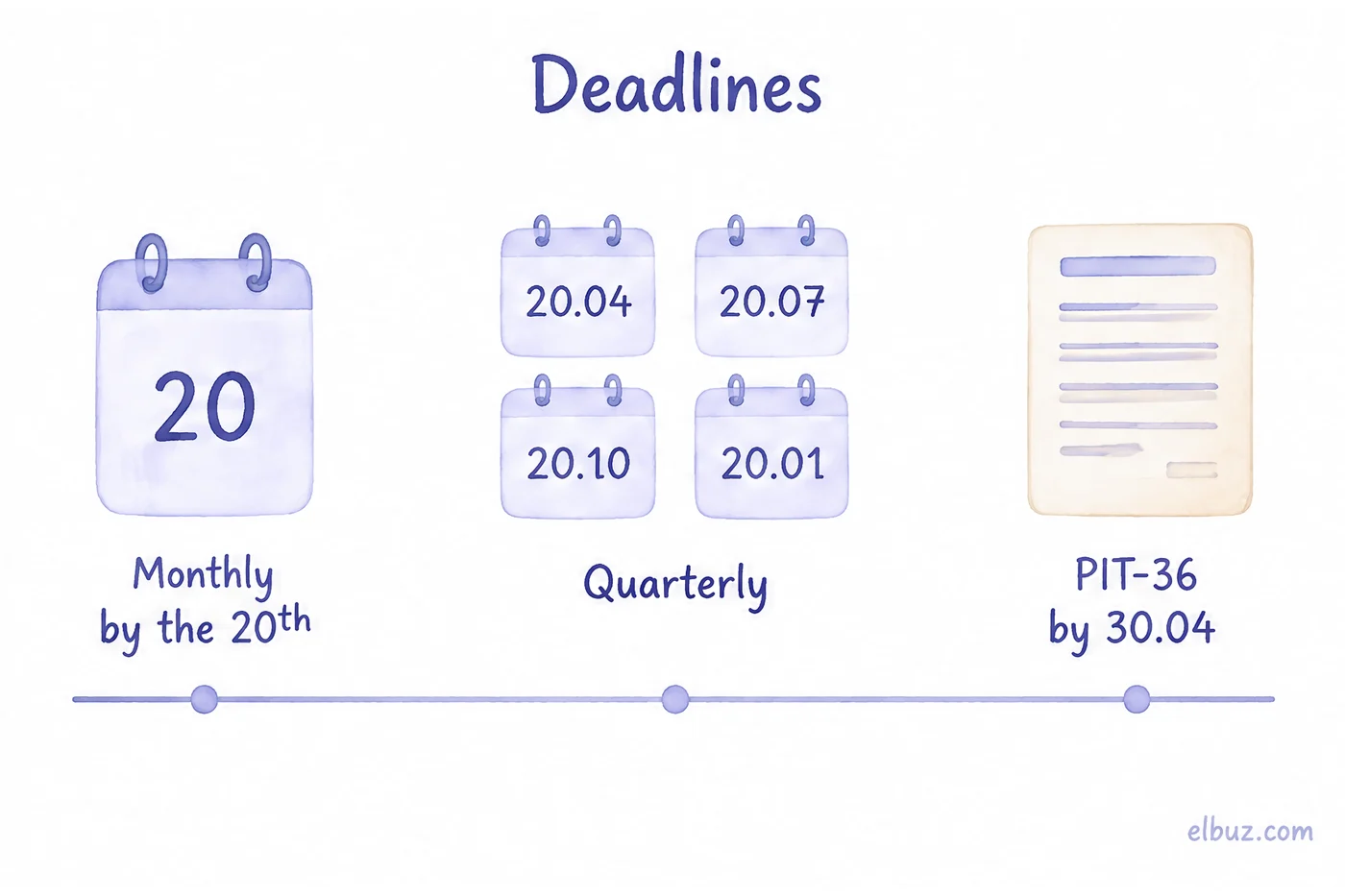
- Monthly is the default, by the 20th.
- Quarterly is available to a small taxpayer (sales including VAT in the previous year up to €2 million, for 2026: 8,517,000 zł) and in the year you start the business. Pay by the 20th after the quarter. There is no separate application: you indicate the choice in the annual return.
- Ryczałt is paid monthly or quarterly by the 20th; the annual PIT-28 return is due by 30 April.
If you are only starting, check first whether you can skip social contributions for six months: ulga na start and reduced ZUS. Without social contributions the base for your advance on the tax scale will be higher.
Where to pay: the tax micro-account
All PIT, VAT and CIT advances go to your individual micro-account (mikrorachunek podatkowy); you generate its number on podatki.gov.pl from your PESEL or NIP. Payment must be made by bank transfer. In the transfer, state the tax form and period, for example PIT-36 for June, so the tax office books the money correctly.
Payments and charges are visible in e-Urząd Skarbowy in the settlements section. Check there for any shortfall before you file the annual return.
Common mistakes with tax advances
- Calculating tax on a single month's income. The 3,600 zł reduction on the tax scale applies to the tax since January. Result: overpaying in the first half of the year and underpaying at the end.
- Paying small amounts every month. Skipping a difference of up to 1,000 zł is a legal right, not a late payment.
- Missing a payment above 1,000 zł. The tax office charges interest for every day of delay; what happens if you do not pay for longer is in penalties for unpaid taxes in Poland.
- Switching to quarterly advances without the right to. Quarterly advances are only for small taxpayers and the first year of business.
- Mixing up the PIT advance and VAT. They are separate taxes: a VAT payer reports sales in JPK_V7 by the 25th, see VAT registration in Poland.
Frequently asked questions
How do I calculate the zaliczka na podatek dochodowy?
Take your income since 1 January (revenue minus costs and social contributions), apply your tax rate, subtract 3,600 zł on the tax scale, then subtract advances paid earlier. The difference is the advance for the month.
When is the income tax advance due in Poland?
By the 20th of the following month; for December, by 20 January. Quarterly advances are due by the 20th after the quarter.
Do I have to pay the advance if it is under 1,000 zł?
No. If the tax since January minus advances paid does not exceed 1,000 zł, you may skip the month; the amount is picked up in later calculations.
How much will the advance be in 2026?
It depends on your income since January and your tax form: 12% minus 3,600 zł on the tax scale, 19% on the flat tax, a percentage of revenue on ryczałt. There is no fixed amount.
How can I check the advances I have paid?
In e-Urząd Skarbowy, which shows payments to your micro-account and the amounts charged. You also need the total for the annual PIT-36 or PIT-36L return.
What is the difference between the advance and the annual tax?
The advance is a prepayment during the year. The final tax is calculated in the annual return by 30 April, and the difference from the advances is paid or refunded.
Sources
- Biznes.gov.pl, taxation on general rules (advances, 1,000 zł, deadlines, small taxpayer) — 00264.
- Biznes.gov.pl, flat tax (advances, health contribution deduction limit 14,100 zł) — 00253.
- Biznes.gov.pl, lump-sum tax on recorded revenue — 00263.
- Podatki.gov.pl, small taxpayer limit for 2026 (8,517,000 zł) — podatki.gov.pl.
- Podatki.gov.pl, tax micro-account generator — podatki.gov.pl.
Checked 31.10.2026.


