

A digital product is something a buyer receives as a file, a key or access after paying: an e-book, an online course, a template, software, music or photos. EU law calls it digital content — "data which are produced and supplied in digital form". There is no stock and no shipping, but there are costs: creating the product, the platform fee, VAT, advertising and your obligations to the buyer.
That leads to the main mistake: treating every sale of a digital product as pure profit. Money goes to the platform, the tax office and ads, and the cost of creating the product pays off only after a certain number of sales. Below are the types of digital products, how a sale works, a calculation on an illustrative example, where to sell, what EU rules on VAT and refunds say, and how to start.
When people ask what digital products are
Usually the person already has a skill — design, teaching, photography, coding — and has seen others sell templates, guides or courses. The first searches are "what are digital products" and "digital products examples". Then come "how to sell digital products", "where to sell digital products for free", "best platform for beginners" and "what digital products sell best".
The last question helps least: someone else's bestseller says nothing about demand for yours. It is more useful to calculate how many sales you need to cover the cost of creating the product, and to check whether you can find that many buyers.
Types of digital products
Digital products fall into five groups by what the buyer gets: text, learning, a template, software or a media file.
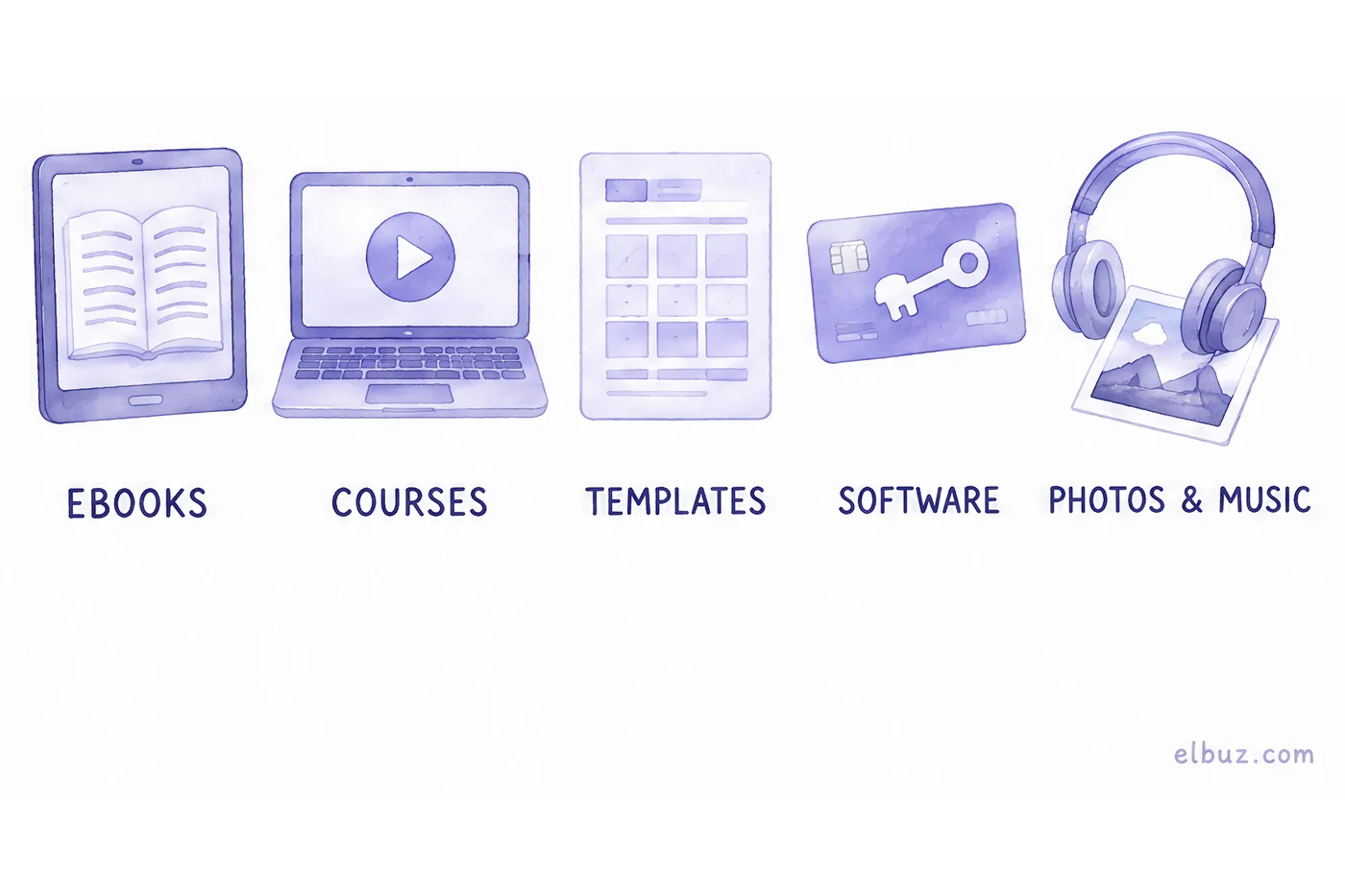
| Type | Examples | How the buyer gets it | Watch out for |
|---|---|---|---|
| Ebooks and guides | E-books, manuals, checklists | PDF or EPUB file | The file is easy to forward to others |
| Courses | Video lessons, recorded webinars, challenges | Access to a members' area or a private channel | Students need support and updates |
| Templates | Social media layouts, spreadsheets, presentations, website themes | File or a link to a copy | State clearly which app opens it |
| Software | Apps, plugins, games, license keys | Key or account | Compatibility and updates are your responsibility |
| Photos, video, music | Stock photos, presets, sounds, tracks | File with a license | Rights to everything in the frame or track |
Separately from digital content, EU law defines digital services — when the buyer doesn't get a file but uses a service: cloud storage, an online editor, a software subscription. The practical difference for a seller: a service has to work for the whole paid period.
How selling a digital product works
A sale has three steps: payment, automatic delivery and access for the agreed period. Automatic delivery is the key part — the buyer expects the product right after paying, not when you wake up.
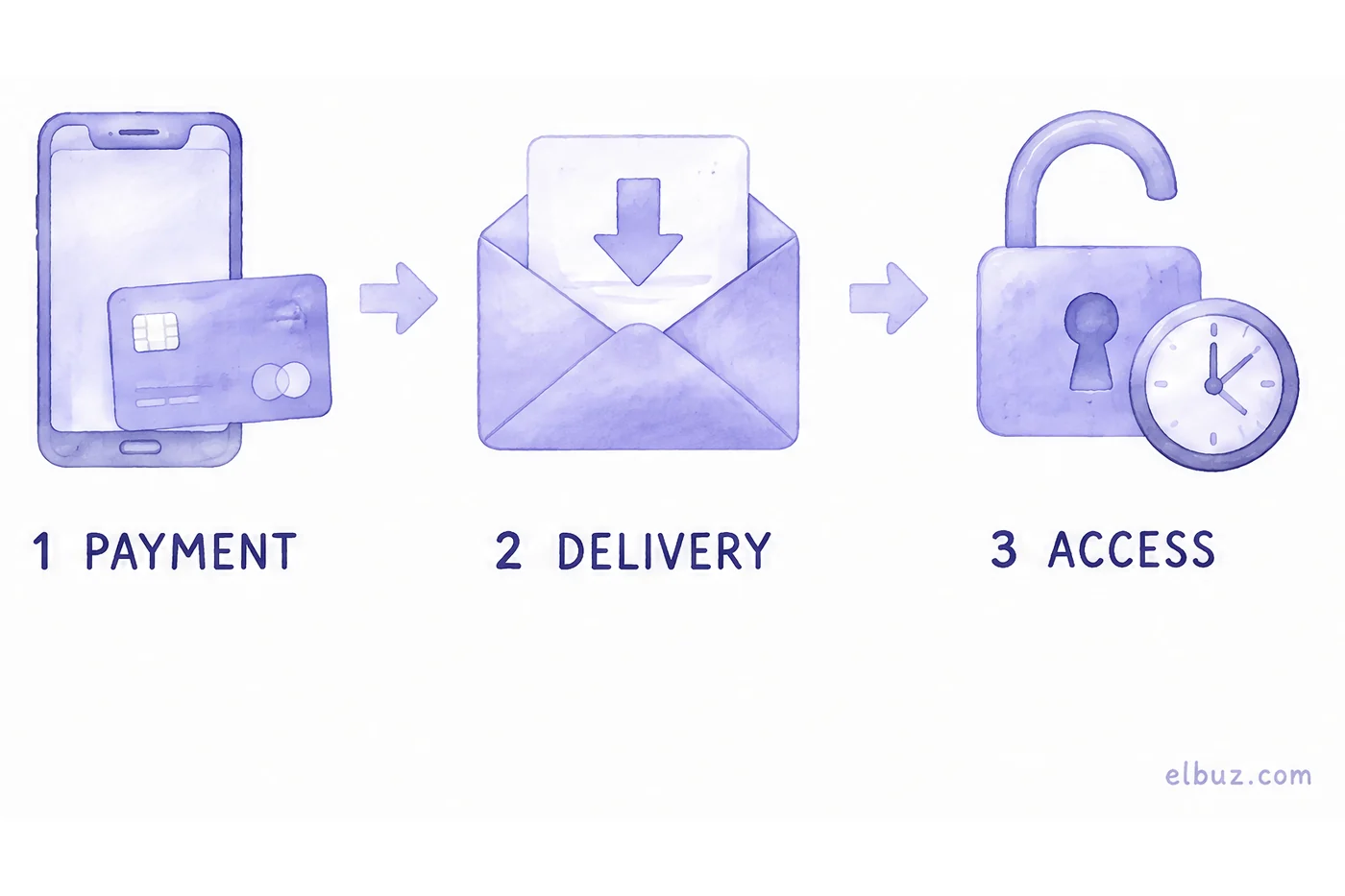
- Payment. By card through the platform's checkout or your own payment provider. How card fees add up on your own site — merchant acquiring for online stores.
- Delivery. A download link in an email or account, a key, an invite to a private channel. Under the EU Digital Content Directive, the seller has delivered once the content, or the means to access or download it, is made available to the buyer.
- Access. Forever (a file) or for a period (a course, a subscription). State the period and the number of downloads in the product description before payment.
How much you keep from one sale
From the price of a digital product, subtract VAT, the platform fee and the advertising cost per sale — the rest is yours, and it has to pay back the cost of creating the product.
Illustrative example for the arithmetic, not market prices. An e-book sells for €30 including VAT. At a 20% VAT rate, €5 of the price is VAT. The platform takes 10% of the price (€3), and advertising costs €10 per sale.
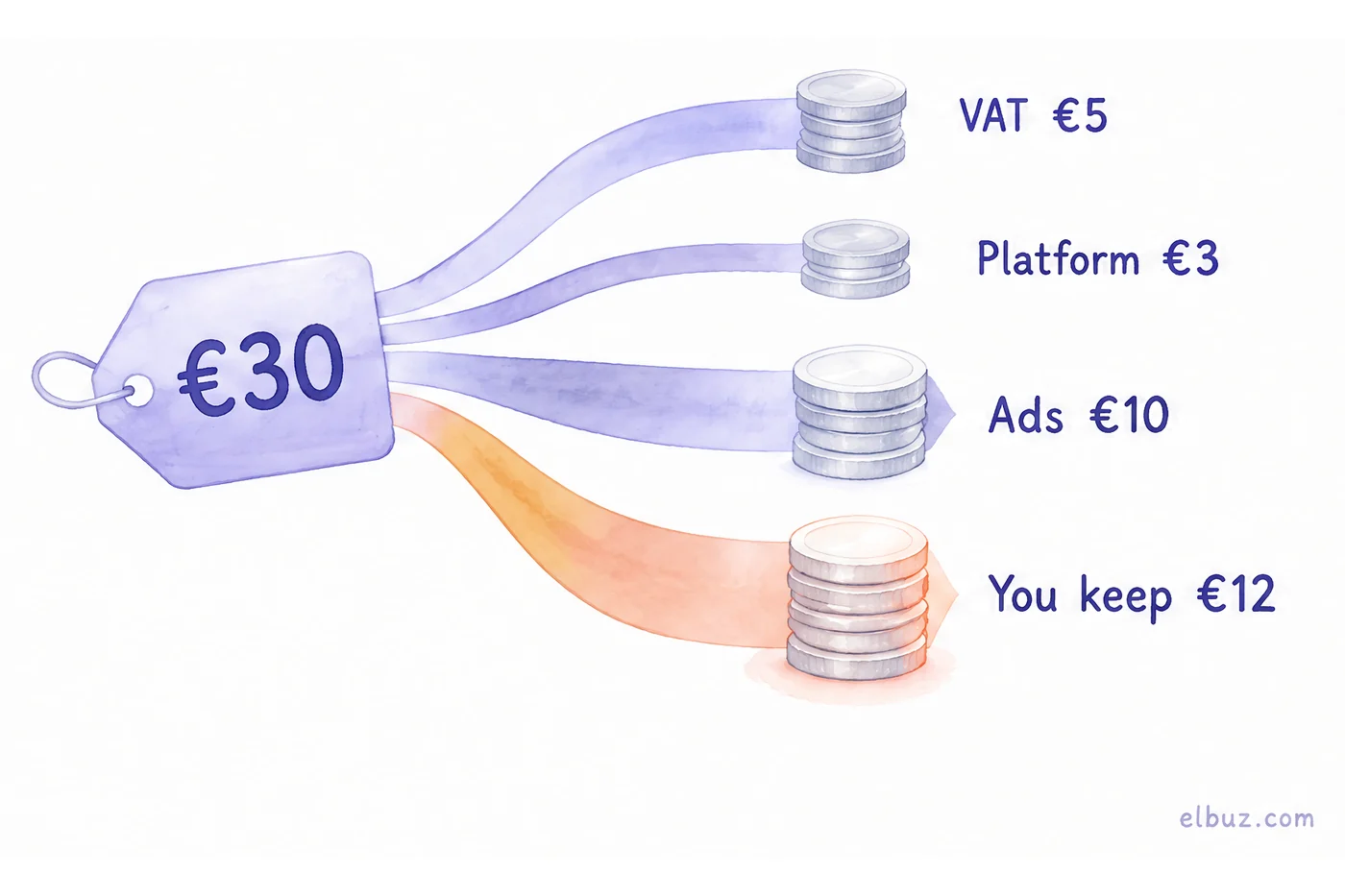
- 30 − 5 − 3 − 10 = €12 per sale, before income tax.
- Creating the e-book — design, editing, your time — costs, say, €1,200: 1,200 ÷ 12 = 100 sales to break even.
- If 30% of buyers come without ads (from your newsletter or blog), you keep €22 on each of their sales, and you break even sooner.
The conclusion: the biggest cost of a digital product is not creating it but finding the buyer. That's why sellers with their own audience (a blog, a channel, a customer list) earn more on the same products than those who pay for every sale with ads.
Where to sell digital products
There are three routes: your own website, a digital products marketplace, and selling in a messenger or on social media. The choice depends on whether you already have an audience.
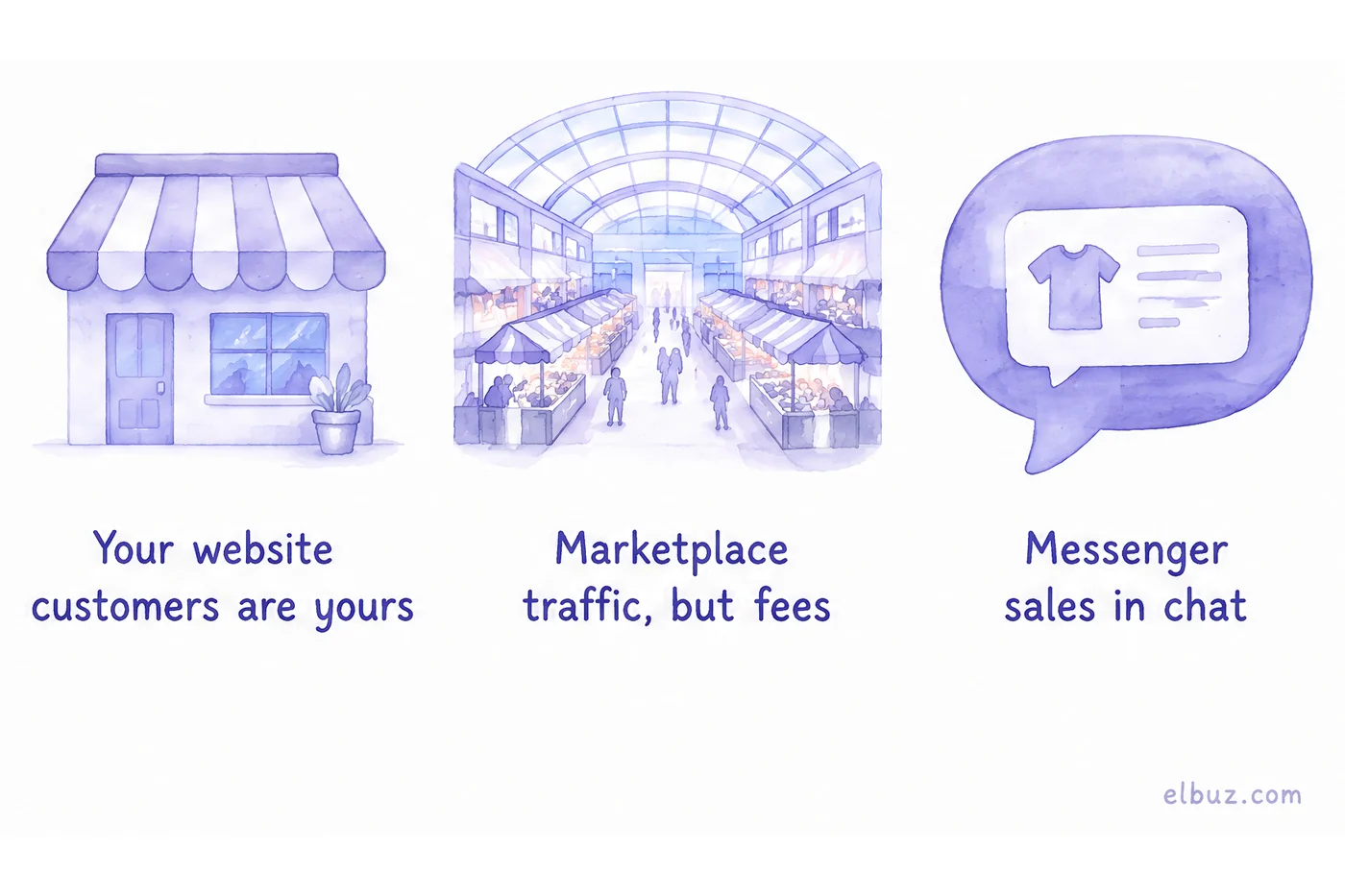
| Channel | Pros | Cons | Best for |
|---|---|---|---|
| Your own website | Customers and contacts are yours, prices and terms are yours | You set up traffic, delivery and tax yourself | Sellers with an audience or several products |
| Digital products marketplace (Gumroad, Etsy and similar) | Ready-made product page, payment and file delivery | Fees, platform rules, the customer belongs to the platform | A first product and testing demand |
| Messenger or social media | Selling in conversation, quick start | Manual delivery and records unless you have a bot | Courses, consultations and private channels |
Check fees on the platform's pricing page on launch day. Gumroad, for example, takes 10% + $0.50 on direct sales (through your link) and 30% on sales to buyers who found you through its Discover marketplace — three times more, depending on who brought the buyer. Gumroad also states that it acts as merchant of record and handles sales tax and VAT for you; on your own site, that is your job. If you plan to sell in chat, start with a script: how to write a chatbot script.
VAT and buyer rights in the EU
When you sell digital products to consumers in the EU, two sets of rules matter: VAT is charged in the buyer's country, and the buyer has rights under the Digital Content Directive and the Consumer Rights Directive.
VAT. Downloads such as e-books, software, music and images are usually electronically supplied services for VAT purposes, and B2C electronic services are taxed where the customer lives. There is one exception for small EU sellers: if you are established in one EU country and your cross-border sales of such services and distance sales of goods to other EU countries stay below €10,000 a year, your home country's VAT rules can apply. Above that, you charge each buyer's country rate and can report it all in one quarterly return through the One Stop Shop (OSS) in your own country. Sellers outside the EU use the non-Union OSS scheme. In the US, sales tax on digital products depends on the state: check with your state's tax authority or an accountant.
Buyer rights. The Digital Content Directive (EU) 2019/770 applies to supplies from January 1, 2022. For the seller it means:
- supply the content without undue delay after the contract is concluded, unless agreed otherwise (Art. 5);
- be liable for a lack of conformity: where national law sets a time limit for a one-off supply, it is at least two years; for a subscription, the whole period of supply (Art. 11);
- prove that the content was supplied — the burden of proof is on the seller; and prove it was in conformity if a problem appears within one year (Art. 12);
- refund the buyer within 14 days of being informed that they want a price reduction or are ending the contract (Art. 18).
The 14-day right of withdrawal. Online buyers in the EU can usually cancel within 14 days without giving a reason (Consumer Rights Directive, Art. 9). For digital content not supplied on a tangible medium, the right is lost once the download or streaming has started, but only if the buyer gave prior express consent to start during the withdrawal period, acknowledged losing the right, and you sent a confirmation (Art. 16(m)). In practice: a checkbox at checkout and a confirmation email. Without them, a buyer can download the file and still cancel.
The practical takeaway: the product description is part of the contract. Write down the file format, the app that opens it, the access period and what exactly is included before payment, and keep proof of delivery (an email, a download log).
Copyright. You can sell only what you have rights to: your own materials, or someone else's under a license that allows resale. That includes fonts, photos and music inside your template or course.
Risks and mistakes
| Mistake | Consequence |
|---|---|
| The price is set "like everyone else's" without counting ads per sale | Every sale loses money, even though a copy costs nothing to make |
| The description has no format or requirements | The buyer can't open the file and asks for a refund |
| Manual delivery | The buyer waits for hours, complains, and some ask for their money back |
| No consent checkbox for immediate download | The buyer keeps the 14-day right to cancel after downloading |
| All sales on one platform | A ban or a rule change stops sales, and you have no customer contacts |
| Someone else's photos, fonts or music in the product without a license | A rights holder complaint and the product is taken down |
How to start
- Choose one product from what you already know how to do, and describe who it's for and what problem it solves.
- Calculate the payback with the formula above: price, VAT, fee, ads, cost of creation.
- Check demand before creating it: a pre-sale or a waiting list among your audience.
- Start on a digital products marketplace if you have no audience of your own — it gives you payment and delivery without setup.
- Sort out the paperwork before regular sales: register your business, check how VAT applies to your sales, and write the format, access period and refund terms in the description.
Elbuz is built for stores that sell physical goods — catalogs, suppliers, stock and orders — so you don't need it to sell only digital files. If you also sell physical products alongside digital ones, Elbuz keeps their catalog, prices and orders in one place.
Frequently asked questions
What are digital products?
Products in digital form that a buyer receives as a file, a key or access: e-books, courses, templates, software, photos or music. EU law calls them digital content — data produced and supplied in digital form.
What are examples of digital products?
E-books and guides, online courses, templates for social media or spreadsheets, apps and plugins, stock photos, presets and music. They fall into five groups by what the buyer gets — see the table of types.
Where can I sell digital products?
On your own website, on a digital products marketplace such as Gumroad or Etsy, or in a messenger or on social media. Without an audience, a marketplace is the easier start; with one, your own site keeps more of each sale.
What digital products sell best?
Common ones are courses, templates, e-books, photos and music, but someone else's bestseller doesn't guarantee demand for yours. Test demand with a pre-sale to your own audience before you create the product.
Do I need to charge VAT on digital products in the EU?
Yes, when you sell to consumers: VAT on electronic services is generally due in the buyer's country. EU-based sellers below €10,000 a year in cross-border sales can apply home-country rules, and above that use the One Stop Shop.
Can customers return digital products?
It depends. The 14-day right to cancel ends once the download starts, but only if the buyer agreed to immediate delivery, acknowledged losing the right, and got a confirmation. If the content isn't supplied or doesn't match the description, the buyer can still get it fixed, a price reduction or a refund within 14 days.
Sources
- Directive (EU) 2019/770 on contracts for the supply of digital content and digital services, Art. 2, 5, 11, 12, 18, 24 — EUR-Lex (text checked against the copy on legislation.gov.uk).
- Directive 2011/83/EU on consumer rights, Art. 9 — EUR-Lex; Art. 16(m) as amended by Directive (EU) 2019/2161, Art. 4(12) — EUR-Lex.
- European Commission, Taxation and Customs Union — Place of taxation (Art. 58 and 59c of the VAT Directive).
- European Commission — The One Stop Shop.
- Gumroad — Pricing.
Checked on October 31, 2026. This article is general information, not legal or tax advice.


