

High margin products are items where the gross margin, the difference between the selling price and the cost of goods, takes a large share of the price. Sellers usually call 40% and above high, but that is a convention, not a standard. A high margin on the price tag is not yet profit: check how many euros you keep from each unit sold after ads, marketplace fees and returns.
Lists of "the most profitable niches" help little here: the margin depends on your purchase price and your sales channel, not on the category. Below is what makes a product high margin, a calculation where a product with a 70% margin earns less than one with 30%, and a way to find high margin items in your own catalog.
When people look for high margin products
Usually someone is choosing a niche for a first store, or sees that too little is left on the products they already sell. The searches are "high margin products", "high margin items to sell online", "most profitable products to sell online", and then "is a 40% profit margin too high" and "can margin be more than 100%".
"What sells with the biggest margin" is a misleading question: the lists repeat the same jewelry, candles, skincare and phone cases, but nobody counts how much of that margin goes to ads and returns. It is more useful to learn to check any product on your own numbers.
What a high margin product is
It is a product whose gross margin, as a percentage of the selling price, is high compared with the rest of your catalog. Formula: gross margin, % = (price − cost of goods) ÷ price × 100. An item that sells for €60 and cost you €18 has a gross margin of 70%. If you are VAT-registered, count it on the price without VAT. The formulas and the difference from markup are covered in what gross margin is.
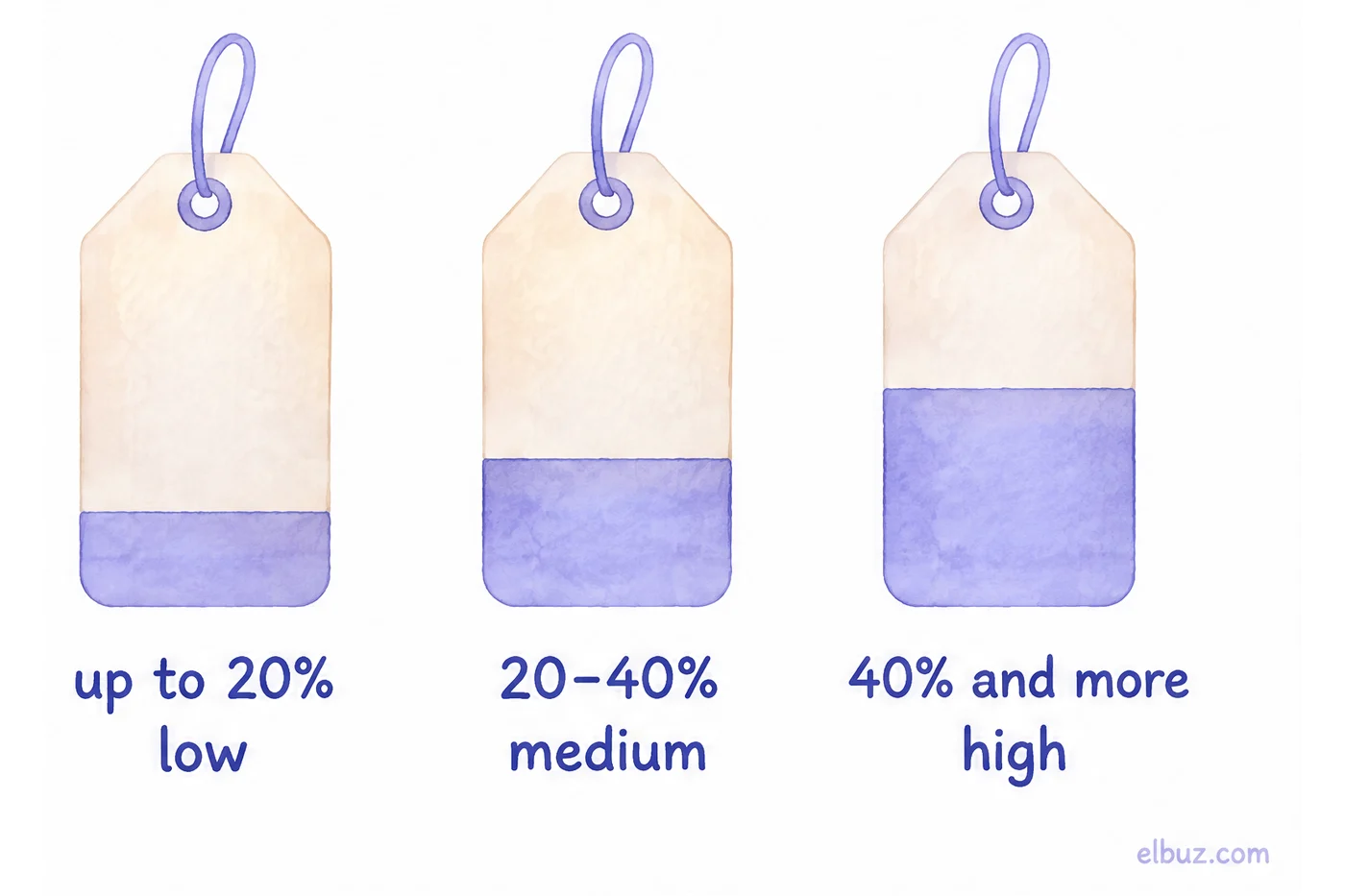
Sellers usually split products into three groups. The limits are a rule of thumb; there is no official standard:
| Gross margin | Group | Typical role in the catalog |
|---|---|---|
| up to 20% | Low | Electronics and well-known brands: they bring shoppers in, profit comes from volume |
| 20–40% | Medium | The core of most stores |
| 40% and more | High | Accessories, add-ons, private label, products without a direct price comparison |
Gross margin cannot exceed 100%: the margin is part of the price. Only markup, which is counted on the cost, goes above 100%: an item bought for €18 and sold for €60 has a markup of 233%.
Why some products have high margins and others low
A high margin holds where the shopper cannot easily compare the price or buys the item together with something else. Signs:
- Nobody else sells the exact same item. Private label, your own design, a bundle of several products: the price cannot be compared in one click.
- It is bought next to the main purchase. A case for a phone, a filter for an appliance, care products for shoes: few people hunt for the lowest price on these.
- Low cost compared with the value to the buyer. Gifts, seasonal and holiday items.
- Small and light. Shipping you pay for does not eat the margin.
Low margins belong to products that dozens of stores sell under the same model number: the shopper sees every price side by side on Google Shopping or a marketplace, and the cheapest seller sets the price.
A high margin has a downside: it is often "held up" by costs that the simple formula leaves out. Impulse products do not sell without ads, clothing and shoes come back because of size (in the EU, shoppers have 14 days to cancel an online purchase without giving a reason), and seasonal stock sits in the warehouse for half a year. So a high margin is only a hypothesis that a calculation has to confirm.
How to check a product's margin after ads and returns
Count profit per unit sold, not margin on the price: from the revenue of orders the customers kept, subtract the cost of goods, the ads for all orders, the shipping of returns and the stock you cannot resell after a return.
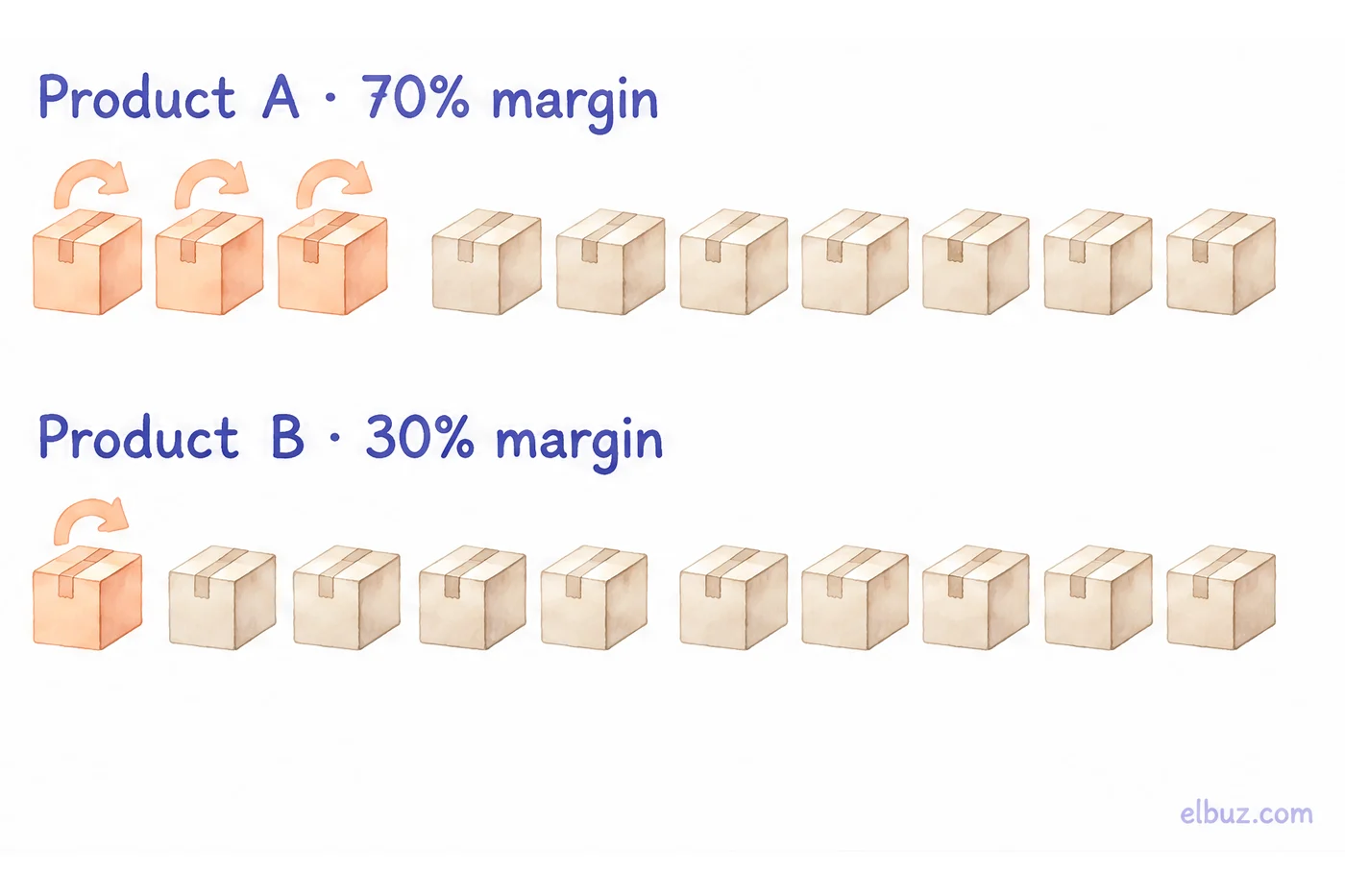
Illustrative example for the arithmetic, not market prices. A store sells two products from its own website. Product A is an impulse buy at €60 with a cost of €18, a 70% margin. Ads cost €15 per order, 3 of 10 parcels come back, each return costs €14 in shipping both ways, and one of the three returned units can no longer be sold. Product B sells at €200 with a cost of €140, a 30% margin. Ads cost €25 per order, 1 of 10 parcels comes back, and the return costs €20.
| Item | Product A | Product B |
|---|---|---|
| Units sold | 7 | 9 |
| Revenue, € | 420 | 1,800 |
| Cost of goods sold, € | −126 | −1,260 |
| Ads for 10 orders, € | −150 | −250 |
| Return shipping, € | −42 | −20 |
| Written-off stock, € | −18 | 0 |
| Profit from 10 orders, € | 84 | 270 |
| Profit per sale, € | 12 | 30 |
| Profit per €1 of ads, € | 0.56 | 1.08 |
How the rows are calculated: revenue is 7 × 60 and 9 × 200; cost of goods sold is 7 × 18 and 9 × 140; ads are 10 × 15 and 10 × 25; return shipping is 3 × 14 and 1 × 20; the written-off unit costs €18.
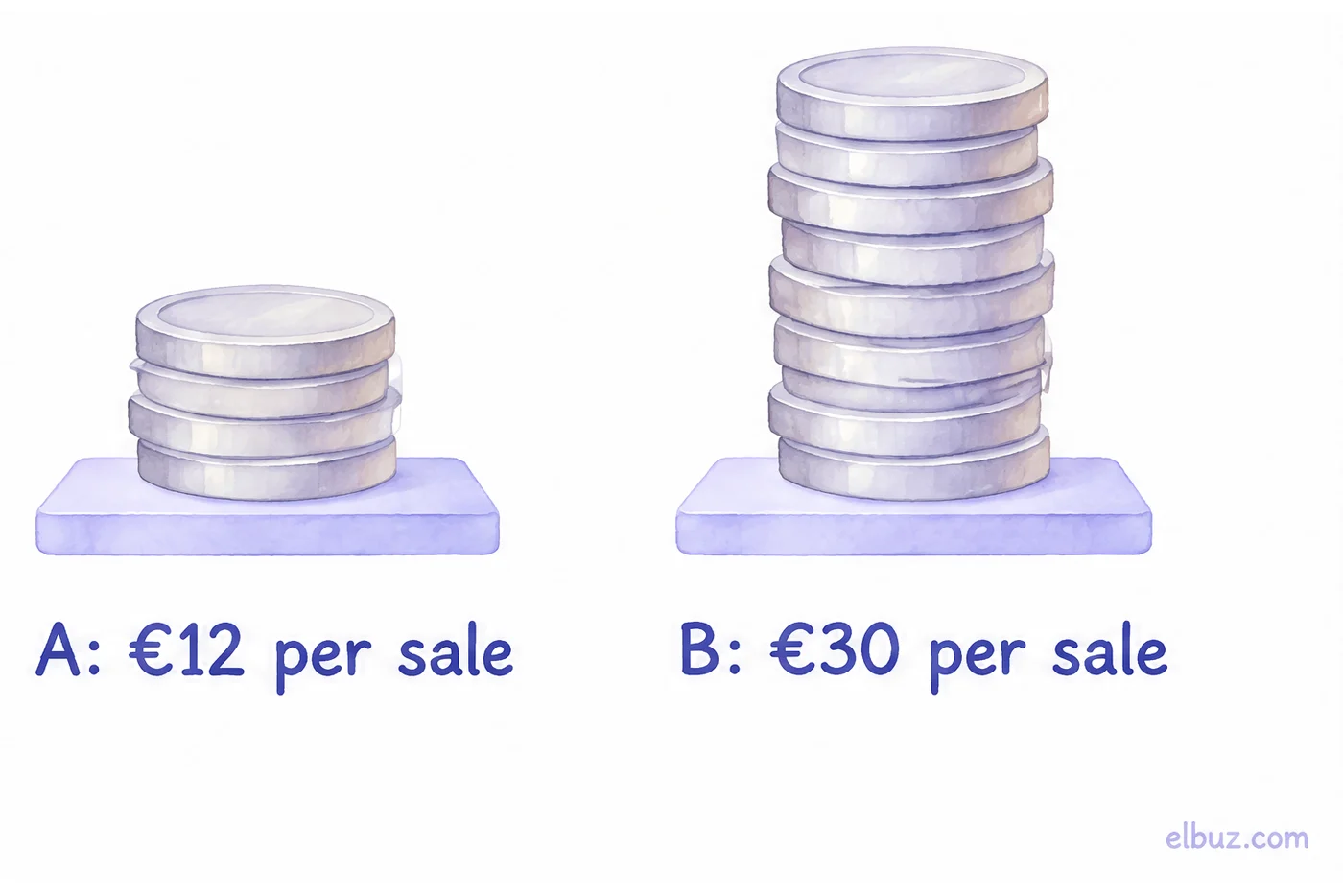
The 70% margin product leaves €12 per sale, the 30% one leaves €30. The reason: ads and returns are costs in euros per order, not a percentage of the price, so on a cheap item they take a larger share. Profit is 20% of revenue for A and 15% for B, yet every euro of ads in B brings twice as much profit. If your ad budget is limited, it works harder on B. The share of revenue you actually keep is the return on sales; how to calculate it for the whole store is in return on sales: formula and example.
What to check on your own product:
- How much ad spend falls on one order: from your ad account, for the last month.
- How many of every ten orders are returned or refused: from your order history, not from assumptions.
- What one return costs: shipping both ways, and whether the item can be sold again.
- The channel fee: on a marketplace you also pay a percentage of the price, which Amazon, for example, sets by category, with a minimum per item.
How to build these costs into the price in advance is covered in how to calculate markup: formulas and examples.
How to find high margin products in your own catalog
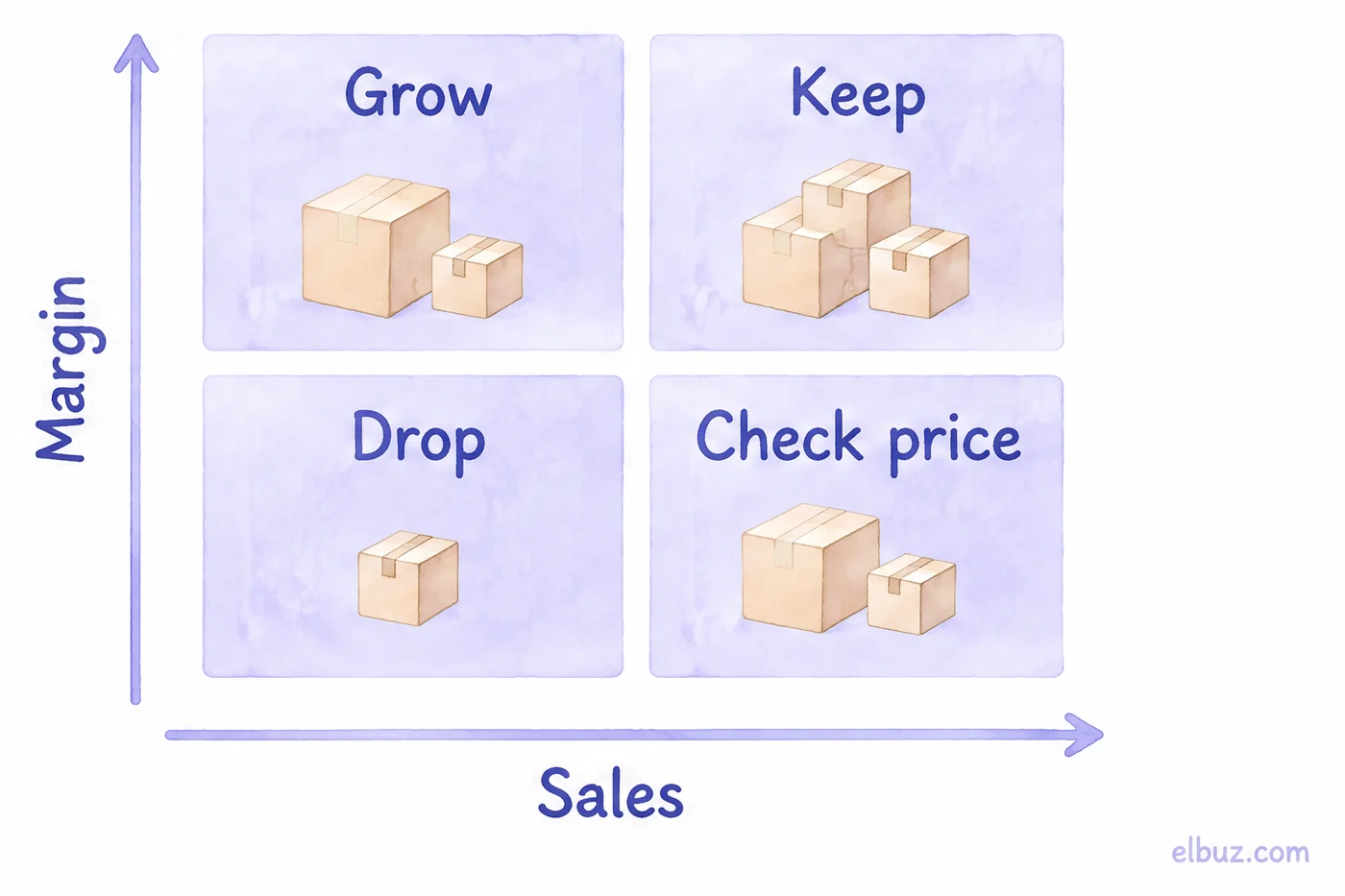
Sort products by two measures, the margin per sale after costs and the number of sales, and each group gets its own decision.
| Margin | High sales | Low sales |
|---|---|---|
| High | Keep: watch stock and the supplier's price | Grow: better photos and copy, show it next to best sellers |
| Low | Check the price: raise it, buy cheaper or sell through a cheaper channel | Drop it, or sell only to order |
Count margin in euros, not only in percent: a product at €3,000 with a 10% margin brings €300 a sale, one at €30 with a 60% margin brings €18. Which products bring most of the total profit shows up in an ABC analysis by profit. To raise the share of high margin sales, add accessories and add-ons to the pages of main products and build bundles.
When to see product margins without spreadsheets
When you have hundreds of products: then a manual margin sheet goes stale with every new supplier price list, and a product that got more expensive at the supplier quietly moves from "keep" to "check the price".
In Elbuz, sales analytics calculates revenue, profit and margin from confirmed orders, filtered by category and order source, and splits products into ABC groups by their share of profit. This is gross margin: the report does not subtract ads and returns, so for candidate products add the calculation from this article. Selling prices are recalculated with every supplier price list by your markup rules, so the margin does not drop when a supplier raises the price.
Who does not need it: if you sell a few dozen products and purchase prices rarely change, the spreadsheet calculation above is enough.
Markup rules in ElbuzPrices recalculated with every price list, margin kept, 14 days free
Frequently asked questions
What is a high margin product?
A product whose gross margin, the difference between price and cost of goods, takes a large share of the price, usually 40% or more. Whether it brings more money shows only after ads, fees and returns.
Is a 40% profit margin too high?
No: 40% gross margin is where sellers usually start calling a product high margin, not a ceiling. Whether it is enough depends on how much of it is left after ads, fees and returns.
Can a margin be more than 100%?
No: margin is counted on the selling price and is always smaller than it. Only markup, counted on the cost, can go above 100%.
What is the most profitable item to sell online?
There is no single one: it is the item that leaves a noticeable amount in euros after ads, fees and returns, and that your supplier keeps in stock. Check a candidate on ten orders, as in the example.
What is the difference between margin and markup?
Both start from price minus cost, but margin is divided by the price and markup by the cost. An item bought for €18 and sold for €60 has a 70% margin and a 233% markup.
Which products have the highest margins?
Those whose price is hard to compare: private label, bundles, accessories and add-ons to the main purchase. But every store has its own list, so check the margin on your own purchase price and channel.
Sources
- Amazon referral fees: a percentage of the total price or a minimum amount per item, by category — sell.amazon.com/pricing.
- 14-day right to cancel online purchases in the EU — europa.eu, Your Europe.
Checked on October 31, 2026. All other numbers in the article are illustrative examples for the arithmetic.


