

Product differentiation is a difference in your product or store that buyers notice, find important, and choose you for or agree to pay more for. An online store that sells the same products as others rarely differs in the product itself; more often it differs in service, advice, speed, bundles or terms. And a difference works only if the buyer can check it.
The typical mistake is to call a difference what everyone writes: "quality products", "fast shipping", "low prices". The second is to add a service and not recalculate the price, so the difference eats the margin. Below: the types of differentiation, a table of what to differ in and how to prove it, a calculation of how much you can raise the price, and how to check that the difference works.
When people look for product differentiation
Usually the store sells products a buyer finds on a price comparison site in a minute, and it loses to whoever is two euros cheaper. The owner searches for "product differentiation", "competitive advantage", "how to differentiate your business" to get out of the price war. A student searches for the same thing with a definition and types for a course paper.
The next questions are "what are the types of differentiation", "product differentiation examples", "Porter's differentiation strategy". A more important question is asked rarely: how much does the difference cost, and will a higher price pay for it?
Types of differentiation
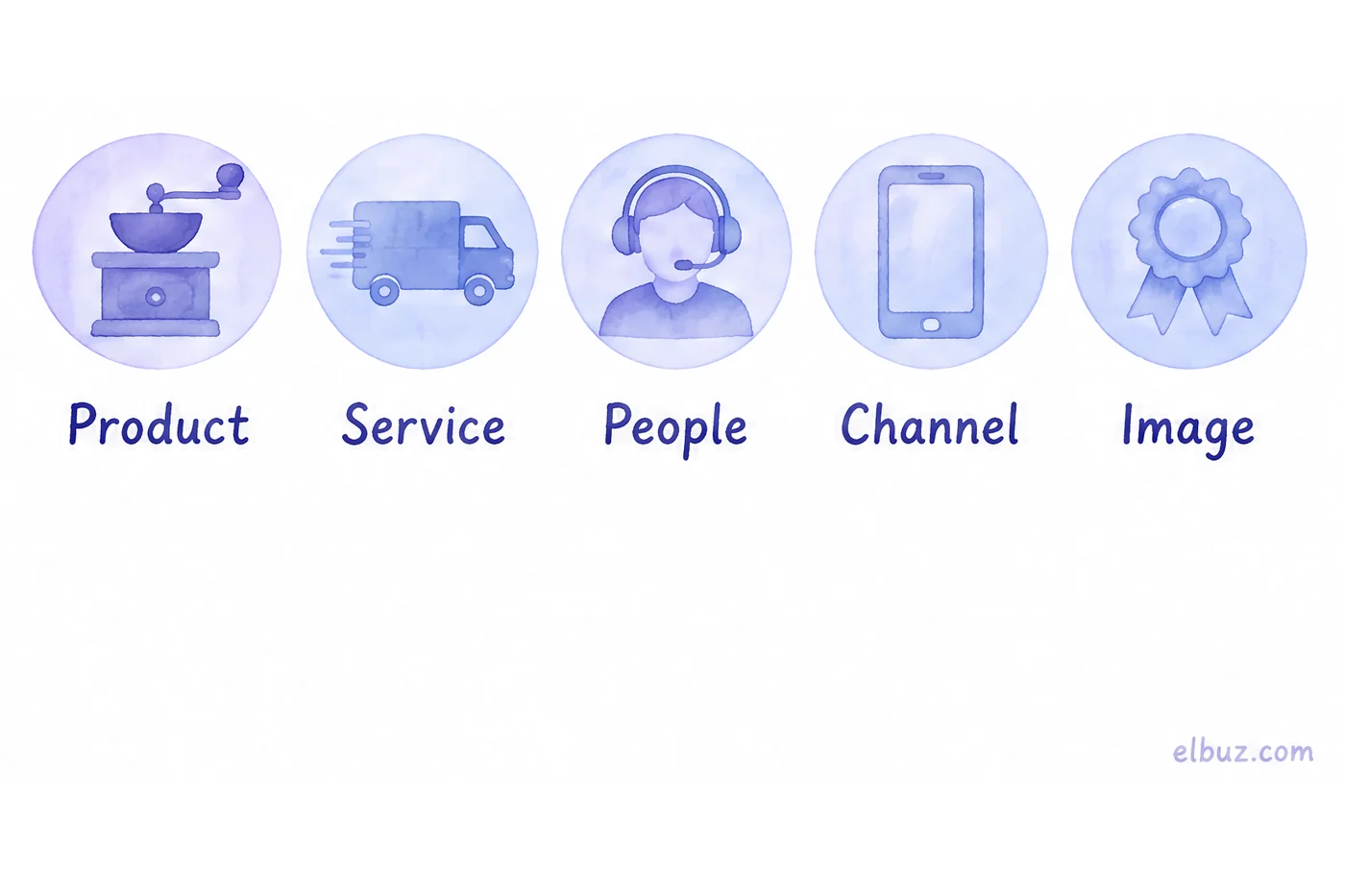
Michael Porter described differentiation as one of three generic competitive strategies, next to cost leadership and focus on a narrow segment. Philip Kotler broke down what you can differ in: product, services, personnel, channel and image. For an online store it looks like this.
| Direction | What the difference is | Example for a store |
|---|---|---|
| Product | Features, quality, bundle, private label | A "grinder + scale + brush" bundle instead of separate products |
| Service | Delivery, returns, warranty, setup | Setting the grinder to the buyer's coffee machine before shipping |
| People | Product knowledge, speed and tone of replies | A consultant who brews coffee and can recommend a roast |
| Channel | Where and how people can buy | A repeat order in a messenger with one message |
| Image | What the store is associated with | A store for people who know coffee, not "everything for the home" |
Differentiation is also split into vertical (one product is objectively better, and people pay more for it) and horizontal (the products are equal, but different people prefer different ones: color, taste, style). It helps a store to know which one it has: vertical gives the right to a higher price, horizontal gives a sharper fit with a segment.
What to differ in and how to prove it
A difference is a promise, and buyers believe proof. So for every difference, write down right away how to prove it and where to show it so the buyer sees the proof before buying.
| Difference | How to prove it | Where to show it |
|---|---|---|
| Fast dispatch | A specific time: "orders placed by 4 pm ship the same day" | Product page next to the "Buy" button, an email with the tracking number the same day |
| Accurate stock | "In stock" means the item is in the warehouse, not in a supplier's week-old price list | Stock status and dispatch time on the product page; made-to-order items marked separately |
| Product knowledge | Your own photos, tests, videos, model comparisons | Product page, reviews on the blog, chat replies with a link to the test |
| A warranty you can rely on | Terms with numbers: "a faulty item replaced within 1 day of receipt" | A separate terms page and a short line on the product page |
| A full range in the niche | All compatible accessories and consumables for the product | A "Compatible with this product" block, a compatibility filter |
| Service included in the price | Setup, assembly, selection: included, not "on request" | A line on the product page and in the order confirmation |
| Rewards for regulars | A price or bonus that grows with the number of purchases | Customer account, a post-purchase email; how to build it is in the article on an ecommerce loyalty program |
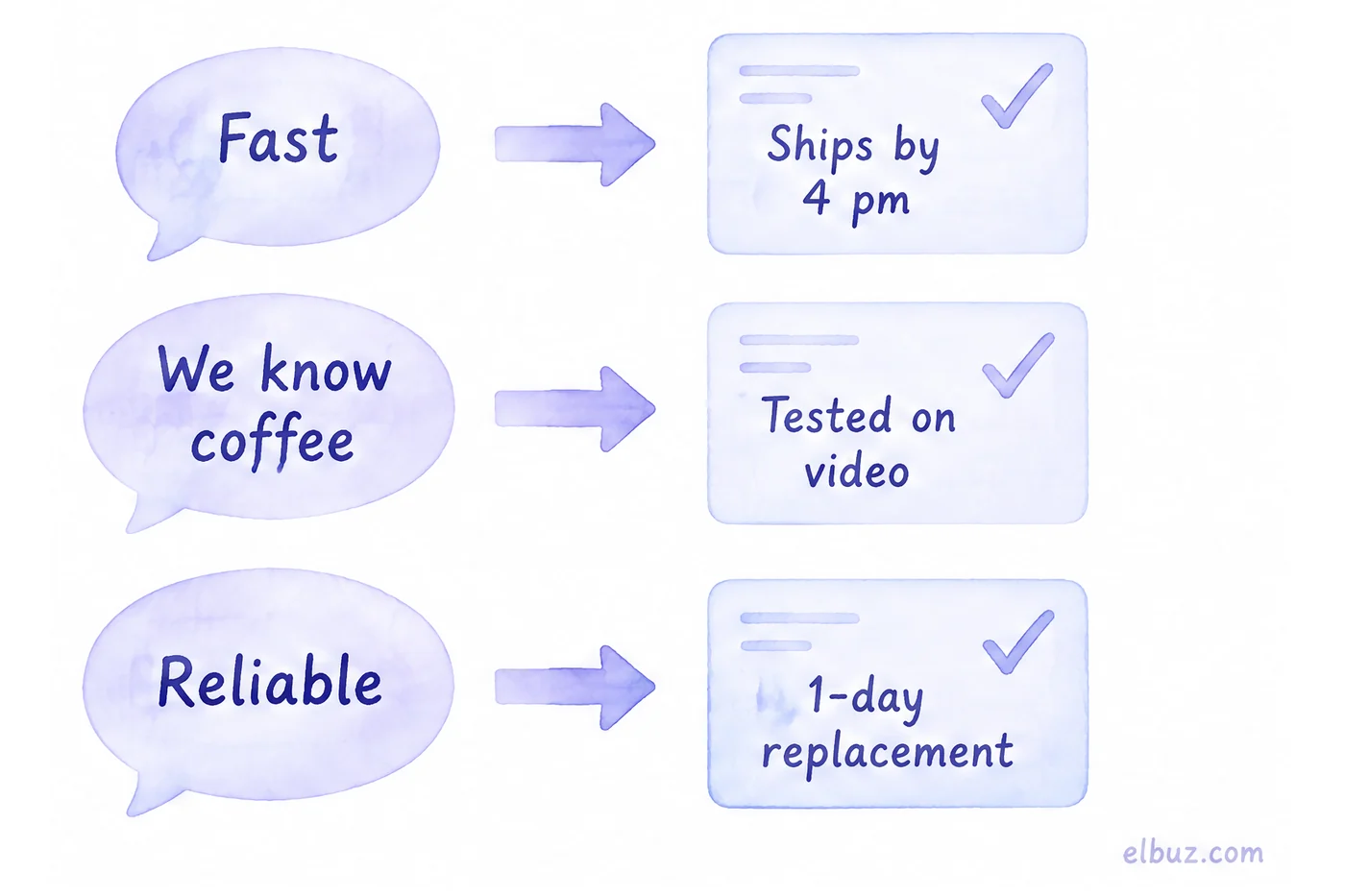
The numbers in the table show how to phrase a promise; they are not a standard. Use the ones you actually deliver every day: a promise the store breaks does more harm than no promise.
How much you can raise the price for a difference
The premium over the market price should be no less than the cost of the difference and no more than what the difference is worth to the buyer. One formula shows whether the premium pays off: how far sales can drop without profit going down.
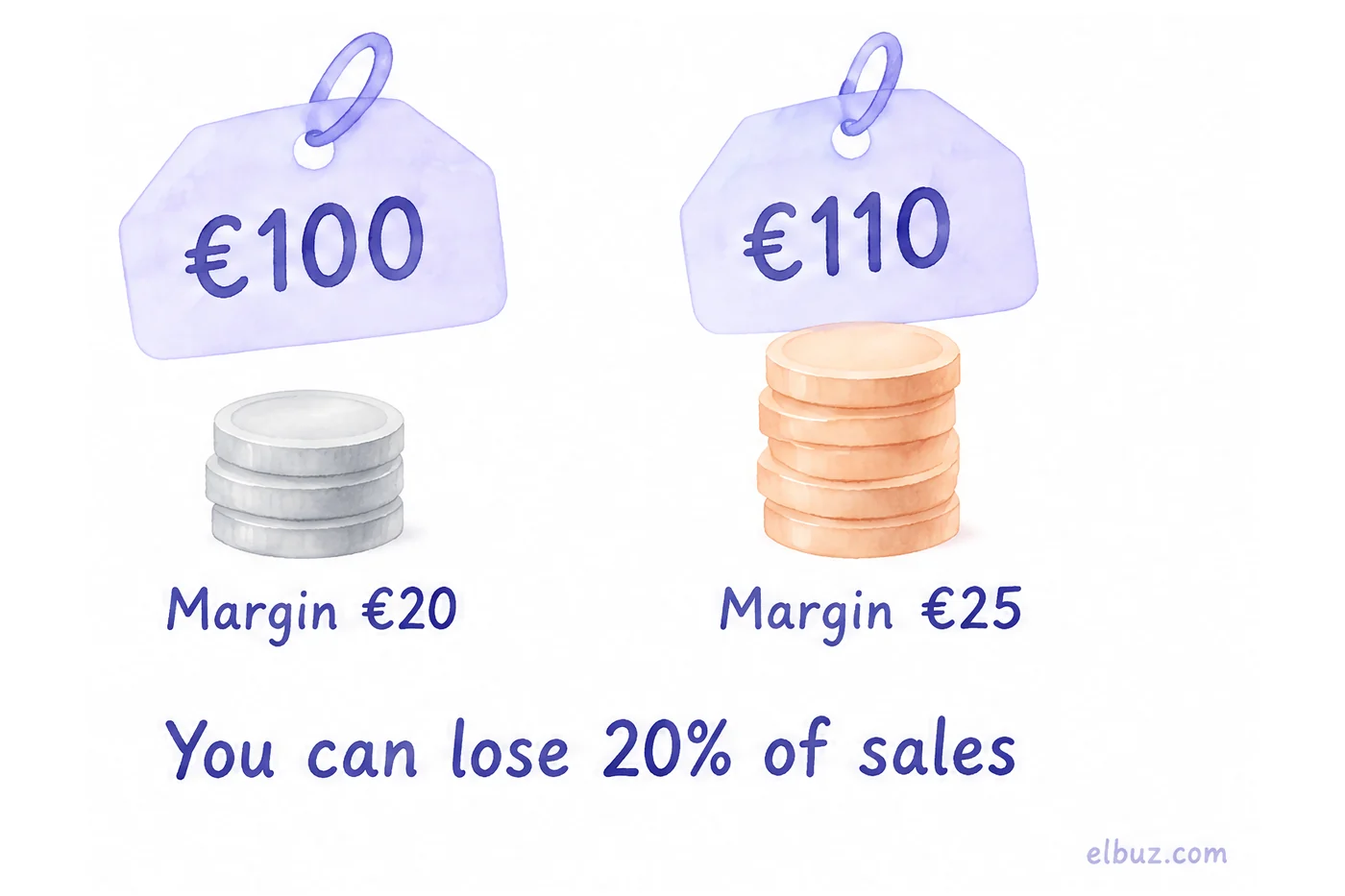
Illustrative example for the arithmetic, not market prices. Everyone sells a coffee grinder for €100, the purchase cost is €80, the margin is €20. The store adds grind setup and next-day replacement of faulty items, which costs it €5 per order, and sets the price at €110.
| Metric | Like everyone | With the difference |
|---|---|---|
| Price, € | 100 | 110 |
| Purchase cost, € | 80 | 80 |
| Cost of the difference, € | 0 | 5 |
| Margin per item, € | 20 | 25 |
| Margin from 100 sales, € | 2,000 | 2,500 |
| Sales needed to keep €2,000 | 100 | 80 |
(1 − 20 / 25) × 100 = 20%. So with the difference the store can sell 20 fewer units out of 100 and earn the same: 80 × 25 = €2,000. If the €110 price drives away more than one buyer in five, the difference does not pay off: make it cheaper to deliver or more valuable to the buyer.
How to calculate margin and how it differs from markup is in the article on gross margin vs markup.
How to check that the difference works
A difference works if buyers notice it and choose you because of it. You can see this in store data without surveys:
- Conversion rate of products with the difference: compare it with the same products before the change or with products without the difference.
- Share of repeat purchases: if the difference is in service, the number of repeat buyers should grow.
- Questions in chats: do buyers ask about your difference ("will you set the grind?") or about the price? The second means the difference is not visible.
- Reasons for refusals and returns: check that no new ones appeared because of a promise you could not keep.
Change one thing at a time and look at the result no earlier than a few weeks later, so you have enough orders to draw a conclusion.
Differentiation mistakes
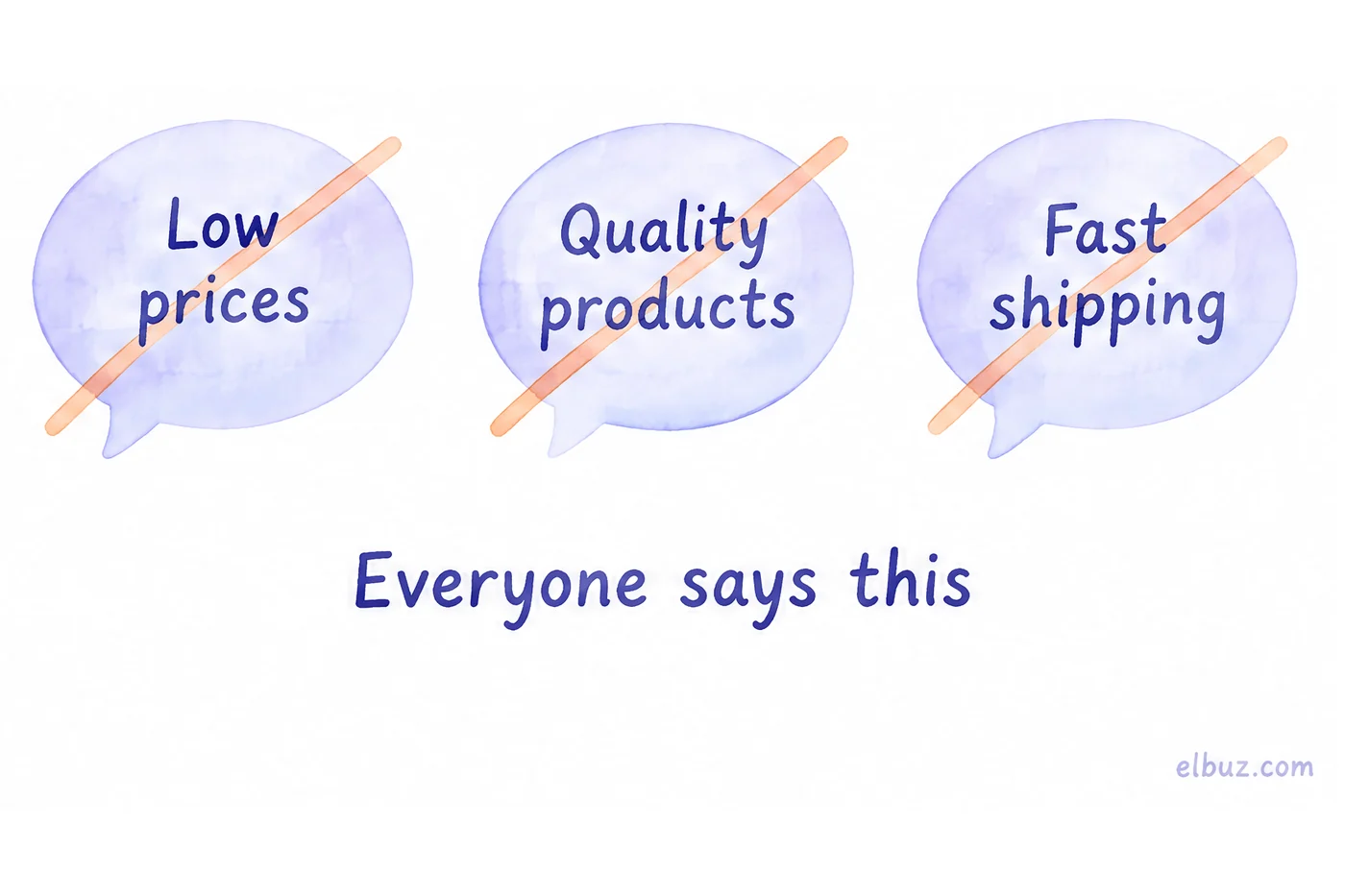
- A difference everyone claims. "Low prices", "quality products", "fast shipping" without numbers are background noise, not a difference.
- A difference the segment does not care about. Gift wrapping will not help sell beans to someone who buys them every month for themselves. Choose the segment first; how to do it is in the article on STP marketing and positioning.
- A difference competitors copy in a week. A competitor will match a discount or free shipping at once. Product knowledge, a deep range in the niche and service that needs well-run processes last longer.
- Service without a price recalculation. Setup, a gift or a fast replacement cost money; if the price stays the same, your margin pays for them.
- A promise that is not kept. "Same-day dispatch" on a Friday evening when the warehouse is closed is a reason for a bad review.
When differentiated products need a different markup
A difference rarely covers the whole catalog: grind setup applies to grinders, not filters, and bundles are put together in one category. So the premium is set not for the whole catalog but for a category or brand, and it has to be recalculated whenever the supplier changes the price.
In Elbuz, markup is set with rules: separately for a supplier price list, a category and a brand, and prices are recalculated with every new price list. A floor of "not below cost plus N%" keeps the price from falling below it even if the purchase cost has gone up. How it works is on the markup pricing page.
Who does not need it: if you have a few dozen products and supplier prices hardly change, the formula from the section above in a spreadsheet is enough.
Markup rules in ElbuzA separate markup for a category and brand, recalculated with every price list
Frequently asked questions
What is product differentiation?
It is the difference that makes a buyer choose you over a competitor. It can be in the product, service, people, sales channel or image.
What is a differentiated product?
A product that buyers do not consider fully equal to competitors' products, because of its features, bundle, service or brand. So they compare it on more than price.
What are the types of product differentiation?
By direction: product, service, people, channel and image. By nature: vertical (one product is objectively better) and horizontal (products are equal, but different people prefer different ones).
What is Porter's differentiation strategy?
One of Michael Porter's three generic competitive strategies: a company offers something buyers value and will pay more for, instead of competing on the lowest cost.
What is the difference between differentiation and positioning?
Positioning defines who the store is for and what place it takes among the alternatives. Differentiation is the specific differences that support and prove that position.
Can you differentiate if you sell the same products as everyone else?
Yes: the difference then moves to service, advice, speed, bundles and terms. Examples with proof are in the table of differences.
Sources
- Porter M. E. Competitive Strategy: Techniques for Analyzing Industries and Competitors. Free Press, 1980 — generic competitive strategies.
- Kotler P., Keller K. L. Marketing Management. Pearson — directions of differentiation: product, services, personnel, channel, image.
- Smith W. R. Product Differentiation and Market Segmentation as Alternative Marketing Strategies. Journal of Marketing, 1956, vol. 21, no. 1 — doi.org.
Checked on October 31, 2026. Prices and costs in the calculation are an illustrative example.


