

To start an online bookstore, choose a niche you can recommend in (children's books, professional titles, comics, used books), register a business, open trade accounts with publishers or a book wholesaler, and build your catalog around ISBNs. In Germany and France, check the fixed book price laws first. The number that decides profit is the average order: one book with free shipping earns almost nothing.
Books are cheap, but a parcel costs the same to ship whether it holds a €20 book or a €200 gadget, so a bookstore makes its money on orders of several books. The second trap is the catalog: one title exists in several editions, formats and translations, and the buyer has to see exactly which one they are paying for. Below: the format, registration and pricing laws, the order math, the catalog, a startup budget, suppliers and a launch checklist. The general route for any niche, from the business model to the first order, is in how to start an online store.
When people ask how to start an online bookstore
Usually it is someone who reads a lot, runs a book blog, a BookTok account or a book club, or has worked at a publisher or a bookshop. They search "how to start an online bookstore" or "how to open a bookshop with no money", and then "how much does it cost to open a bookshop", "where to buy books wholesale" and "do I need an LLC".
The question asked most often is what markup to set. The more useful one is how many books sit in an average order and who pays for shipping. That decides whether anything is left of the markup.
What to sell: the format of your bookstore
The easiest start is a niche where you can give advice: children's books, professional literature, comics, books in the original language, used books. A broad "all new releases" store competes on price and delivery speed with Amazon and the large chains, and that is a fight a new store loses.
| Format | What to plan for |
|---|---|
| Niche: children's, professional, comics, original language | Customers stay for the selection and the advice; easier to work with a few publishers |
| New books from a wholesaler, shipped on order | No stock bought up front, but you need the wholesaler's availability in your catalog |
| Used and rare books | Every copy is its own listing with condition and photos; cheap to buy, a lot of manual work; also sells well on eBay and AbeBooks |
| Book club or subscription box | Repeat orders from the same readers; needs a steady selection and a community |
Your own website and marketplaces work together: Amazon and eBay bring buyers who already search for a specific title, AbeBooks is where people look for used and rare copies, and your own site is where the niche selection and repeat customers live.
Registration: business, tax and ISBN
Selling books regularly is a business, so register it the way your country requires: a sole proprietorship or an LLC in the US, a sole trader or a limited company in the UK, a trade registration in Germany. An LLC is not required to start; it separates your personal liability from the business. Selling books does not usually need a special licence.
- Sales tax and VAT. Register for sales tax in the US or VAT in the EU and the UK where your country's rules and thresholds require it. Many European countries tax books at a reduced VAT rate, so check the rate for books, not the standard one.
- ISBN. A bookstore does not need its own ISBN. ISBNs are assigned by publishers to each edition and format of a book; for the store, the ISBN is the key of the catalog.
- Trade accounts. Publishers and wholesalers usually ask for business details before they give you a trade discount, so register first.
Fixed book prices in Germany and France
In Germany and France you cannot set your own price for new books: the publisher sets it, and the retailer sells at that price (Germany) or at most 5% below it (France). If you sell to end customers in these countries, discounts are not a tool for raising the order value.
| Country | Law | What it means for an online store |
|---|---|---|
| Germany | Buchpreisbindungsgesetz (BuchPrG), 2002 | Anyone selling books commercially to end customers in Germany must charge the price the publisher or importer has set for that edition (§ 3, § 5). The law also covers e-books that replace printed books. Used books and copies marked as damaged are exempt. |
| France | Loi n° 81-766 of 10 August 1981 (loi Lang), amended by loi n° 2021-1901 (loi Darcos) | The retail price must be between 95% and 100% of the publisher's price. Delivery of books cannot be free unless the book is collected in a bookshop; the minimum is €3 for orders with less than €35 of new books, and at least €0.01 above that (arrêté of 4 April 2023). |
Several other European countries have their own fixed book price rules. If you plan to sell into a country, check its law before you plan promotions and free shipping.
How much is left from an order: one book versus three
Free shipping on a single book eats almost the whole markup, so offer free shipping only from an order value that usually means several books. Calculate that threshold on your own numbers before launch.
Illustrative example for the arithmetic, not market prices. A book retails at €20, your supplier gives you a 40% trade discount, so you buy it for €12 and keep €8. Shipping at your expense costs €5 per parcel, whether it holds one book or three.
- One book: €8 − €5 = €3 left for you.
- Three books in one parcel: 3 × €8 = €24 markup, €24 − €5 = €19.
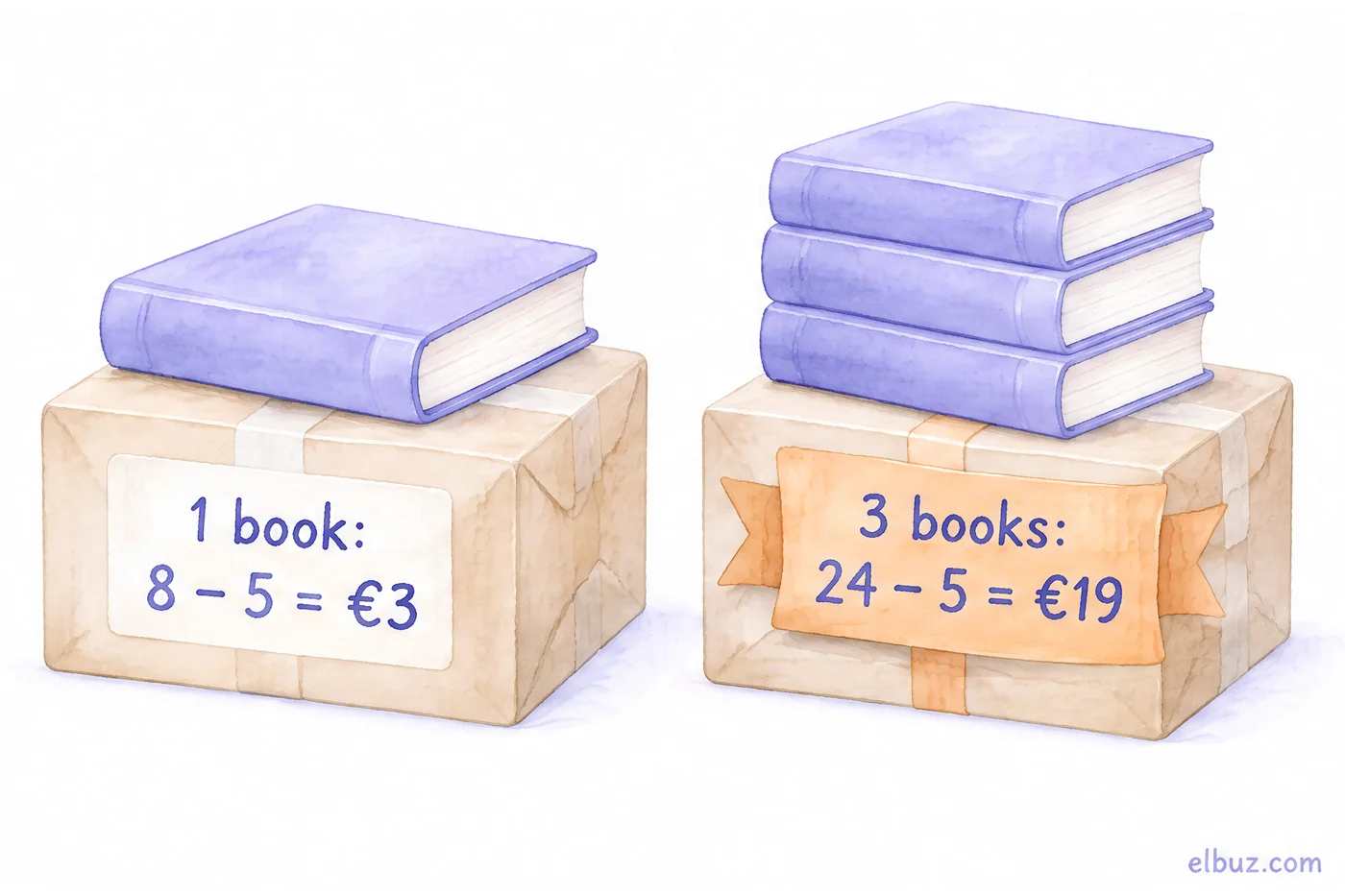
The rule follows: set free shipping from an amount that typically means two or three books, and let the customer pay shipping for a single book. In France free delivery is not allowed at all, and in Germany you cannot discount, so curated lists, series and "readers also bought" bundles raise the order value better than price cuts. Markup and margin formulas are in how to calculate markup, and you can check your own numbers in the profit margin calculator.
Catalog: one edition, one product card
The key of a book catalog is the ISBN. Every edition and every format gets its own ISBN, so the hardcover, the paperback and a new translation of the same title are different products. Since 2007 an ISBN has 13 digits and starts with 978 or 979, and it is printed as the barcode on the back cover.
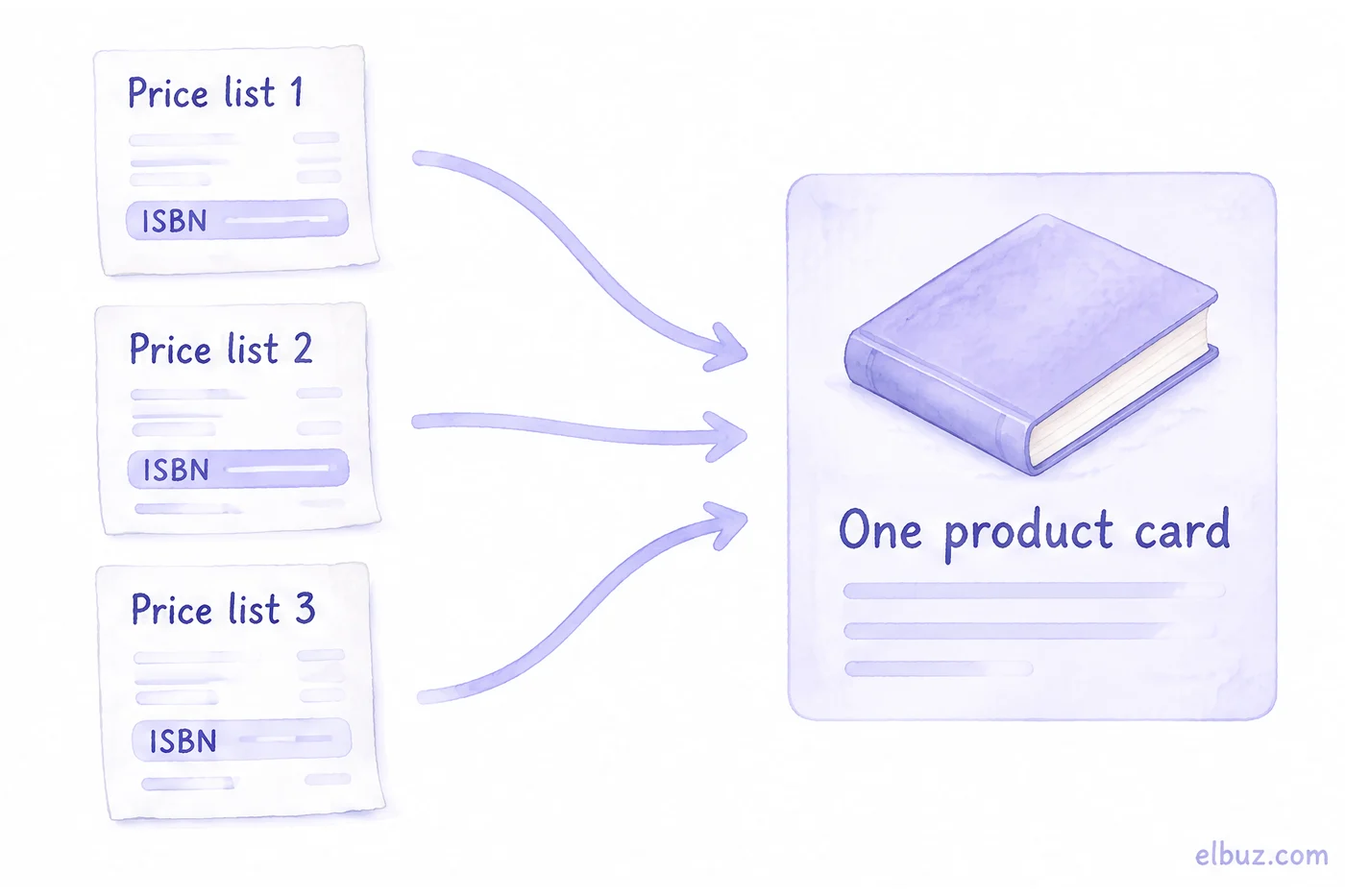
If several suppliers carry the same book, merge their rows into one product card by ISBN, not by title: each supplier writes the title its own way, the ISBN is the same. Then the card has one price and combined availability instead of three duplicates with different prices.
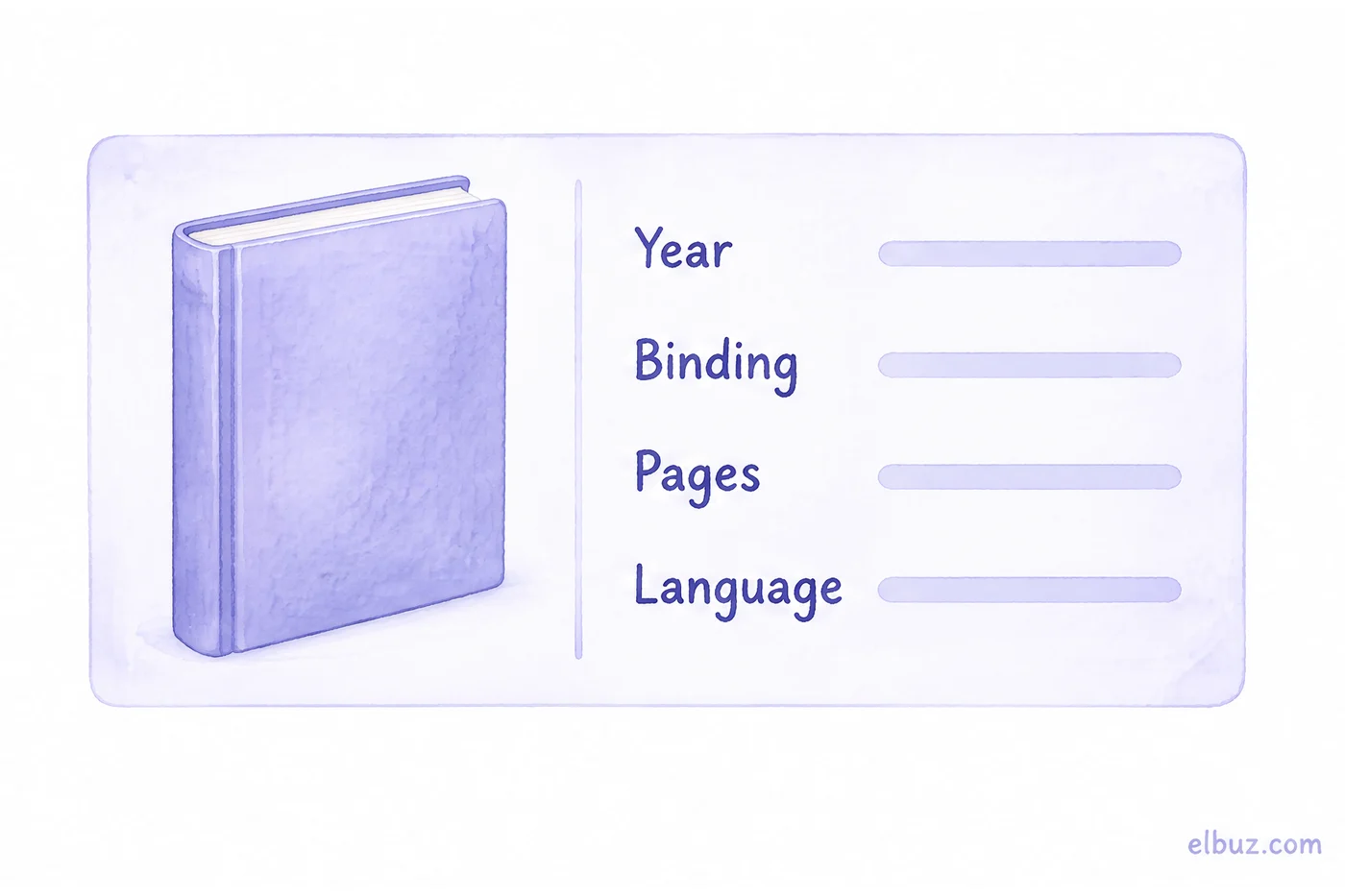
- Publication year and publisher — buyers often look for a specific edition or translation.
- Binding — hardcover or paperback; the price depends on it.
- Page count and format — matters for gifts and children's books.
- Language — a separate field, so customers can filter by it.
- For used books — the condition and photos of the actual copy.
How much money you need to start
In this example, a store without stock needs about €2,000 for the first three months, and one with a starter range about €4,700. The difference is buying 300 books plus packaging. Illustrative example for the arithmetic, not market prices; registration and tax costs depend on your country.
| Item | No stock | With stock |
|---|---|---|
| Business registration and accounting | 300 | 300 |
| Website, 3 × 40 | 120 | 120 |
| Ads and content | 1,500 | 1,500 |
| Test orders | 80 | 80 |
| Starter range: 300 books × 8 on average | 0 | 2,400 |
| Packaging and shelves | 0 | 300 |
| Total | 2,000 | 4,700 |
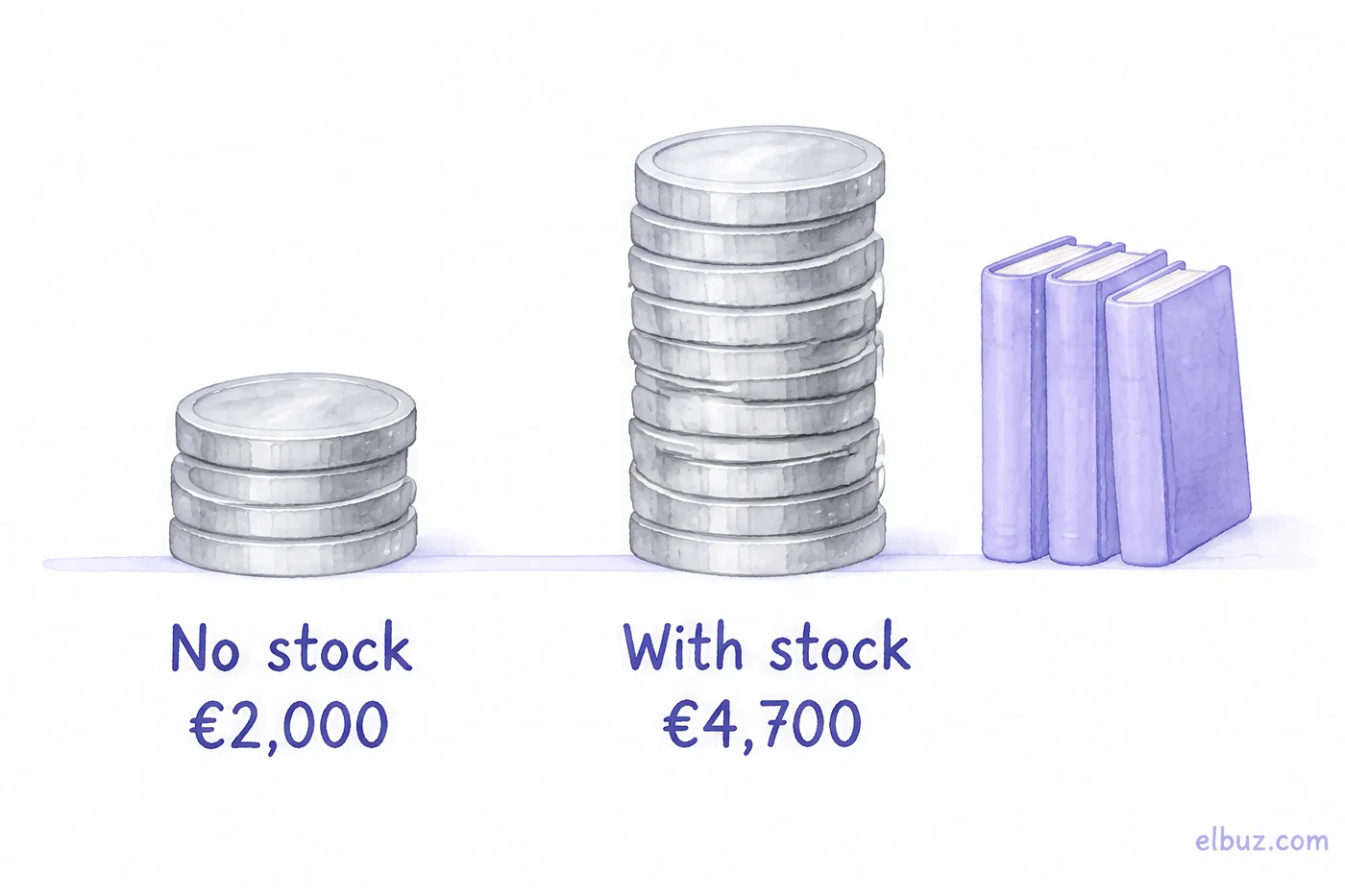
Your own stock pays off on titles that sell all the time: the bestsellers of your niche, series, textbooks and professional titles. The rest can be ordered from the wholesaler when a customer buys.
Book suppliers: publishers and wholesalers
Work directly with the publishers of your niche and with a wholesaler that carries many publishers. In the US, Ingram is the large one: it lists more than 17 million titles and, through its Consumer Direct Fulfillment service, ships orders from your website straight to your customer. That is how a new store sells without stock. What to ask before the first order:
- what trade discount you get and from what volume;
- whether there is a data feed or price list with ISBN, publication year, binding, page count and cover images;
- how often availability is updated and whether you can order single copies;
- whether unsold books can be returned and on what terms;
- whether they ship to your customers under your store's name.
How selling without stock works, and who pays for returns, is in how to start dropshipping.
How to promote an online bookstore
A niche bookstore beats the big ones on selection and advice, not on price, so build promotion around readers and topics.
- Lists that match searches: "books for teenagers", "what to read about business", "easy books in English for learners".
- Social media and email: new release reviews, excerpts, pre-order announcements, #BookTok videos.
- Book bloggers and book clubs — that is where your readers are.
- Google Shopping with a product feed whose prices and availability update together with the catalog.
When to hand the catalog and publisher price lists to software
When you have several suppliers and thousands of editions: one book arrives in three price lists with different prices, availability changes every week, and you cannot merge the duplicates and update the website by hand.
In Elbuz, products from different suppliers' price lists are linked to one product card, including by barcode, which for books is the ISBN; see supplier price list processing. The website can run on Elbuz CMS: the hosted store gets products, prices and stock from Elbuz, and website orders go straight into the program.
Who it does not suit: if you have a few hundred used books, each a single copy, a spreadsheet and a ready-made site builder are enough.
An online bookstore on Elbuz CMSCatalog and prices from publisher price lists, 14 days free
Launch checklist
Before the first sale
Frequently asked questions
What do I need to start an online bookstore?
A registered business, a niche, trade accounts with publishers or a wholesaler with a data feed by ISBN, a website or marketplace account, and a check of the fixed book price rules where you sell. The order of steps is in the launch checklist.
How much does it cost to start an online bookstore?
It depends on whether you buy books up front. In the illustrative example, the first three months cost about €2,000 without stock and about €4,700 with a starter range of 300 books.
Do I need an LLC to sell books online?
No, an LLC is not required: you can start with any business form your country allows, such as a sole proprietorship in the US. An LLC separates your personal liability from the business.
Does an online bookstore need its own ISBN?
No. Publishers get ISBNs for each edition and format. The store uses the ISBN as the catalog key, to merge one book from different suppliers into one product card.
Can I sell books at a discount in Germany and France?
Not new books. In Germany you must charge the price set by the publisher; in France you may go at most 5% below it, and book delivery cannot be free. Used books are outside the German law.
Is an online bookstore profitable?
It depends on the average order. One book with free shipping earns almost nothing, an order of several books does; see the example calculation.
Sources
- Buchpreisbindungsgesetz (BuchPrG) of 2 September 2002, last amended 8 October 2023: § 2, § 3, § 5, § 7 — gesetze-im-internet.de.
- Loi n° 81-766 du 10 août 1981 relative au prix du livre, article 1 (95–100% of the publisher's price, no free delivery) — legifrance.gouv.fr.
- Arrêté du 4 avril 2023 relatif au montant minimal de tarification du service de livraison du livre (€3 below €35 of new books, JORF of 7 April 2023) — legifrance.gouv.fr.
- International ISBN Agency, "What is an ISBN?" (13 digits since 2007, 978/979 prefix, separate ISBN for each product form) — isbn-international.org.
- Ingram Content Group, Ordering and eCommerce for retailers (17 million titles, Consumer Direct Fulfillment) — ingramcontent.com.
Checked 01.11.2026. Other figures in the article are illustrative examples for the arithmetic.


