

The short answer to how to start a cosmetics business online: pick a narrow category and buy only from suppliers whose products already meet your market's rules. In the EU that means a Responsible Person, a CPNP notification and a compliant label; in the US, the FDA requirements under MoCRA. Then build a store with filters and full ingredient lists, and plan for repeat purchases. In our illustrative example, three months without inventory cost about €2,700.
A cosmetics store does not earn on the first order; it earns on the second. The first one often runs at a loss because of ad costs, and owners who miss this close the store a few months in, just as customers start coming back. Below: what the law asks of a reseller, a budget with and without inventory, the math of the first and second order, what is special about this niche, and a launch checklist. The general path for any niche, from business model to first order, is in how to start an ecommerce business.
When people ask how to start a cosmetics business
Usually the person already sells beauty products to friends or runs an Instagram page and wants a store of their own. They search "how to start a cosmetics business" or "how to sell cosmetics online", and then: "Do I need a license to sell skin care?", "How much money do I need to start a beauty business?", "How do I start with no money?"
Many start with "where can I buy cheaper". The question that matters more: will the supplier give you documents and fresh expiry dates? That decides whether a marketplace approves the listing and whether the customer comes back.
What to sell: the store format
For a start without inventory, the easiest route is a narrow category where you can recommend a product, not just show a price.
| Format | What to plan for |
|---|---|
| Wide range of brands | You compete on price with chains and marketplaces; several suppliers and daily price updates |
| Narrow niche: K-beauty, natural, professional, men's grooming | Buyers search by category or brand; advice and the full product line matter |
| Perfume | The main risk is counterfeits; buy only from authorized distributors with documents for each batch |
| Your own brand (private label) | You become the Responsible Person (EU) or the firm named on the label (US), with all the duties that come with it |
Searches like "how to start a skincare line" are about the last row: developing your own formula with a lab or private-label manufacturer. That is a separate project with its own safety assessment. This article is about a store that resells products made by others.
Registering the business and taxes
Selling regularly is a business, so you start by registering one in your country or state: a sole proprietorship, an LLC or a local equivalent, plus VAT or sales tax registration where it applies. There is no separate federal license to sell cosmetics in the US: the FDA states that it "does not license cosmetics firms", while state or local authorities may have their own requirements.
- EU, selling to other member states. Since 1 July 2021, once your cross-border B2C distance sales of goods within the EU exceed €10,000 a year, VAT is due in the customer's country. The One Stop Shop (OSS) lets you declare it in one return instead of registering in each country.
- US. Check your state's sales tax and business licensing rules before the first sale; they differ by state.
EU and US rules for selling cosmetics
As a reseller you do not certify products yourself, but you may only sell cosmetics for which someone else has taken legal responsibility and whose label meets the rules. In the EU this is Regulation (EC) No 1223/2009; in the US it is the Federal Food, Drug, and Cosmetic Act as amended by MoCRA (2022).
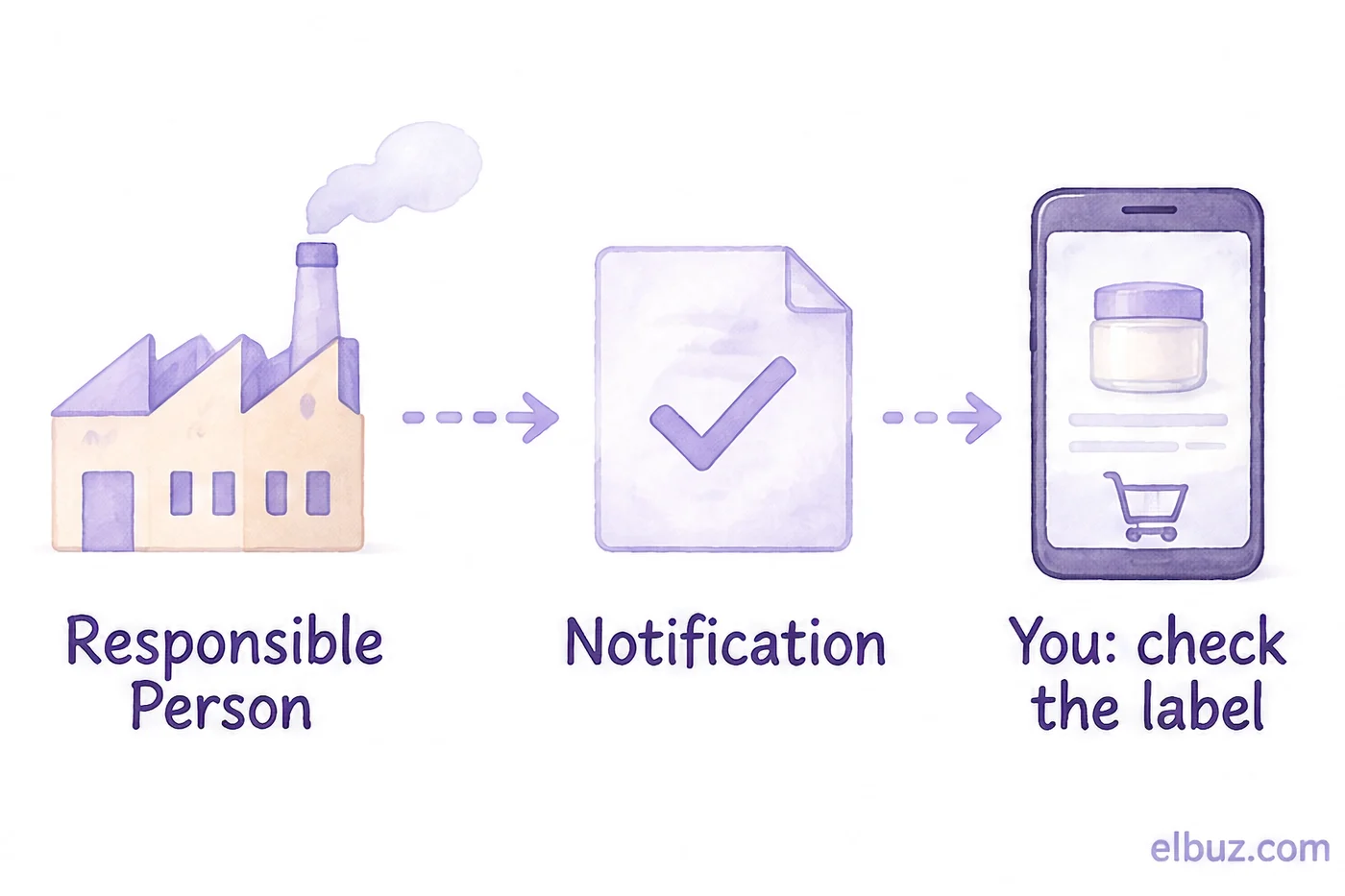
European Union.
- Responsible Person. Only cosmetics with a designated Responsible Person established in the EU may be placed on the market: the EU manufacturer, the importer, or someone they appoint in writing. This person keeps the product information file (PIF) with the safety report for ten years after the last batch and notifies the product in the CPNP portal before it goes on sale.
- You as a distributor. Before selling, check that the label shows the Responsible Person's name and address, the batch number and the ingredient list, that it is in the language required in the country of sale, and that the date of minimum durability has not passed. Products with a durability over 30 months carry the period-after-opening symbol instead of a date. Storage and transport under your responsibility must not damage the product.
- When the duties become yours. Selling under your own name or trademark, or changing a product in a way that may affect compliance, makes you the Responsible Person. Translating the label is not such a change, but if you bring a product from another member state and translate its label on your own initiative, you must submit some information to the CPNP yourself.
United States.
- The FDA does not approve cosmetics before sale (color additives are the exception). Under MoCRA, manufacturers and processors register their facilities, and the "responsible person" (the manufacturer, packer or distributor whose name is on the label) lists each product with its ingredients, keeps safety substantiation records and reports serious adverse events.
- Certain small businesses, with average US cosmetics sales under $1,000,000 a year over the previous three years (adjusted for inflation), are exempt from registration and listing, but not for products such as eye-area or injected products.
- The label must give the name and address of the manufacturer, packer or distributor; a website or P.O. box is not enough. If your store's name goes on the label, you take on the duties of that firm.
Ask each supplier who the Responsible Person is (EU) or whose name is on the label (US) and whether the product is notified or listed. A supplier who cannot answer is a risk for you, not only for them.
How much money you need to start
Without inventory, about €2,700 for the first three months; with your own stock of a narrow range, about €9,000. The difference is the first stock purchase and packaging. Illustrative example for the arithmetic, not market prices; your registration and accounting costs depend on the country.
| Item | No inventory | With inventory |
|---|---|---|
| Business registration and accounting | 600 | 600 |
| Website platform and apps, 3 × 100 | 300 | 300 |
| Test orders and testers | 300 | 300 |
| Ads and content | 1,500 | 1,500 |
| First stock purchase | 0 | 6,000 |
| Packaging: boxes, filler, thermal bags | 0 | 300 |
| Total | 2,700 | 9,000 |
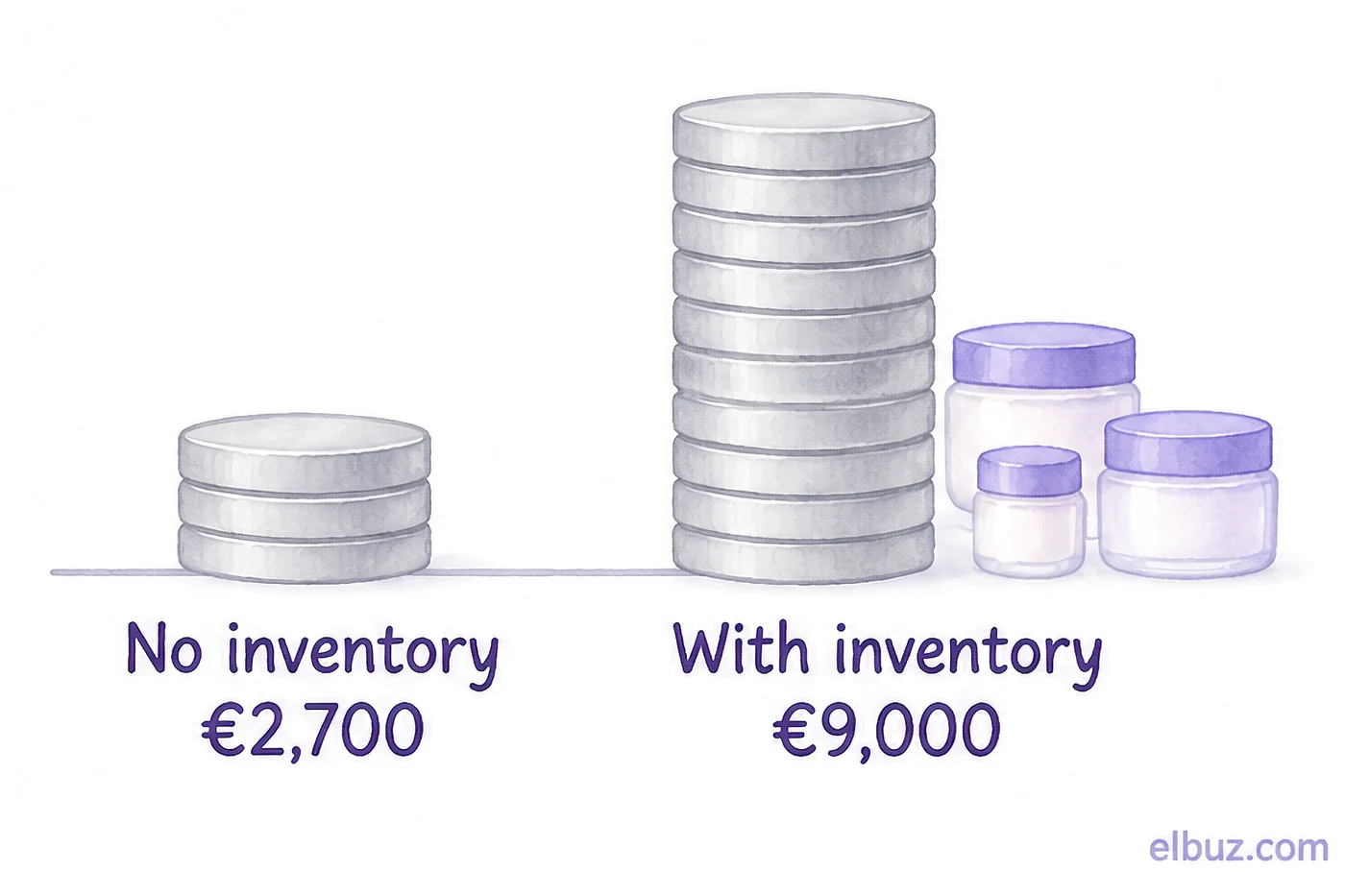
Your own stock gives a lower purchase price but locks money into goods with an expiry date. So most stores start with a supplier who ships single units and move to their own stock only for products that already sell steadily.
Why the second order brings the profit
Because you pay for ads once, to win the first customer, and the repeat order comes almost free. Illustrative example: a face cream sells for €30, costs you €20, so the markup is €10; the payment fee at 2% is €0.60; the buyer pays for shipping.
- First order: the ad cost €13. 10 − 13 − 0.60 = −€3.60.
- Second order from the same customer after a reminder: no ad cost. 10 − 0.60 = +€9.40.
- Both orders together: −3.60 + 9.40 = +€5.80.
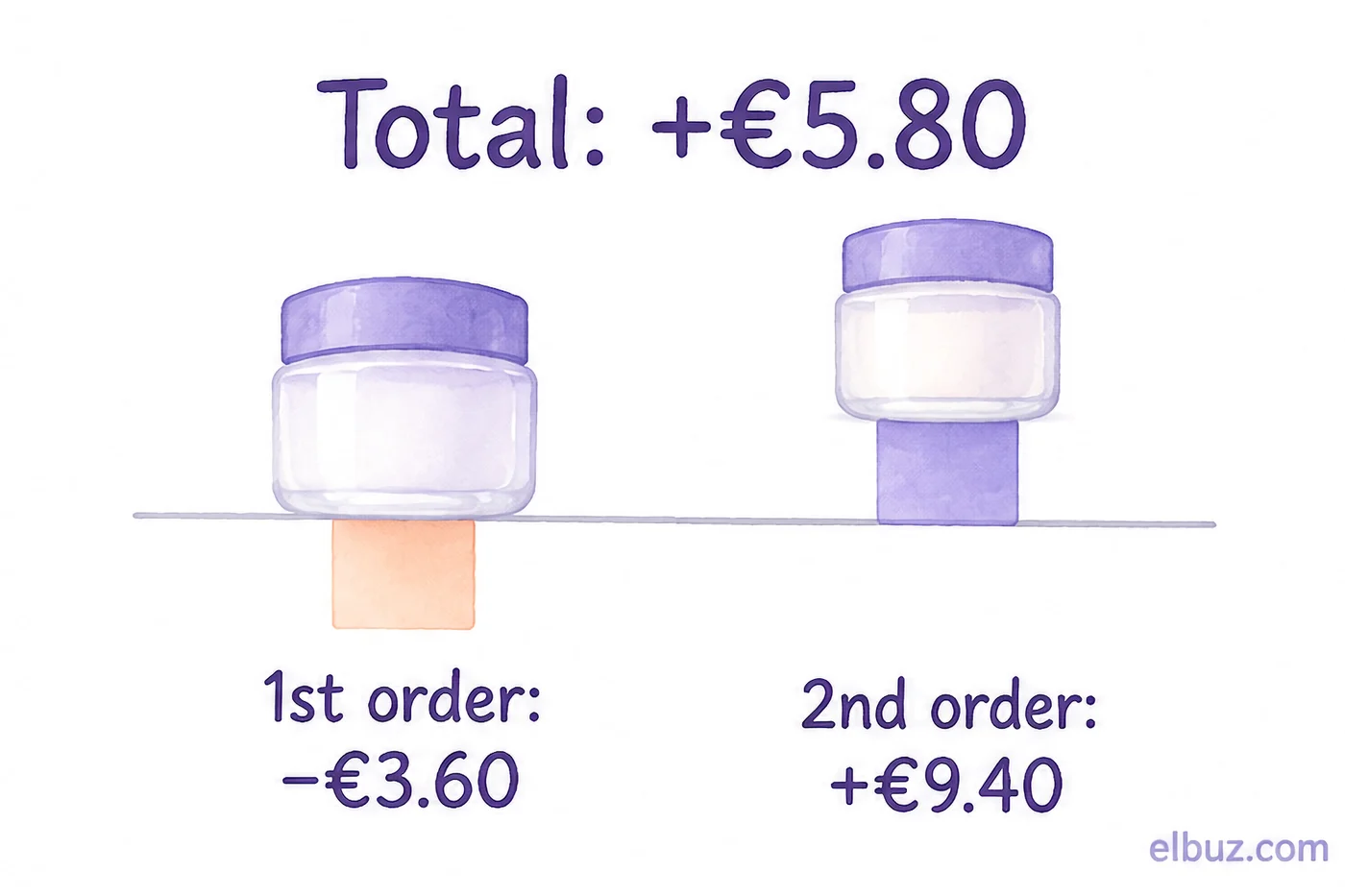
Three practical conclusions: keep the same products in stock, because the customer comes back for exactly them; remind people to reorder around the time the product runs out; and judge ad cost per customer, including their repeat orders, not per order. Plug in your own numbers in the profit margin calculator.
Cosmetics suppliers and dropshipping
You can buy from authorized brand distributors, importers or manufacturers directly: a distributor gives documents and proof of authenticity, a manufacturer gives a price without middlemen. How to find and vet them is covered in how to find dropshipping suppliers. Ask before the first order:
- are they an authorized distributor of the brand, and what documents come with each batch;
- how much shelf life is left when the goods arrive;
- does the price list include volume, SKU, barcode, the INCI ingredient list and the label language;
- who is the Responsible Person (EU) or whose name is on the label (US);
- how they pack liquids and pump bottles, and whether they ship in heat and frost;
- do they ship single units, and how often they update stock.
How selling without inventory works and who pays for returns is in what dropshipping is and how to start. For cosmetics, stock must update daily: a customer whose order for a favorite cream gets cancelled goes to another store.
What is special about the niche: expiry, temperature, returns
Cosmetics spoil with time, heat and frost, and opened products are hard to take back. Sort out these three things before the first sale.
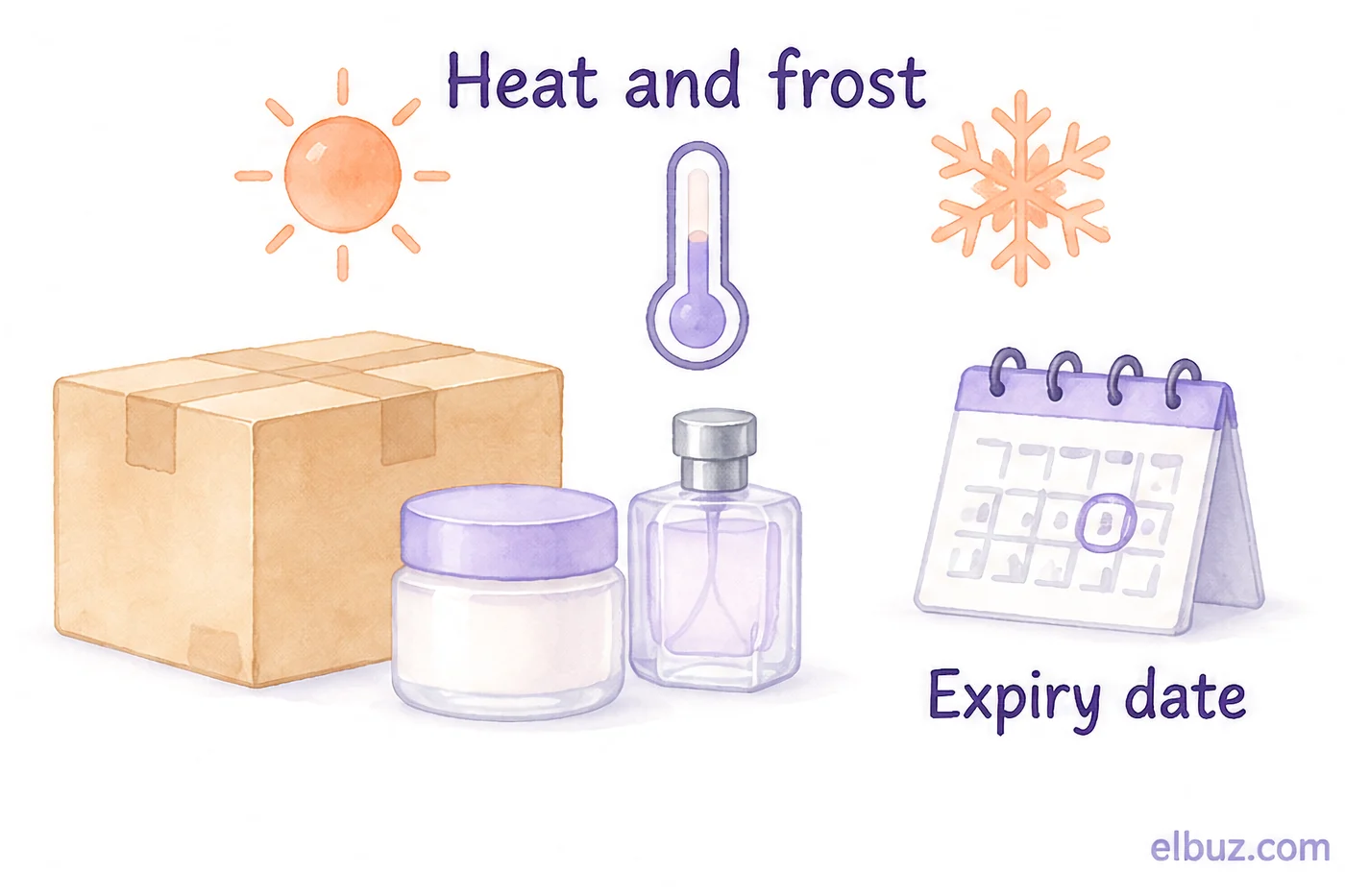
- Expiry dates. Track the date of each batch and sell the oldest first. In the EU, selling a product past its date of minimum durability is a breach of the distributor's duties.
- Temperature. Creams, emulsions and perfume spoil in heat and frost, both in storage and in transit. In such periods use thermal packaging or a shipping point closer to the customer.
- Returns. In the EU, online buyers usually have 14 days to withdraw from a purchase, but the right does not apply to sealed goods unsealed after delivery that are unsuitable for return for health protection or hygiene reasons. In the US, return terms are mostly set by your store policy. Either way, publish the conditions on the site and agree them with a lawyer.
- Product page. Buyers read the ingredients and volume; a page without the INCI list and a photo of the label sells worse, and a marketplace may reject it.
How to promote an online cosmetics store
In this niche, search by brand and product, shopping ads and repeat sales work best.
- Brand and category pages for searches like "cream for dry skin" or a product line name.
- Google Shopping and the Meta catalog with a feed that updates prices and stock together with the catalog; see product feeds for Google Shopping, Meta and TikTok.
- Reviews and routine advice: in a niche where people buy on recommendation, this is the main way to earn trust.
- Reminders and rewards for repeat purchases: the math above shows why this is not optional.
Marketplaces such as Amazon, eBay, Zalando or TikTok Shop bring buyers, but for branded beauty products they may ask for invoices from the manufacturer or an authorized distributor before approving listings. Check the requirements and the dropshipping policy in each seller account before you list.
When to hand the catalog and price lists to software
When you have several suppliers and hundreds of products: prices and stock need updating daily on the website and marketplaces, or a returning customer will see "out of stock" on exactly their product.
In Elbuz, cosmetics suppliers' price lists load on a schedule and prices are recalculated by your markup rules; see supplier feed processing. You can build the store on Elbuz CMS: the hosted store receives products, prices and stock from Elbuz, and website orders go straight into the program. The same catalog goes to Amazon and Etsy through the Amazon integration and Etsy integration: listings come from your product cards, prices and stock sync by SKU on a schedule, and marketplace orders land in the same list as your website orders.
Who does not need it: if you sell one or two product lines from one supplier and update the range once a month, a spreadsheet and an off-the-shelf store builder are enough.
Cosmetics store on Elbuz CMSProducts, prices and stock from your suppliers, 14 days free
Launch checklist
Before the first sale
Frequently asked questions
Do I need a license to sell skin care?
Not from the FDA: it does not license cosmetics firms, though your state or city may require business licenses or a sales tax permit. In the EU there is no license either, but you may only sell products with a Responsible Person, a CPNP notification and a compliant label.
How much money do I need to start a beauty business online?
It depends on whether you buy stock up front. In our illustrative example, three months cost about €2,700 without inventory and about €9,000 with your own stock; see the budget table.
Can I start a cosmetics store with no money?
Not with zero, but with little: dropshipping removes the stock purchase, while registration, the website and ads remain. Expect the first orders to run at a loss until customers reorder.
Who is the Responsible Person for cosmetics in the EU?
The EU manufacturer, the importer, or a person they appoint in writing. A reseller becomes the Responsible Person only by selling under its own name or trademark or by changing the product.
Does a store that resells cosmetics need to register with the FDA?
MoCRA puts facility registration on manufacturers and processors and product listing on the firm whose name is on the label. If you only resell products labeled by others, those duties sit with that firm; once your name goes on the label, they are yours.
Can I sell cosmetics through dropshipping?
Yes, with suppliers that ship single units, update stock daily and can confirm the product meets EU or US rules. On marketplaces, check each one's dropshipping policy first.
How do I promote an online cosmetics store?
With brand and category pages for search, shopping ads fed by an up-to-date product feed, reviews and routine advice, and reminders for repeat purchases.
Sources
- Regulation (EC) No 1223/2009 on cosmetic products: Art. 4 (Responsible Person), Art. 6 (obligations of distributors), Art. 11 (product information file), Art. 13 (notification), Art. 19 (labelling) — eur-lex.europa.eu.
- European Commission, Cosmetic Products Notification Portal (CPNP) — single-market-economy.ec.europa.eu.
- Directive 2011/83/EU on consumer rights: Art. 9 (14-day withdrawal period), Art. 16(e) (sealed goods unsuitable for return for health or hygiene reasons) — eur-lex.europa.eu.
- European Commission, VAT One Stop Shop: €10,000 EU-wide threshold for distance sales since 1 July 2021 — vat-one-stop-shop.ec.europa.eu.
- FDA, Modernization of Cosmetics Regulation Act of 2022 (MoCRA), page current as of 29.10.2026 — fda.gov.
- FDA, Guidance for Industry: Registration and Listing of Cosmetic Product Facilities and Products (small business exemption) — fda.gov.
- FDA, Small Businesses & Homemade Cosmetics: Fact Sheet (no FDA license, premarket approval, label address) — fda.gov.
Checked 01.11.2026. Other figures in the article are illustrative examples for the arithmetic.


