

The 5W model is a way to split a market into segments with five questions: What do people buy, Who buys, Why they buy, When and Where. Each answer gives you one trait of a buyer, and a combination of answers gives you a segment: a group of people who need the same offer. In marketing courses the method is often credited to British marketer Mark Sherrington.
Most people fill in the 5W table from memory and end up with a profile like "women aged 25–45 who care about quality", which you cannot act on. An online store already has most of the answers in its orders, search queries and customer messages. Below: where to find each answer, an example table for an illustrative coffee store, a check of whether a segment is worth your time, and what to do with the segments next.
When people look for the 5W model
Two typical cases. The first is a course: the 5W model came up in a marketing class, and the student searches for "5 W's of marketing example" to see how the table is filled in. The second is a store owner whose "everyone" ads stopped paying off: they search for "customer segmentation", "how to identify market segments" and land on 5W.
The next questions are usually how many segments there should be and how to pick one. The first question is the wrong one: the number of segments means nothing. What matters is whether each segment needs a different offer. If it does not, it is one segment under several names.
The five questions and where to find the answers
Each question describes a buying situation, not a person. Answer with facts from your store data rather than guesses: then you can check a segment and count it.
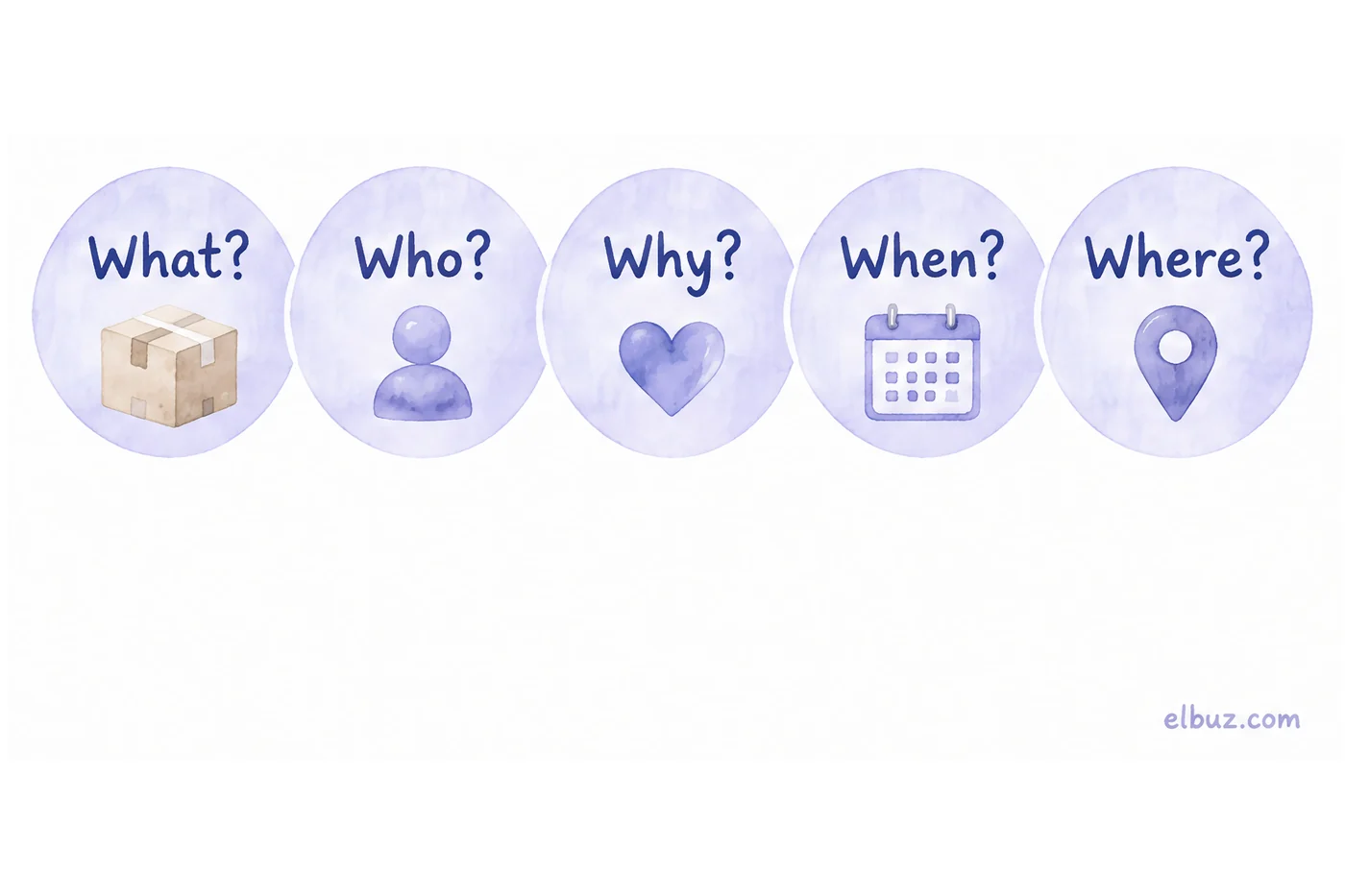
| Question | What you find out | Where to find the answer |
|---|---|---|
| What? | Which product or solution people buy: category, price level, bundle | Orders by category, products most often bought together |
| Who? | Who buys and who decides: for themselves, for the family, for a business, as a gift | Customer type in the order (consumer or company), shipping address, messages |
| Why? | Which problem the purchase solves and what matters most: price, speed, advice, warranty | Questions in chats and calls, return reasons, reviews, on-site search queries |
| When? | Situation and frequency: first purchase, repeat, season, holiday, an old item broke | Order dates, time between repeat purchases, seasonal peaks |
| Where? | Where people search and buy: search engines, marketplaces, social media, price comparison sites, offline | Order source, UTM tags, channel of first contact |
Sources list the questions in different orders, but it is easiest to start with What: the product sets the boundaries of the market, and the other questions split it into groups. The most valuable question is Why. Two people buying the same coffee grinder for different reasons (a first purchase and a replacement for a broken one) need different arguments, even if their age and city are the same. The reason behind a purchase is most reliably learned in a conversation with the buyer — how to run one, in customer discovery interviews.
Example: a 5W table for a coffee store
Illustrative example: an online store sells whole-bean coffee, coffee makers and accessories. We fill in 5W separately for each group of buyers visible in the orders. The traits below illustrate the method; they are not market data.
| Question | First espresso machine | Beans every month | Gift |
|---|---|---|---|
| What | Espresso machine or bean-to-cup machine, grinder | Whole-bean coffee 1 kg, filters, cleaning products | Coffee gift sets, a cezve, gift wrapping |
| Who | Someone who used to drink instant coffee or buy it at a café | A coffee machine owner who has already chosen a taste | Someone buying for another person, who may not drink coffee at all |
| Why | Wants good coffee at home and is afraid of buying the wrong machine | Wants the same taste without searching every time, and a fresh roast | Wants a gift that looks right and arrives on time |
| When | Once, often after a move or a renovation | Regularly, every 3–5 weeks | Before holidays and birthdays |
| Where | Searches like "which espresso machine to buy", reviews, price comparison sites | Repeat order on the website, email, messenger | Marketplaces such as Amazon or Etsy, social media, searches like "gift for coffee lover" |
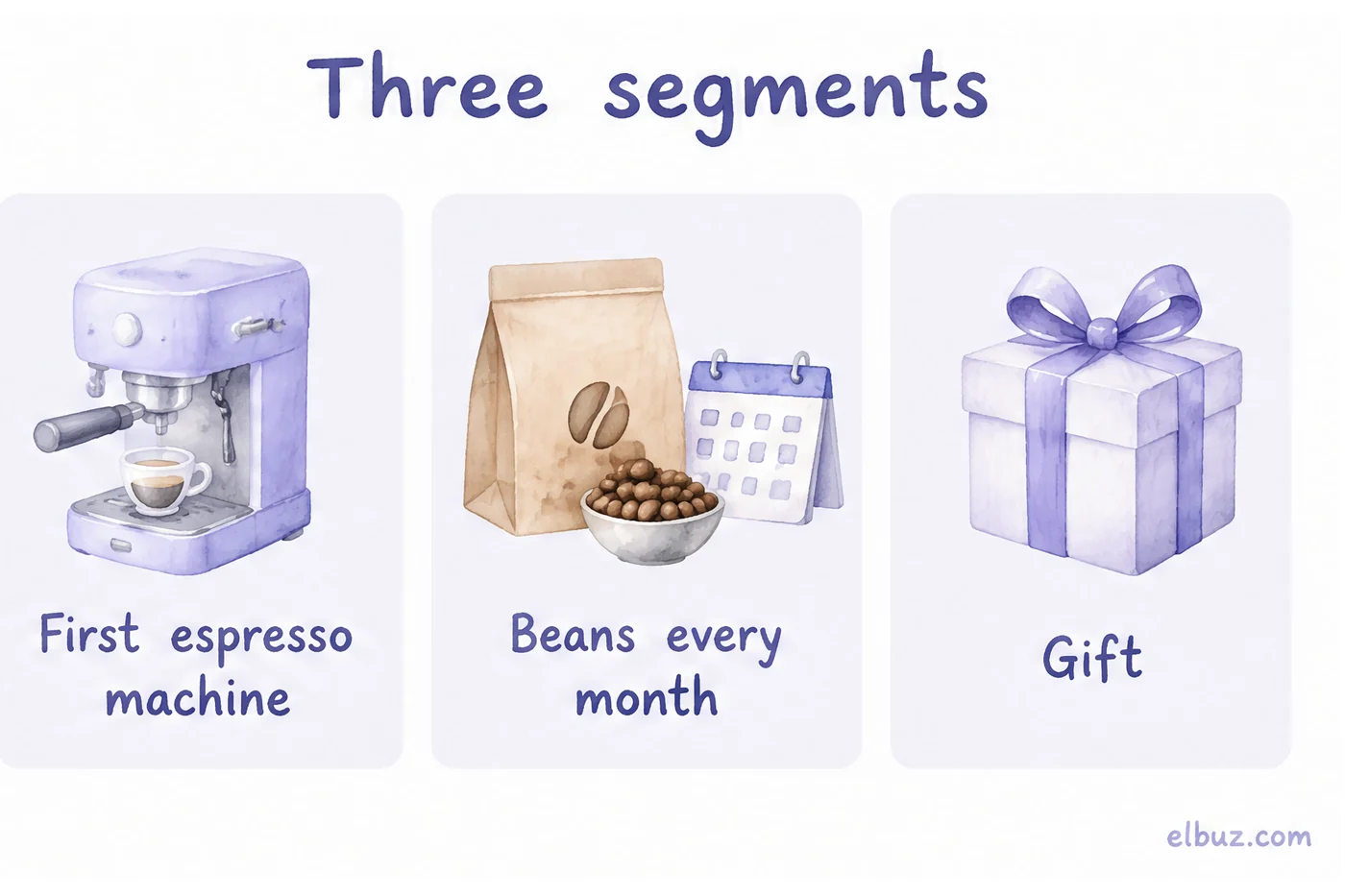
The table shows right away that these are three different offers. The first group needs advice and a comparison of models. The second needs a subscription or a reminder to reorder. The third needs a gift set, wrapping and a firm delivery date. One ad that says "the best coffee, delivered" hits none of them.
How to check that a segment is worth targeting
A segment is worth targeting if it is large enough, you can reach it through a channel, it needs its own offer and it brings profit. This is a short version of the criteria marketing textbooks give: measurable, substantial, accessible, differentiable and actionable.
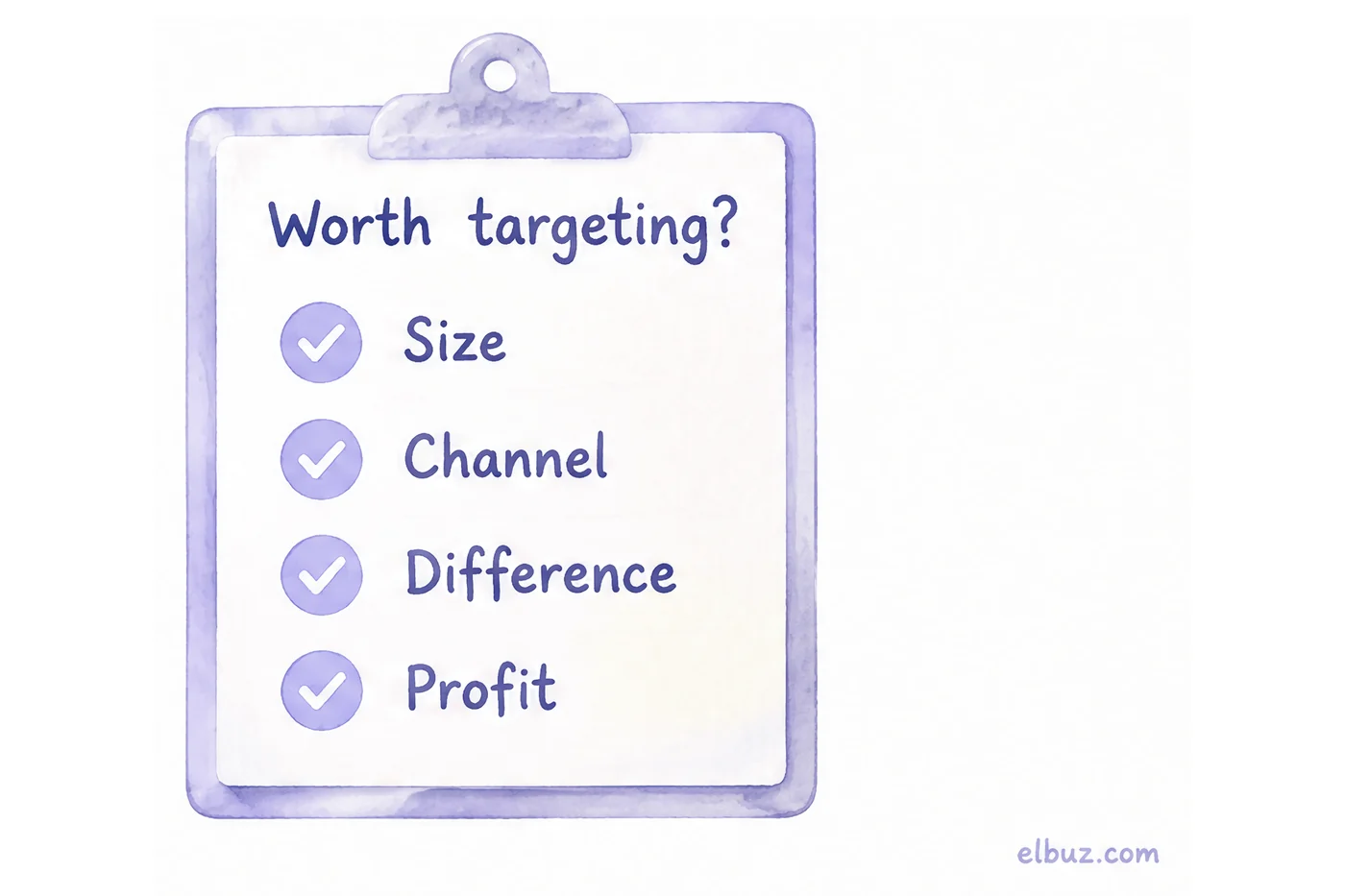
| Check | Question to your data | Warning sign |
|---|---|---|
| Size | How many orders or search queries come from this group? | The segment exists only on paper: you cannot see it in the orders |
| Channel | Where can you find these people, and what does it cost to reach them? | The only way is broad ads aimed at everyone |
| Difference | Do they need a different product, price, message or service than the groups next to them? | The offer for two segments is the same word for word |
| Profit | What is the average order value, and how often do they buy again? | The segment buys only at the lowest price and never comes back |
A segment that fails even one check is better merged with the one next to it or put on hold. How to score segments against each other and choose the main one is covered in the article on STP marketing and targeting.
Where people go wrong with 5W
- Answering with demographics. "Who: women aged 25–45" is not a segment, it is half the country. A role and a situation are more useful: "buying for the first time", "buying for the office", "buying as a gift".
- Skipping "Why". Without the motive the table turns into a product description, and the offers for all segments come out the same.
- Filling it in once. Segments change with your range and channels. Review the table when you add a new category or start selling in a new channel.
- Making too many segments. If there is no separate message, price or service for each segment, the segmentation stays on paper.
- Confusing it with the 5 Ws of journalism. There, Who, What, When, Where and Why describe an event for a news story. In segmentation the same questions describe a purchase.
What to do with the segments next
5W answers only the first step: which groups of buyers exist. Next you choose which group to serve (targeting) and decide what your store should be for that group compared with the alternatives (positioning). Together these three steps are called the STP model.
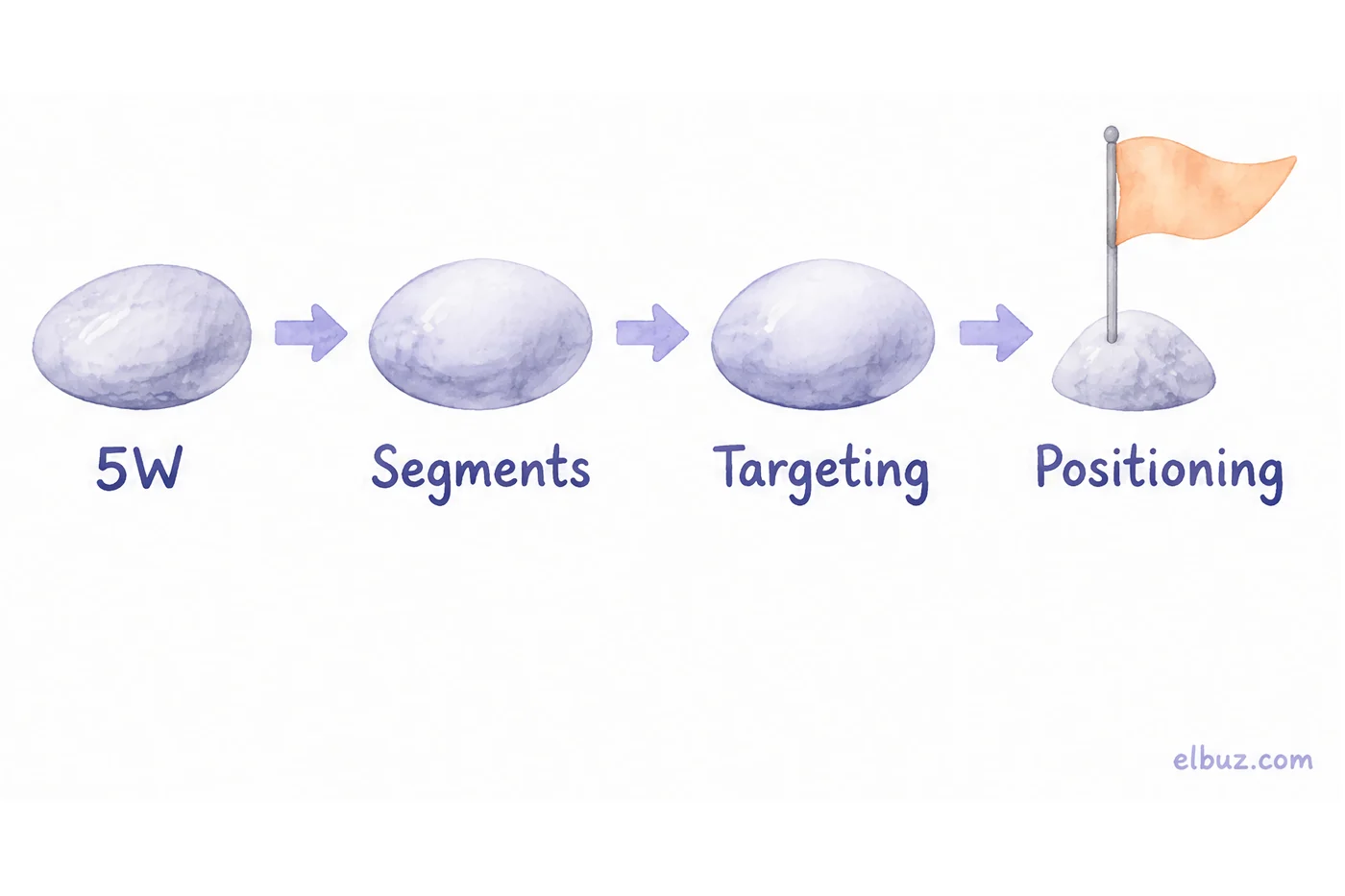
- Segments: the 5W table, as above.
- Targeting and positioning: segment scores and the positioning statement template in the article on STP marketing for an online store.
- A difference you can prove: how to stand out for the chosen segment and back it up, in the article on product differentiation.
- A product range for each segment: which products to stock for each group, in the article on the assortment matrix.
When segments are visible in your customer base
When and Why are the hardest questions to answer by hand: you need to know who bought a second time, who buys regularly and who has not come back for a long time. If orders are kept in one database, these groups are visible without a spreadsheet.
In Elbuz, the CRM calculates each customer's segment from their purchases: New, Repeat, Regular, VIP, Dormant or Lost, plus a 1–5 rating and the average order value. That answers When and part of Who. The motive (Why) cannot be counted from purchases: AI collects the customer's interests and pain points from the conversation, but the conclusion about the segment is yours.
Who does not need it: if you get a few orders a week and know your customers by name, a 5W table in a document is enough.
Ecommerce CRM in ElbuzEach customer's segment and rating are calculated from their orders
Frequently asked questions
What is the 5 W's method in marketing?
It is a set of five questions about a purchase: what people buy, who buys, why, when and in what situation, and where they search and buy. The combination of answers describes a segment.
Who created the 5W model of segmentation?
It is usually credited to Mark Sherrington, a British marketer from the consultancy Added Value and author of "Added Value: The Alchemy of Brand-Led Growth" (2003). The attribution comes mostly from Eastern European marketing sources.
How do you identify market segments?
Answer the five 5W questions with facts from orders, messages and traffic sources, and group buyers whose answers match. Then keep only the groups that pass the size, channel, difference and profit checks.
What are the four types of market segmentation?
Geographic, demographic, psychographic and behavioral. The 5W questions cover all four, with the focus on behavior: what, when and where people buy.
How many segments should you have?
As many as you are ready to make separate offers for. For a small store that is usually 2–4 segments: if two groups need the same offer, they are one segment.
What is the difference between 5W and STP?
5W is a tool for the first step of STP, segmentation. STP adds two more steps: choosing a segment and positioning the store for it.
Sources
- Sherrington M. Added Value: The Alchemy of Brand-Led Growth. Palgrave Macmillan, 2003 — link.springer.com. The book is the source for the author's background; the 5W method is described here as marketing courses present it.
- Smith W. R. Product Differentiation and Market Segmentation as Alternative Marketing Strategies. Journal of Marketing, 1956, vol. 21, no. 1 — doi.org.
Checked on October 31, 2026. The coffee store segments are an illustrative example.


