

An ecommerce business plan answers three questions: how much money you need before launch, how many orders a month cover all costs, and when the money you put in comes back. The other sections — market, competitors, marketing, legal form — exist to make those numbers believable. In the illustrative example below, the store needs about €32,000, 542 orders a month to break even and 12 months to pay back everything invested.
Most plans break in the financial section: they count the startup costs but not the losses of the first months, although a store does not reach its break-even point on day one. Below are the sections of the plan with the question each one must answer, and a full financial plan for one illustrative store: startup costs, unit economics of an order, a month-by-month plan and what happens if one number changes.
When people look for an ecommerce business plan
Usually the niche is chosen, there is a supplier and a rough idea of prices, and the person searches for an "ecommerce business plan template" or "example" so as not to write the document from scratch. Sometimes a bank, an investor or a partner asks for the plan. Next to it in search: "how much does it cost to start an ecommerce business", "do I need an LLC to start an online store", "how long should a business plan be".
A template filled with someone else's numbers helps little here: other people's costs and prices say nothing about your store. It is more useful to go through the calculation once with your own numbers — the order is below.
Which sections an ecommerce business plan has
An ecommerce business plan has seven sections, and each must answer one question. If a section does not answer it, you see it at once:
| Section | The question it answers | Warning sign |
|---|---|---|
| Executive summary | What you sell, to whom, how much money you need and when it comes back | Not a single number |
| Market and competitors | Do people search for the product, and at what price is it already sold | "No competitors", or a list of names without prices and shipping terms |
| Products and suppliers | Where the goods come from, at what cost, how fast stock is replenished | One supplier with no backup |
| Sales channels and marketing | Where you sell and what one order from ads costs | An ad budget, but no cost per order |
| Operations | Who takes orders, packs and ships them, which platform runs the website | The owner does everything, and it is not counted as a cost |
| Legal form and taxes | Sole proprietor or company, VAT or sales tax, tax on profit | Prices in the plan include VAT you will pay to the state |
| Financial plan | Startup capital, break-even point, payback month | Profit from the first month |
The U.S. Small Business Administration lists a similar set for a traditional plan and adds a funding request for when you are raising money. The first six sections are written in words, but each ends with a number that goes into the financial plan: purchase cost, average order value, cost per order from ads, salaries, tax. That is why the financial plan is written last and covered here in detail. For your own launch, a lean one-page version with the same numbers is enough.
How much money you need to start
Startup capital is what you spend before the first sale plus the losses of the months until the store reaches its break-even point. The second part is often larger than people expect.
Illustrative example for the arithmetic, not market prices. The same store as in the articles on the break-even point and return on sales: an average order of €50 without VAT, a plan of 1,000 orders a month.
| Item | Amount, € |
|---|---|
| Website and platform at launch | 4,000 |
| Photos, descriptions, catalog content | 2,000 |
| First stock purchase — half a month of planned sales | 15,000 |
| Packaging, shelving, label printer | 1,500 |
| Total before the first sale | 22,500 |
| Losses of the first four months — from the monthly plan | 9,200 |
| Startup capital | 31,700 ≈ 32,000 |
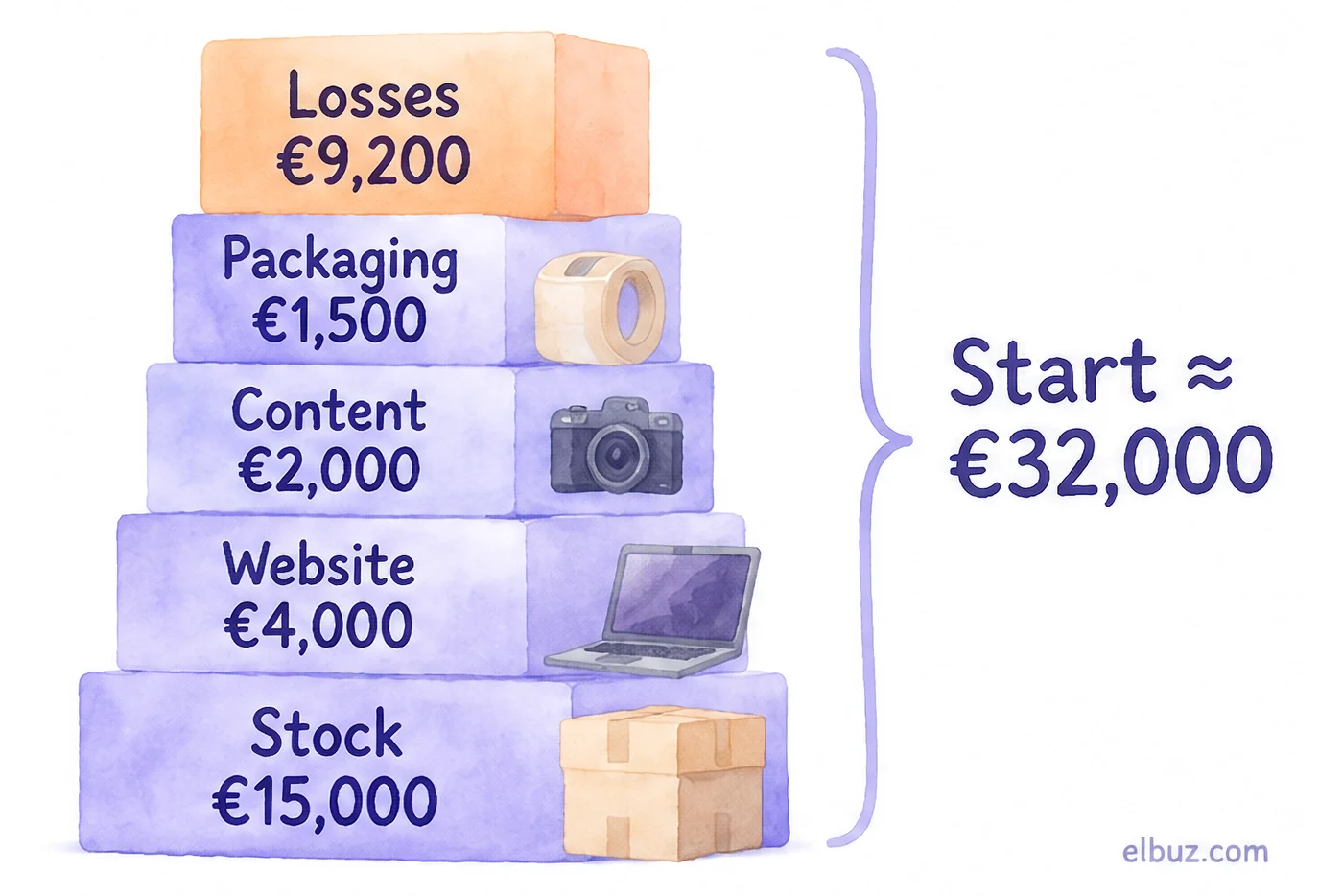
The first stock purchase is the largest item, and its size depends on the model. In dropshipping you do not buy goods upfront, so startup costs fall several times over, but the dropship price is higher than the wholesale one, and the margin per order is thinner.
How much is left from one order
From one €50 order the store keeps €12 after the goods, fees, shipping and ads. This amount is the contribution margin: rent, salaries and software are paid out of it.
| Line | Amount, € | Share of price |
|---|---|---|
| Average order, without VAT | 50 | 100% |
| Goods (cost) | −30 | 60% |
| Marketplace and payment fees, 6% | −3 | 6% |
| Shipping paid by the store | −1 | 2% |
| Ads per order | −4 | 8% |
| Contribution margin | 12 | 24% |
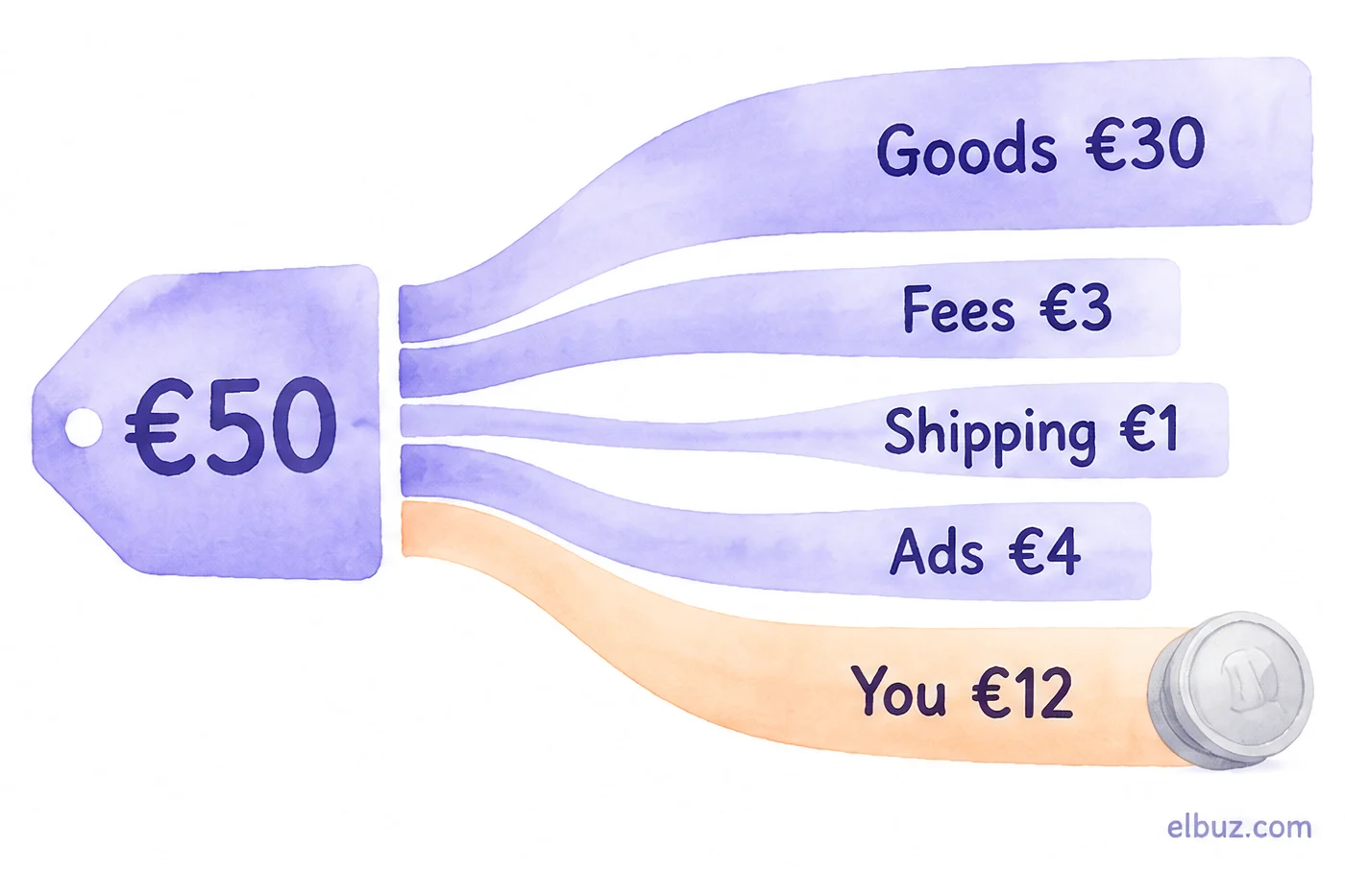
Take the price without VAT: the VAT a shopper pays is not your money. If your tax regime charges a percentage of revenue rather than profit, add it as one more line here — otherwise every later number in the plan comes out too high. How to set a price that covers all of these costs is shown in how to calculate markup.
How many orders a month cover your costs
542 orders: €6,500 of fixed costs a month divided by €12 of contribution margin per order. Fixed costs are what you pay even if there are no orders at all:
| Item | Amount, € |
|---|---|
| Warehouse rent | 1,500 |
| Two employees, with payroll taxes | 3,600 |
| Accountant | 400 |
| Website platform, software, phone | 1,000 |
| Total | 6,500 |
At the planned 1,000 orders the store earns 1,000 × 12 − 6,500 = €5,500 of operating profit a month, an operating return on sales of 11%. Where the gap between the 40% gross margin and this 11% comes from is covered in the article on return on sales.
When the store turns a profit and pays back
In the example, the store makes a monthly profit from month 5 and returns all the money invested in month 12. You only see this in a month-by-month plan: orders do not arrive in full from day one, while fixed costs are paid in full.
Assume the store adds 100 orders every month: 200 in month 1, 900 in month 8, and the planned 1,000 from month 9. Monthly profit = orders × 12 − 6,500.
| Month | Orders | Monthly profit, € | Cumulative, including €22,500 of startup costs, € |
|---|---|---|---|
| 1 | 200 | −4,100 | −26,600 |
| 2 | 300 | −2,900 | −29,500 |
| 3 | 400 | −1,700 | −31,200 |
| 4 | 500 | −500 | −31,700 |
| 5 | 600 | 700 | −31,000 |
| 6 | 700 | 1,900 | −29,100 |
| 7 | 800 | 3,100 | −26,000 |
| 8 | 900 | 4,300 | −21,700 |
| 9 | 1,000 | 5,500 | −16,200 |
| 10 | 1,000 | 5,500 | −10,700 |
| 11 | 1,000 | 5,500 | −5,200 |
| 12 | 1,000 | 5,500 | 300 |
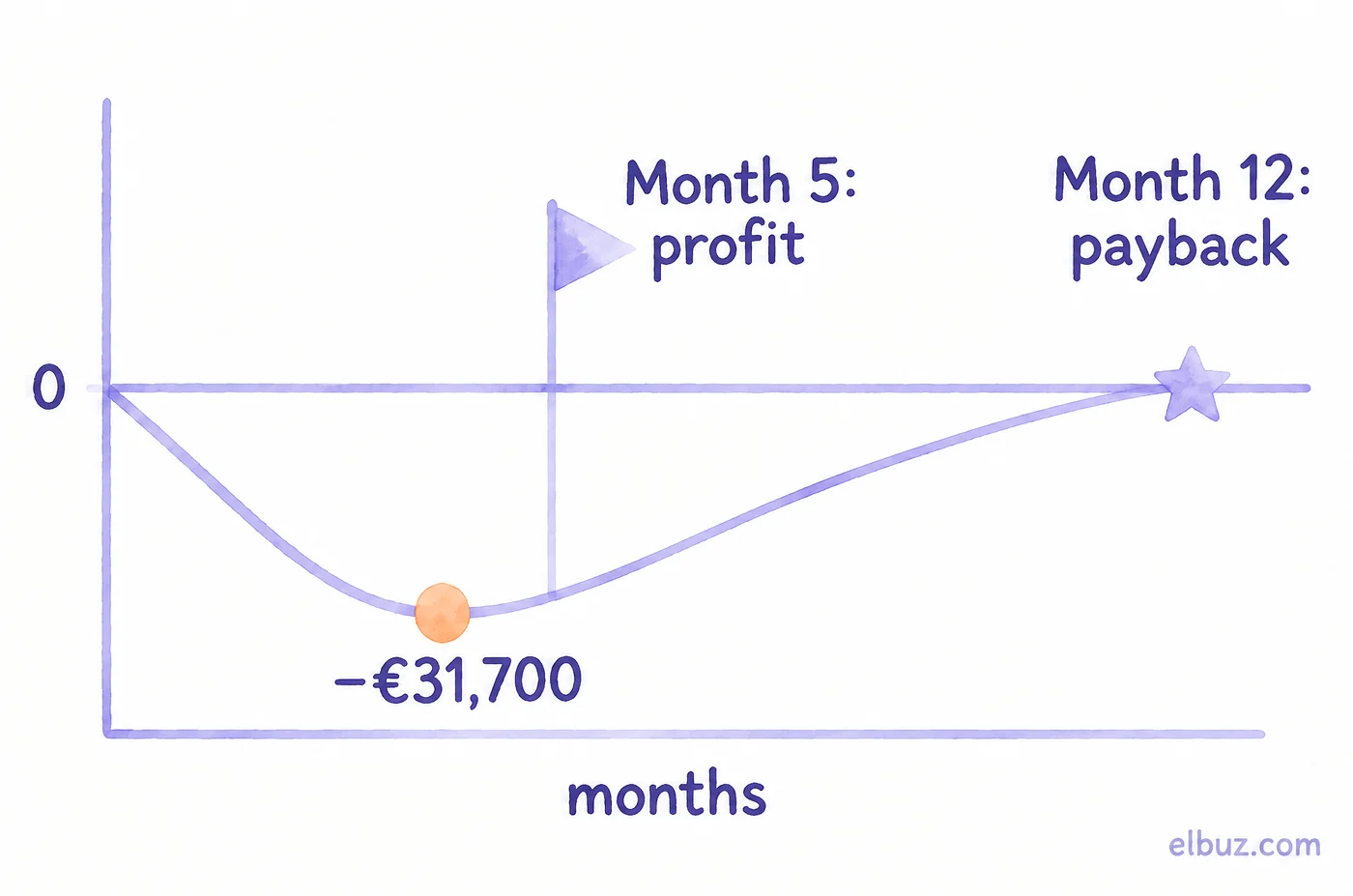
The lowest point is −€31,700 after month 4: that is how much money you need before launch, or the store stops before it reaches profit. Hence the startup capital in the table above. After that, every month of 1,000 orders returns €5,500: after month 11 you are still €5,200 short, after month 12 you are €300 ahead.
If you count the stock in the warehouse as an asset rather than a cost, the money comes back sooner: without the €15,000 first purchase, the cumulative line turns positive in month 10. Show both figures in the plan — a bank or an investor will ask about exactly these. Tax on profit is not in the monthly plan: it depends on the country and the legal form, and it only starts once the year shows a profit.
What if one number does not come true
The plan is most sensitive to the cost of an order from ads: €2 more per order takes more than a third of the profit. Recalculate the plan with one change at a time — everything else as in the example, fixed costs €6,500.
| Change | Contribution margin per order, € | Break-even, orders | Profit at 1,000 orders, € |
|---|---|---|---|
| As planned | 12 | 542 | 5,500 |
| Ads €6 per order instead of €4 | 10 | 650 | 3,500 |
| Fixed costs +€1,000 | 12 | 625 | 4,500 |
| Cost of goods −5% | 13.50 | 482 | 7,000 |
| Prices +5% | 14.35 | 453 | 7,850 |
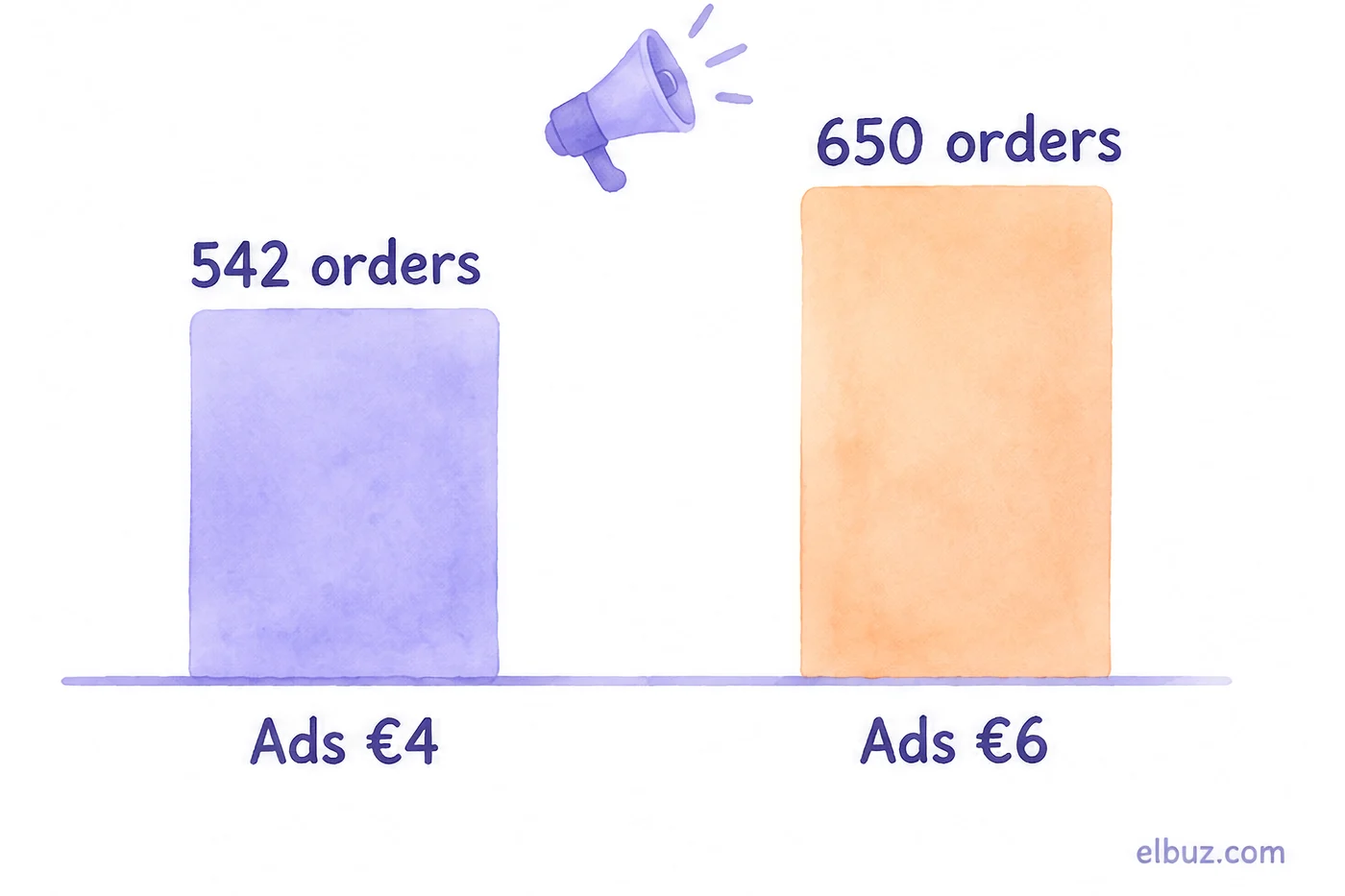
Ads at €6 instead of €4 raise the break-even point to 650 orders, and at the planned thousand the store earns €3,500 instead of €5,500. A 5% price increase works the other way: of the €2.50 added, the 6% fee takes €0.15, and the rest goes to profit. So before launch, test the cost of an order from ads with a small budget on one channel, not with a forecast. How to turn the allowed cost per order into a cost-per-click limit is shown in Google Ads for ecommerce; how much you can pay for a new customer who comes back — in customer acquisition cost.
How to assess the market and marketing in the plan
In an ecommerce business plan, the market is judged not by the size of the industry but by whether you can get your 542 orders at €4 each. Three checks:
- Demand. Search volume for your products in Google Ads Keyword Planner or Google Trends, and on marketplaces such as Amazon, eBay or Etsy, the number of reviews the category leaders have.
- Market price. What 5–10 competitors charge, with what shipping and return terms. If your €50 order at a €30 cost does not hold at market prices, the plan fails before ads even start.
- Channel. Where exactly the orders will come from: a marketplace with a fee, your own website with search ads, or social media. Each channel has its own cost per order; in the plan it is one average number, so write down the cost for each channel next to it.
Which legal form and taxes to put in the plan
The legal form and taxes depend on the country, so the plan names them and puts their cost into the numbers. Three things to settle:
- Sole proprietor or company. In the US you are a sole proprietor automatically once you start trading without registering another structure, and you are personally liable for the business's debts; an LLC protects you from personal liability in most cases, according to the SBA. In the UK the same choice is sole trader or limited company.
- VAT or sales tax. Keep prices and revenue in the plan without VAT. In the EU, once your sales to consumers in other member states exceed €10,000 a year, VAT is charged at the rate of the buyer's country, and you can declare it through the One Stop Shop. In the US, sales tax rules are set by each state. To convert prices with and without VAT, use the VAT calculator.
- Tax on profit. It does not move the break-even point but lowers what you keep. In the UK, for example, corporation tax is 19% on profits under £50,000 and 25% over £250,000.
Check the plan against these thresholds: in the example, the first year brings 8,400 orders × €50 = €420,000 of revenue. Agree the legal form and the tax regime with an accountant in your country before launch, not after the first quarter.
Which risks to write into the plan
The ones that change the numbers of the financial plan. For each, write down which number it hits and what you will do:
- Ads get more expensive. Hits the cost per order; action — keep the limit from the table above and switch off channels that cost more.
- The supplier raises prices or the exchange rate moves. Hits the cost of goods; action — review selling prices after every new supplier price list, keep a second supplier.
- Returns. Each returned parcel means two shipments and no revenue; put an average return cost per order into variable costs, especially if you sell clothing or shoes.
- Seasonality. Months with half the sales; action — a reserve for fixed costs, not only for the launch.
- Fixed costs grow in steps. A third employee or a bigger warehouse raises the break-even point — recalculate it before you hire.
How to compare the plan with reality after launch
Once a month, put planned and actual revenue, margin and number of orders side by side. A business plan nobody checks describes a different store six months later: supplier prices and ad costs have changed, and the break-even point with them.
In Elbuz, sales analytics shows revenue, profit and margin for completed orders — by month, filtered by category and order source. That is the gross level: the report does not subtract fees, ads or taxes, so build the contribution margin on top of it with the unit economics table from this article. How orders and customers are kept in one place is described on the ecommerce CRM page.
Who does not need it: with a few dozen orders a month, a spreadsheet where you enter actual numbers next to the plan every month is enough.
Orders and sales analytics in ElbuzRevenue, profit and margin from completed orders, 14 days free
Frequently asked questions
How do I write an ecommerce business plan?
Go through seven sections: executive summary, market, products and suppliers, sales channels, operations, legal form and taxes, financial plan. Each should end with a number that goes into the financial plan, which you write last.
How much does it cost to start an ecommerce business?
The startup costs plus the losses of the months before the break-even point. In the illustrative example that is €22,500 before the first sale and another €9,200 of losses in the first four months.
How long does it take for an online store to pay back?
It depends on the contribution margin per order and how fast sales grow. In the illustrative example, the store makes a monthly profit from month 5 and returns all the money invested in month 12.
How long should a business plan be?
As long as it takes to answer the questions of the seven sections. For your own launch, a one-page plan with the financial tables is enough; a bank or an investor usually expects a full document with projections for several years.
Do I need an LLC to start an online store?
No. In the US you can start as a sole proprietor, but then you are personally liable for the business's debts; an LLC protects you from personal liability in most cases.
Can I write a business plan myself?
Yes. For your own launch, the sections and calculations from this article are enough. For a loan or an investor, the plan is usually formatted to the bank's or fund's requirements, but the numbers in it are the same.
Sources
- Sections of a traditional and a lean business plan — U.S. Small Business Administration, sba.gov/business-guide/plan-your-business/write-your-business-plan.
- Sole proprietorship and LLC liability — U.S. Small Business Administration, sba.gov/business-guide/launch-your-business/choose-business-structure.
- EU €10,000 threshold for distance sales and the One Stop Shop — European Commission, vat-one-stop-shop.ec.europa.eu.
- UK corporation tax rates — gov.uk/government/publications/rates-and-allowances-corporation-tax.
Checked on October 31, 2026. All other numbers in the article are illustrative examples for the arithmetic.


