

Manual attribute matching: preventing duplicates right during parsing
When filling the catalog from different sources (supplier sites, marketplaces), you will inevitably encounter a problem: the same characteristic may be called differently.
For example, your catalog already has an attribute "Diagonal". When parsing a new product, you find the same characteristic on the donor site, but under the name "Screen Size" If you do nothing, the system will create a new, duplicate attribute.
To prevent this from happening, Elbuz has a powerful tool -manual attribute matching. It allows you to tell the system on the fly that the "Screen Size" is the same as your "Diagonal". The system will remember this rule and apply it automatically in the future.
Watch a short video to see the process in action:
How Manual Matching Works: A Step-by-Step Guide
This tool works at the moment of adding content to the product, yet before saving, preventing duplicates from even appearing in your database.
Step 1: Notice the signal - the "Magnet" icon 🧲
When you parse data from a source site, the system analyzes the attributes it finds. If it finds attributes that aren't already in your catalog, a magnet icon appears in the content search window.🧲 with a number. This number shows how many new attributes unknown to the system will be created if you simply click "Save".
This is your call to action!
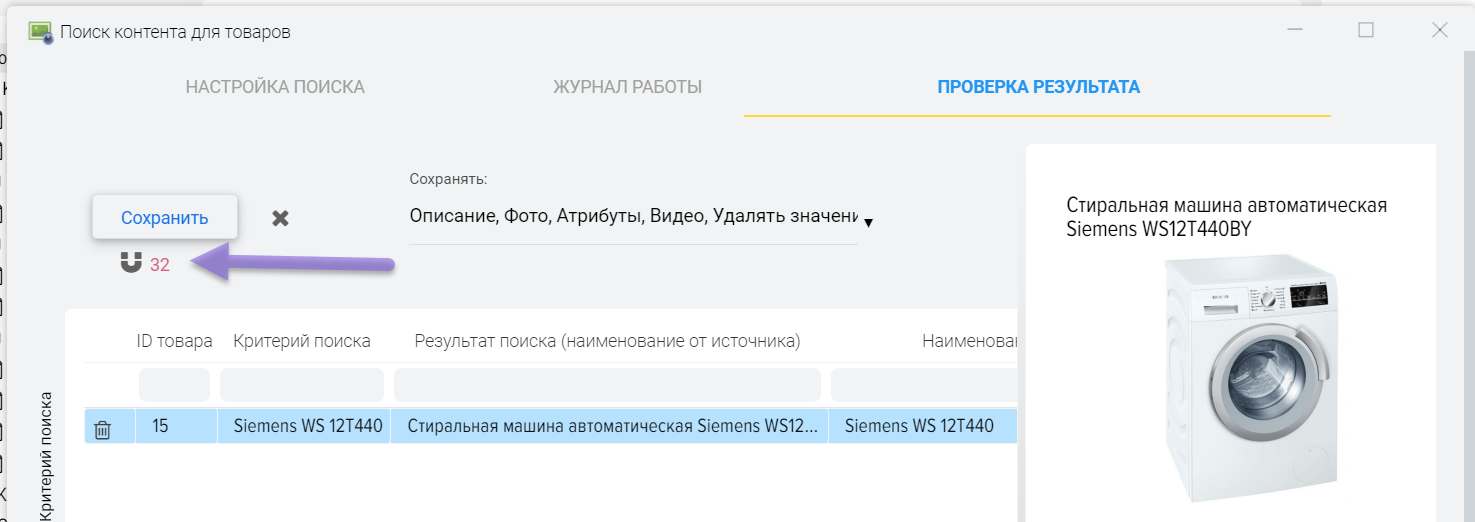
Step 2: Open the mapping window
Click on the magnet icon 🧲 to open the mapping settings window. Here you will see a table where you can "make friends" with attributes from the source site and your attributes.
Step 3: Match the attributes - teach the system
In the window that opens, you will see a list of new attributes. Your task is to indicate which of the attributes that already exist in your database they correspond to.
- Find the line with the new attribute (for example, "Screen Size").
- Do it double click in this line by field "Base directory attribute name".
- From the drop-down list, select your primary attribute that you want to use (for example, "Diagonal").
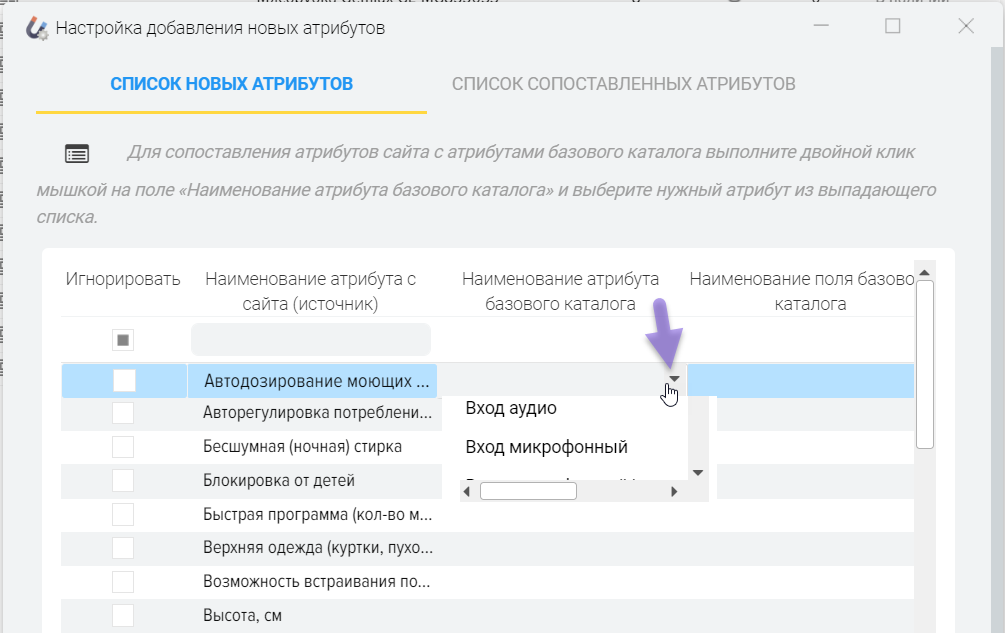
What happens next? The system will instantly remember this connection. Now, with each subsequent parsing from any site where the attribute "Screen size" is encountered, Elbuz will automatically substitute the value into your attribute "Diagonal".You will never have to do this again for this pair of names!
Additional options in the comparison window:
- Ignore attribute: If the source site comes with an attribute that you don't need (for example, "internal supplier code"), just check the box in the column "Ignore" The system will not save it.
- Match with product field: Sometimes the attribute value needs to be saved not in the characteristic, but in the main field of the product card. For example, the value of the attribute "Manufacturer" can be directly saved in the field "Manufacturer". To do this, select the desired field in the column "Base Catalog Field".
Managing and viewing created rules
Over time, you will accumulate many matching rules. You can manage them.
How to see all attributes, not just new ones?
By default, the mapping window displays only new attributes that are not yet known to the system. If you want to see the full list of attributes from the source site (including those for which there are already rules), click the button "Show all attributes". This is useful if you want to change an existing rule or set up an ignore for an attribute that is already known to the system.
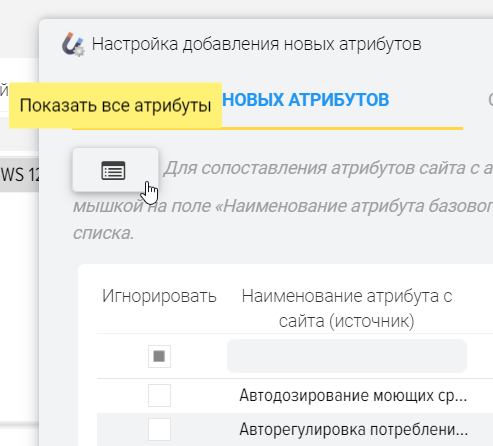
Where can I see the entire list of saved rules?
All the connections you create are stored in one place. To view them:
- Open the matching window (by clicking on the magnet 🧲 ).
- Go to the tab "List of mapped attributes".
Here you will see a full table of all your rules: "attribute from the site" → "your attribute". This list can be viewed and edited.
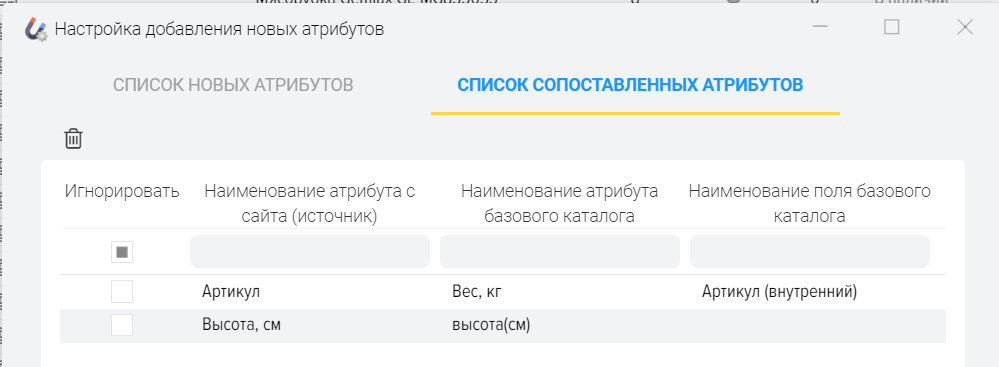
Key benefits of manual matching:
- Proactive control: You're not fixing the mess, you're preventing it from happening.
- Save time in the future: By setting up a rule once, you automate the processing of data from all sources.
- Perfect data purity: Your catalog remains neat, which is the key to creating quality filters on the site.


.png)
.png)